
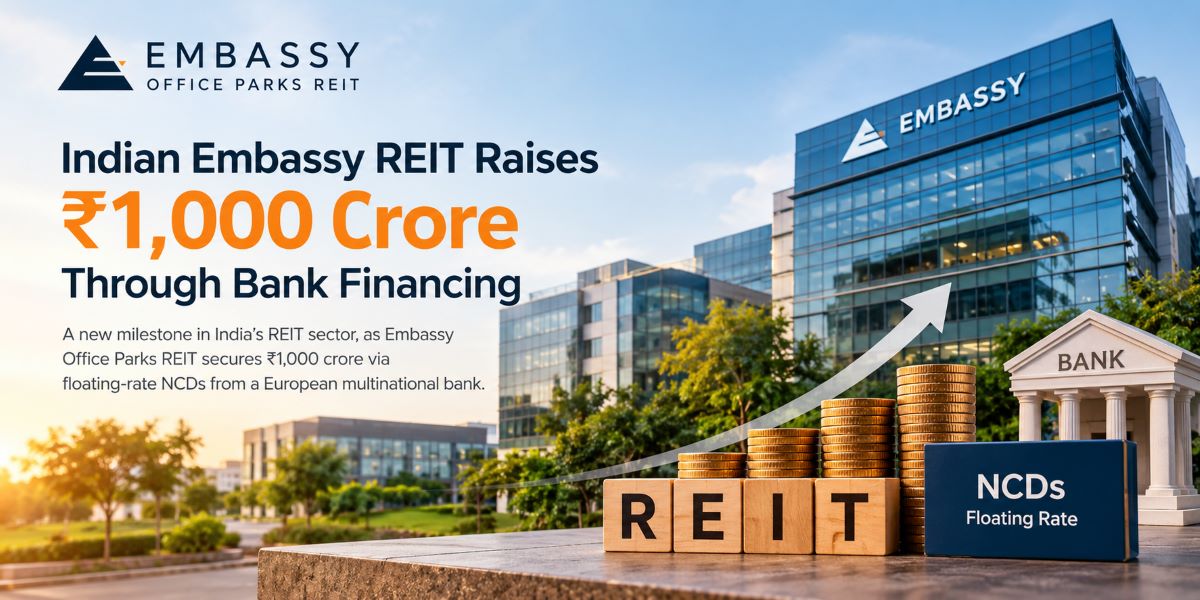
Embassy Office Parks REIT has reportedly raised ₹1,000 crore through floating-rate non-convertible debentures (NCDs), marking a notable development in India’s commercial real estate financing market. The financing was subscribed to by a European multinational bank at the trust level.The transaction gives Embassy REIT another potential source of capital while highlighting the growing role of institutional financing in India’s developing REIT sector. For investors, the development also brings attention to debt levels, borrowing costs, interest-rate risk, and the way REITs manage their capital structures.
What Happened With Embassy Office Parks REIT?
Embassy REIT Raises ₹1,000 Crore: Embassy Office Parks REIT has raised ₹1,000 crore through floating-rate NCDs. Unlike equity funding, NCD financing involves borrowing money that must be repaid according to agreed terms.The reported trust-level financing provides Embassy REIT with another option for managing its capital requirements. However, the amount raised alone does not indicate how the financing will affect future profits or distributions.
Who Provided the Financing?: The NCDs were reportedly subscribed to by a European multinational bank. The transaction is notable because it has been reported as the first instance of an Indian REIT accessing financing from a scheduled commercial bank directly at the trust level.This development may also reflect increasing institutional participation in India’s listed real estate investment market.
What Are Floating-Rate NCDs?: Floating-rate non-convertible debentures are debt instruments where the interest rate can change according to an agreed benchmark or reference rate.Unlike convertible securities, NCDs do not convert into equity. For a REIT, they can provide access to debt capital, but changing interest rates can increase or decrease future financing costs.
Why Is the ₹1,000 Crore Financing Important?
A New Financing Route for Indian REITs: The Embassy REIT bank financing transaction adds another potential source of capital for India’s REIT market.REITs can use different financing channels, including debt instruments, institutional financing, bank funding, and internal cash flows. Access to trust-level financing may provide established REITs with greater flexibility when managing their capital structures.The transaction is therefore relevant not only to Embassy REIT but also to the broader development of Indian REIT financing and commercial real estate investment.
What Does Trust-Level Financing Mean?: Trust-level financing means that borrowing is arranged at the REIT or trust level rather than being directly tied to one particular property.This distinction matters because investors evaluating REIT debt financing need to understand where liabilities sit within the overall structure and how repayment obligations may affect the trust’s financial position.
Embassy REIT Financing: Key Facts
| Key Detail | Reported Information |
| REIT | Embassy Office Parks REIT |
| Amount raised | ₹1,000 crore |
| Financing instrument | Floating-rate non-convertible debentures |
| Subscriber | European multinational bank |
| Financing level | Trust level |
| Market | Indian REIT sector |
| Reported significance | First reported access by an Indian REIT to scheduled-commercial-bank financing at the trust level |
The specific financing terms and use of proceeds should be confirmed through the latest company and regulatory disclosures.
How Does REIT Financing Work in India?
Where Do REITs Get Their Funding?
Indian REITs can use several sources of capital depending on their financial structure and requirements. These may include:
- Bank loans
- Bonds and debentures
- Institutional financing
- Internal cash flows
- Other permitted financing arrangements
Using multiple sources can give a REIT greater flexibility when managing investments, refinancing requirements, and financial obligations.
Why Do REITs Use Debt Financing?: Debt financing can support several activities. Depending on the terms and stated purpose of the borrowing, funds may be used for property acquisitions, expansion, refinancing existing debt, or other permitted corporate and investment purposes.For Embassy Office Parks REIT, the exact use of the ₹1,000 crore should be determined from official disclosures rather than assumed.
Floating-Rate vs Fixed-Rate Financing
| Feature | Floating-Rate Financing | Fixed-Rate Financing |
| Interest rate | Can change over time | Generally remains fixed for the agreed period |
| Rate exposure | Higher exposure to benchmark movements | Lower direct exposure to benchmark changes |
| Cost predictability | Can vary | More predictable |
| Main consideration | Potential increase in interest expenses | Potentially less benefit if market rates fall |
| REIT consideration | Important to monitor borrowing costs | Provides greater cost visibility |
The choice between financing structures depends on market conditions, borrowing requirements, and the terms negotiated by the REIT.
What Is Embassy Office Parks REIT?
How Embassy REIT Works: Embassy Office Parks REIT is a real estate investment trust focused on income-generating commercial properties.A REIT allows investors to gain exposure to real estate through listed units rather than directly purchasing individual properties. The underlying properties generate income primarily through leasing, while the REIT manages the portfolio and distributes eligible cash flows to unitholders according to applicable rules.
Embassy REIT’s Commercial Real Estate Portfolio: Embassy REIT focuses on commercial real estate, particularly office properties and business-park assets serving corporate occupiers across major Indian business markets.Because property holdings, occupancy levels, and portfolio figures can change, investors should refer to the latest company disclosures for current information.
How Do REITs Generate Returns?: REIT returns can come from income generated by leased properties as well as changes in the value of underlying real estate.
Important factors include:
- Rental income
- Occupancy
- Leasing activity
- Rental growth
- Property valuations
- Operating expenses
- Financing costs
This makes the performance of commercial real estate in India an important consideration when assessing a REIT.
What Could the ₹1,000 Crore Financing Be Used For?
Property and Portfolio Investment: Debt financing can provide additional capital for potential acquisitions, expansion, or other permitted investment activities.However, the exact use of the ₹1,000 crore raised by Embassy Office Parks REIT should be confirmed through official disclosures rather than assumed.
Refinancing and Capital Management: REITs can also use debt as part of broader capital management. New borrowing may potentially help manage existing obligations, upcoming maturities, or the overall structure of liabilities.Investors should consider total debt, interest expenses, repayment schedules, and the REIT’s ability to generate cash flow from its properties.
Supporting Future Growth: Additional financing capacity may provide Embassy REIT with greater flexibility when considering future investments or managing financial requirements.The actual benefit, however, will depend on borrowing costs, property performance, market conditions, and the terms of future transactions.
What Does This Mean for India’s REIT Market?
More Financing Options: The Embassy REIT ₹1,000 crore financing adds another example of institutional capital entering India’s REIT sector.Multiple financing options, including bank financing, bonds, and debentures, can provide REITs with greater flexibility. However, the availability and pricing of these options depend on market conditions and individual financial circumstances.
Greater Participation From Banks: Bank participation is relevant because it introduces another institutional funding channel for established real estate investment trusts.The reported trust-level financing involving Embassy Office Parks REIT demonstrates how scheduled commercial bank financing can form part of the broader Indian REIT financing landscape.
Potential Impact on Future REIT Transactions: The transaction could serve as a reference point for other Indian REITs considering different debt structures. It does not mean that every REIT will use the same approach.Future REIT bank financing in India may depend on interest rates, credit conditions, regulatory requirements, asset quality, and the financial strength of individual trusts.
Benefits and Risks of Floating-Rate REIT Financing
| Factor | Potential Benefit | Potential Risk |
| Additional capital | Provides access to new funding | Creates repayment obligations |
| Funding diversification | Reduces reliance on one funding source | Adds another financing liability |
| Floating rate | May be suitable under certain market conditions | Interest costs can rise |
| Trust-level debt | Provides capital-management flexibility | Can affect overall leverage |
| Future investment | May support permitted investments | Returns depend on how capital is used |
Interest-Rate Risk: The main consideration with floating-rate NCDs is that borrowing costs can change when the relevant benchmark changes.If interest rates increase, financing expenses may also rise, potentially affecting available cash flow.
Leverage and Investor Considerations
Debt levels are another important factor when evaluating Embassy REIT debt. Investors can monitor:
- Total borrowings
- Leverage ratios
- Interest coverage
- Debt maturity schedules
- Refinancing requirements
- Cash flow available for distributions
Higher financing obligations can affect the amount of cash available for unitholder distributions.
What Investors Should Watch After the ₹1,000 Crore Raise?
Debt Levels: Investors should monitor total debt, maturity schedules, and leverage metrics following the financing.
Interest Costs: Because the NCDs are floating-rate instruments, changes in benchmark rates can influence future borrowing expenses.
Property Performance: Occupancy, leasing activity, rental income, and property valuations remain important indicators of operating performance.
Distributions to Unitholders: Higher interest expenses can reduce available cash flow. Future distributions should therefore be considered alongside property income and financing costs.
Frequently Asked Questions?
How much did Embassy REIT raise?
Embassy Office Parks REIT raised ₹1,000 crore through floating-rate NCDs.
How did Embassy REIT raise the money?
It raised the funds through floating-rate non-convertible debentures subscribed to by a European multinational bank.
What are non-convertible debentures?
NCDs are debt instruments that pay interest but do not convert into equity shares.
What is floating-rate financing?
Floating-rate financing is borrowing where the interest rate can change according to an agreed benchmark.
Why is the financing significant?
The transaction was reported as the first instance of an Indian REIT accessing scheduled-commercial-bank financing at the trust level.
Is Embassy REIT listed?
Yes. Embassy Office Parks REIT is a listed Indian REIT focused on commercial real estate.
Will the ₹1,000 crore raise increase profits?
Not necessarily. The financial impact depends on borrowing costs, how the funds are used, property performance, and the REIT’s overall debt position.
What is the main risk of floating-rate debt?
The main risk is that higher benchmark rates can increase borrowing costs, depending on the financing terms.
