
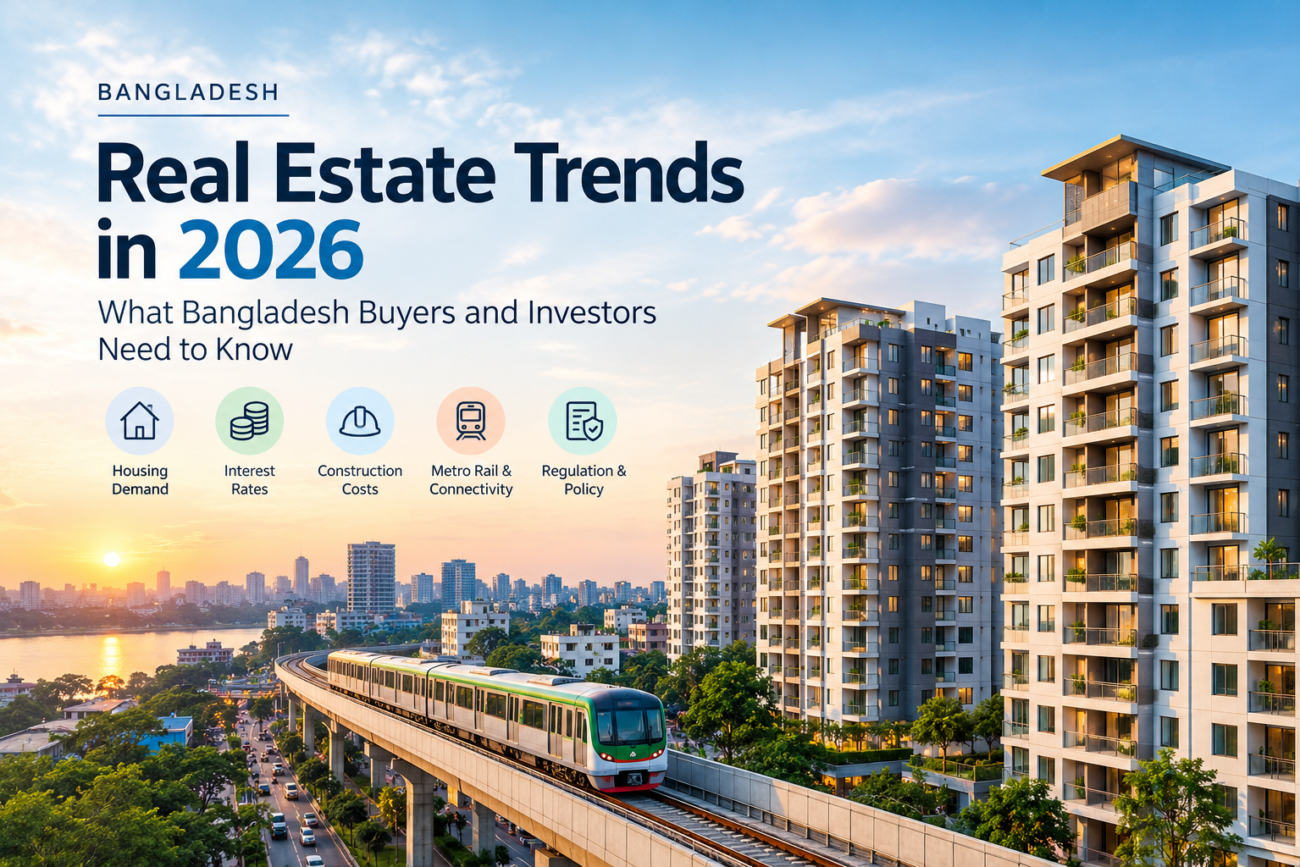
Real Estate Trends in 2026: What Bangladesh Buyers and Investors Need to Know
Bangladesh’s property market is entering 2026 with a mixture of pressure, changing buyer behaviour and emerging opportunities. The Real Estate Trends in 2026 are being shaped by borrowing costs, construction expenses, housing affordability, infrastructure development, regulatory changes and evolving preferences among homebuyers.
The market is not moving in one direction. Some parts of the residential sector are experiencing weaker sales and affordability challenges, while infrastructure-linked locations and selected commercial projects continue to attract attention. Recent industry reporting also shows that real estate activity remains economically important despite difficult market conditions.
For buyers, investors and developers, understanding these changes is becoming more important than simply watching property prices. Location, financing, construction quality, legal documentation and long-term demand can all influence a property decision.
What Are the Real Estate Trends in 2026?
The Real Estate Trends in 2026 in Bangladesh can be understood through several major developments:
- High borrowing costs are affecting housing affordability.
- Construction and development costs remain a major concern.
- Apartment sales have weakened compared with previous years.
- Buyers are becoming more cautious before committing to property.
- Infrastructure and transport connectivity are influencing location demand.
- Developers are becoming more selective about launching new projects.
- Regulatory and tax changes are affecting market confidence.
- Demand for practical, well-located and appropriately priced housing remains important.
These trends suggest that the 2026 market is becoming more selective rather than simply expanding or contracting across every segment.
1. Housing Affordability Is Becoming More Important
One of the biggest factors influencing the Real Estate Trends in 2026 is affordability.
For many middle-income buyers, purchasing an apartment depends heavily on access to housing finance. Bangladesh Bank revised housing-finance rules in January 2026, allowing qualifying banks to provide housing loans of up to Tk40 million per borrower under specified conditions, while maintaining a maximum 70:30 debt-equity ratio.
However, a higher loan ceiling does not automatically make a home affordable. Interest rates, monthly instalments, income stability and down-payment requirements still influence whether buyers can comfortably purchase a property.
This is why developers may need to pay greater attention to apartment sizes, pricing, payment schedules and the needs of middle-income households.
2. Interest Rates Continue to Influence Property Demand
Financing costs remain one of the most important issues in Bangladesh’s housing market.
Bangladesh Bank reported a lending rate of 11.96% at the end of April 2026, compared with 12.03% at the end of December 2025.
When borrowing remains expensive, prospective buyers may postpone purchases or choose smaller properties. This can have a direct effect on developers because fewer buyers are willing or able to commit to long-term financing.
The impact is particularly important for the mid-market segment, where many salaried households depend on bank financing to purchase apartments.
3. Apartment Sales Are Becoming More Selective
Another major development in the Real Estate Trends in 2026 is the slowdown in apartment transactions.
According to The Business Standard, 41,804 apartment transfer deeds were registered nationwide during January–June 2026. The figure represented a decline compared with the corresponding averages and periods of previous years. Dhaka accounted for nearly three-quarters of those registrations.
This does not mean housing demand has disappeared. Instead, buyers appear to be more selective about when and where they spend.
People purchasing homes for immediate residential needs may continue to enter the market, while discretionary investors may take more time to evaluate financing costs, rental prospects, location and resale potential.
4. Construction Costs Are Reshaping New Projects
Construction costs remain another major factor affecting the property market.
Higher prices for construction materials can increase development expenses and place pressure on developers’ margins. When costs rise while buyers become more price-sensitive, developers face a difficult balance between maintaining project quality and keeping apartment prices within reach.
Recent reporting has highlighted rising construction costs, stalled projects and reduced new development activity as significant challenges for the housing sector.
As a result, one of the notable Real Estate Trends in 2026 may be greater focus on project efficiency, construction planning and financially sustainable developments.
5. Metro Rail and Connectivity Are Influencing Property Locations
Location has always been important in real estate, but transport connectivity is becoming increasingly significant.
A 2026 study examining Dhaka’s MRT Line-6 and property values around Uttara North and Uttara South found that proximity to metro stations and location were statistically significant factors associated with residential property values.
This supports a broader trend toward transit-oriented development, where improved public transportation can encourage residential and commercial activity around transport hubs.
For buyers, this means the question is not only “How much does the apartment cost?” It can also be useful to ask:
- How accessible is the location?
- How close is it to public transportation?
- What roads connect the area to major business districts?
- Are schools, hospitals and shopping facilities nearby?
- Could future infrastructure improve accessibility?
These factors can influence both everyday convenience and long-term property demand.
6. Buyers Are Looking Beyond Price
The 2026 buyer is likely to examine more than just the advertised price per square foot.
Construction quality, developer reputation, legal documentation, utility connections, parking, security, maintenance costs and handover schedules can all influence a purchase decision.
In a cautious market, buyers may also place greater importance on payment flexibility and project completion reliability.
This creates an opportunity for developers that can provide transparent information and clearly communicate the practical value of their properties.
7. The Market Is Becoming More Location-Specific
It is increasingly difficult to describe Bangladesh’s property market using one simple trend.
Different areas can perform differently depending on transportation, employment centres, infrastructure, land availability and buyer demographics.
Dhaka provides a clear example. While overall apartment sales have faced pressure, areas connected to major transport corridors can experience different levels of demand. The Daily Star reported that some neighbourhoods around metro corridors continued to see buyer interest even as sales weakened elsewhere.
Therefore, the Real Estate Trends in 2026 should be evaluated at the neighbourhood and property level rather than only through nationwide averages.
8. Developers May Focus More on Smaller and Practical Homes
Affordability pressure can also change what developers build.
When large apartments become difficult for many buyers to finance, smaller and more efficiently planned units may become more attractive. Practical layouts, essential amenities and manageable maintenance costs can matter more than unnecessary luxury features for price-sensitive households.
This does not mean luxury housing will disappear. Instead, the market may become increasingly segmented between buyers seeking premium properties and those prioritising affordability and functionality.
9. Commercial Real Estate Shows a Different Picture
Residential property is not the entire real estate market.
Commercial projects, office spaces, retail developments and mixed-use properties can respond differently to economic conditions. Recent reporting indicates that some commercial real estate activity has been more resilient than residential housing in parts of the market.
Business expansion, employment centres, transport connectivity and changing consumer behaviour can influence commercial property demand.
For investors, this means comparing residential and commercial opportunities based on actual demand, rental potential, operating costs and location rather than assuming that all real estate segments behave in the same way.
10. Regulation and Taxes Matter More in 2026
Government policy is another important part of the Real Estate Trends in 2026.
Changes to property registration, taxation, development rules and financing regulations can influence both buyer confidence and developer activity.
The Business Standard reported that a 15% capital-gains tax on apartment registrations under the FY2026–27 budget was expected by industry representatives to put additional pressure on an already weak housing market.
Because regulations can change the total cost of buying or selling property, buyers and investors should review the applicable rules and transaction costs before making a major decision.
What Do the Real Estate Trends in 2026 Mean for Buyers?
For homebuyers, the current market creates a reason to focus on fundamentals rather than short-term speculation.
Before purchasing, buyers should consider:
Check the Total Cost
Look beyond the apartment’s advertised price. Include registration costs, taxes, financing costs, parking, utility connections, maintenance and other applicable charges.
Evaluate the Location
A well-connected location can provide practical benefits for commuting, education, healthcare and daily services.
Verify Legal Documents
Land ownership, approvals, project documents and registration information should be properly checked before making a major financial commitment.
Examine Construction Quality
Price alone cannot determine whether a property represents good value. Construction standards, materials, structural quality and handover history also deserve attention.
Compare Financing Options
Buyers using housing finance should compare interest rates, repayment periods, down-payment requirements and total repayment costs.
What Do the Real Estate Trends in 2026 Mean for Developers?
Developers are facing a market where buyers have become more cautious and project costs remain challenging.
Successful project planning may increasingly depend on:
- Accurate demand research
- Realistic pricing
- Efficient apartment layouts
- Strong construction management
- Transparent customer communication
- Reliable handover schedules
- Careful land acquisition
- Better financial planning
Instead of assuming that every project will attract buyers, developers may need to build projects around clearly identified demand.
Is 2026 a Good Time to Buy Property in Bangladesh?
There is no single answer for every buyer because property decisions depend on budget, financing, location, purpose and personal circumstances.
Someone purchasing a home for long-term residence may evaluate the decision differently from an investor seeking rental income or resale opportunities.
The current market suggests that buyers should compare properties carefully rather than making decisions based only on expectations of future price increases.
A property with strong location fundamentals, acceptable financing costs, verified documentation and genuine end-user demand may deserve closer consideration than a property chosen purely because of a short-term price expectation.
What Could Shape the Property Market After 2026?
Several factors could continue influencing Bangladesh’s real estate sector beyond 2026:
- Interest-rate movements
- Inflation and household purchasing power
- Construction material prices
- Infrastructure expansion
- Urban population growth
- Housing-finance availability
- Government tax and registration policies
- Developer financing conditions
- Demand for affordable housing
Bangladesh’s real estate sector also remains economically significant. Official GDP data reported by The Financial Express show nominal real-estate activity reaching Tk4.77 trillion in FY2026, up from Tk3.13 trillion in FY2021.
This shows why changes in the property market can have effects beyond developers and homebuyers, extending into construction, finance, materials, professional services and other connected industries.
Frequently Asked Questions About Real Estate Trends in 2026
What are the major Real Estate Trends in 2026?
The major trends include affordability concerns, high borrowing costs, rising development expenses, selective apartment demand, infrastructure-driven location changes and greater attention to regulation and project quality.
Is Dhaka still important for real estate investment?
Dhaka remains Bangladesh’s largest urban property market, but performance differs significantly between neighbourhoods. Connectivity, infrastructure, employment centres and local demand can influence property prospects.
How is metro rail affecting Dhaka real estate?
Research on MRT Line-6 around Uttara North and South found that proximity to metro stations and location were statistically significant factors associated with residential property values.
Are apartment prices going down in Bangladesh?
Price movements vary by location, property type and developer. Recent market weakness has affected sales and transaction volumes, but this does not mean every property or neighbourhood is experiencing the same price movement.
What should buyers check before purchasing an apartment?
Buyers should evaluate total costs, location, legal documentation, construction quality, developer track record, financing terms, utilities, handover commitments and future resale or rental demand.
Final Thoughts
The Real Estate Trends in 2026 show a Bangladesh property market going through an important period of adjustment. Higher financing costs, construction expenses, cautious buyers and regulatory changes are creating challenges, while urbanisation, infrastructure development and continuing housing needs are maintaining long-term relevance for the sector.
The most important change may be the growing need for more informed property decisions. Buyers are looking more carefully at affordability and quality, while developers need to understand actual demand and manage project costs more efficiently.
For anyone considering property in Bangladesh, 2026 is a market where location, affordability, financing, documentation, construction quality and long-term demand deserve attention alongside the headline price.
