
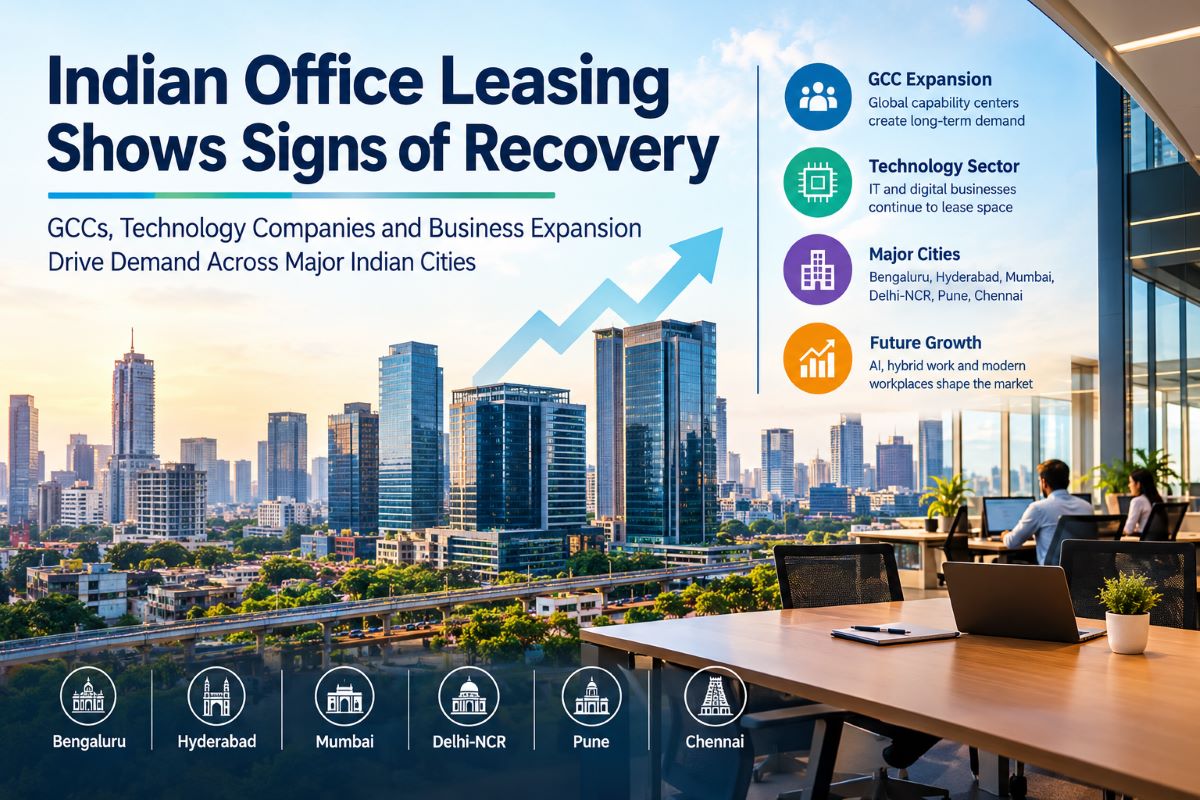
India’s commercial office market is showing signs of renewed activity as companies begin moving forward with office requirements that were previously delayed. Large leasing deals, growing demand from Global Capability Centers (GCCs), and continued requirements from technology companies are supporting activity across major business hubs.The recovery is not uniform across every city or industry, but the latest trend suggests that businesses are becoming more confident about their long-term workplace needs. At the same time, hybrid work, artificial intelligence, and changing workforce strategies are influencing how companies plan their office space.
What Is Happening With Office Leasing in India?
Large companies that previously delayed property decisions are reassessing their requirements and, in some cases, moving ahead with new or expanded office spaces. This is important for India’s commercial real-estate sector because major leasing transactions can create demand for modern office buildings and supporting infrastructure.
Large Office Leasing Deals Are Picking Up: Large office requirements are returning as businesses plan for expansion, new teams, and longer-term operations. The activity is particularly relevant in established technology and business centers where multinational companies and GCCs have significant operations.
Companies Are Moving Ahead With Delayed Space Requirements: Geopolitical uncertainty, changing economic conditions, and questions about future workforce needs had made some businesses more cautious about major office commitments. As companies gain greater visibility into their operations, some previously delayed requirements are now being reconsidered.
Why the Recovery Matters for Commercial Real Estate: Stronger leasing activity can benefit developers, landlords, and businesses connected to commercial property. It can also encourage companies to consider buildings with modern infrastructure, better connectivity, flexible layouts, employee facilities, and technology-enabled workplaces.
Why Is Indian Office Leasing Recovering?
Several factors are contributing to renewed office demand. Businesses are reassessing workplace requirements while GCC expansion and technology operations continue to support demand.
| Key driver | How it can influence office demand |
| GCC expansion | Creates requirements for technology, finance, analytics, and other teams |
| Business expansion | Companies may require additional space for growing workforces |
| Technology demand | IT and technology operations continue to need skilled teams and workplaces |
| Hybrid work | Encourages companies to redesign offices around collaboration and flexibility |
| Reduced uncertainty | Greater visibility can help businesses move ahead with delayed decisions |
Easing Geopolitical Uncertainty: Uncertainty can make businesses cautious about long-term property commitments. When companies have greater clarity about their international operations, costs, and business plans, some postponed real-estate decisions can begin moving forward.
Companies Reassessing Office Space Needs: Workplace strategies have changed considerably. Companies are balancing office-based work with hybrid arrangements and are becoming more selective about how much space they need. This is creating interest in flexible workplaces rather than simply larger numbers of traditional desks.
Growing Demand From GCCs: Global Capability Centers are an important source of office demand in India. Multinational companies use GCCs for technology, engineering, finance, analytics, research, and other global functions. Expansion in these areas can translate directly into additional workplace requirements.
Technology Companies Continue to Need Office Space: Technology companies remain important to India’s office market. Hybrid work and automation may change workplace layouts, but physical offices still support collaboration, meetings, training, specialized teams, and day-to-day business operations.
GCCs Are Driving Demand for Office Space
What Are Global Capability Centers?
GCCs are dedicated operations established by multinational companies to manage specialized functions for their global businesses. India’s skilled workforce and established technology ecosystem have made the country an important location for these operations.
Why Are Companies Expanding GCCs in India?: Companies can access talent across technology, engineering, finance, analytics, and research through Indian GCCs. As these centers add teams and functions, their expansion can create additional demand for suitable office space.
What Types of Office Requirements Are GCCs Creating?
Technology and Engineering: Technology and engineering teams often require workspaces that support collaboration, meetings, specialized operations, and technology infrastructure.
Finance and Analytics: Finance and analytics teams can also contribute to office demand as multinational companies expand global support and business functions in India.
Research and Development: Research and development operations may require specialized teams and modern office environments, particularly where companies are expanding technology and innovation capabilities.
Technology Companies and Office Leasing
Why Tech Companies Still Need Physical Offices: Physical offices remain useful for collaboration, employee interaction, meetings, training, and activities that may be more difficult to manage entirely through remote work.
Hybrid Work and Changing Office Requirements: Hybrid working is changing the purpose of corporate offices. Companies may focus less on maximizing desk capacity and more on creating spaces for teamwork, meetings, collaboration, and employee interaction.
How AI Is Affecting Workforce Planning: Artificial intelligence is encouraging businesses to reconsider how teams work and how certain roles may evolve. This can influence hiring plans, productivity expectations, workplace design, and future office requirements.
Could AI Change Future Office Space Demand?: AI could reduce space requirements in some operations if automation changes workforce structures. However, AI can also create demand for software engineers, data specialists, researchers, and other technology professionals. Its overall effect on office demand will depend on how individual businesses adopt the technology.
Which Indian Cities Are Seeing Office Leasing Demand?
India’s office market is spread across several major business centers, each with a different economic and industry profile.
| City | Major office demand factors |
| Bengaluru | Technology companies, GCCs, skilled workforce |
| Hyderabad | Technology, GCCs, corporate operations |
| Mumbai | Financial services, corporate and professional services |
| Delhi-NCR | Multinational and domestic businesses, professional services |
| Pune | Technology, business services, multinational operations |
| Chennai | Technology, manufacturing, automotive, GCCs |
Bengaluru
Technology and GCC Demand in Bengaluru: Bengaluru remains an important destination for technology companies and global capability operations. Its established technology ecosystem, skilled workforce, and large multinational presence continue to support corporate office requirements.
Hyderabad
Growing Corporate and GCC Requirements: Hyderabad has developed into a major technology and corporate market. GCC expansion, technology operations, and business services continue to contribute to demand for modern commercial workplaces.
Mumbai
Financial and Corporate Office Demand: Mumbai’s position as a major financial and business center supports office requirements from financial services, professional services, multinational companies, and other corporate organizations.
Delhi-NCR
Global and Domestic Business Demand: Delhi-NCR has a diverse business environment that includes multinational companies, domestic businesses, technology firms, consulting organizations, and professional services. Office requirements can vary considerably across locations within the region.
Pune
Technology and Business Services Demand: Pune’s technology ecosystem, talent base, and connection to India’s industrial and business sectors support demand from technology companies, business services firms, and multinational operations.
Chennai
Technology, Manufacturing and GCC Demand” Chennai has a diverse economy covering technology, manufacturing, automotive, business services, and GCC operations. This combination creates different sources of commercial office demand.
What Is Driving Large Office Leasing Deals?
Business Expansion: Companies expanding their workforce, entering new markets, or increasing operations may need additional office space. Larger leases can therefore reflect broader business requirements.
New GCC Setups and Expansion: New GCC launches and existing GCC expansions can create substantial office requirements across technology, finance, engineering, analytics, and research functions.
Technology and IT Services Demand: Technology and IT services remain closely connected to India’s office market. Although hybrid work has changed workplace strategies, growing operations can still require suitable commercial space.
Corporate Consolidation: Some companies may combine teams or functions into fewer, larger, and more efficient locations. This can lead to significant leasing requirements for better-equipped offices.
Demand for High-Quality Office Space: Companies are increasingly considering building quality, connectivity, technology infrastructure, employee amenities, sustainability, and workplace design when selecting offices.
How Geopolitical Uncertainty Affected Office Leasing
Why Companies Delayed Office Decisions: Geopolitical uncertainty can make businesses more cautious about long-term commitments. Companies may wait while assessing international operations, economic conditions, costs, and future workforce requirements.
The Impact of Global Economic Uncertainty: Interest rates, global growth expectations, trade conditions, and business confidence can all influence property decisions. When visibility is limited, businesses may extend existing arrangements instead of committing to larger spaces.
Companies Are Moving Forward With Space Requirements: As companies gain more clarity about their operations, some delayed office requirements are returning to the market. This is one factor behind the signs of recovery in Indian office leasing.
What Has Changed in the Market?
The market is moving from a period of caution toward more active workplace planning in some sectors. Businesses continue to consider costs and flexibility, while GCC expansion and technology operations provide additional sources of demand.
How AI Could Affect India’s Office Market
Why Companies Are Reviewing Workforce Requirements: AI is encouraging businesses to rethink workforce structures and the way different teams operate. These changes can influence hiring, office layouts, and future space requirements.
AI-Driven Productivity and Office Demand: Higher productivity from AI does not automatically mean lower office demand. Companies could use productivity gains to expand services, develop new products, or build technology-focused teams.
Will AI Reduce Office Space Requirements?: AI could reduce space requirements in certain operations if automation results in smaller teams or different workflows. However, the impact will vary by industry and business model.
What Does the Recovery Mean for India’s Commercial Real-Estate Market?
| Market participant | Potential impact |
| Developers | Greater visibility into demand for modern office projects |
| Landlords | Potentially stronger demand for suitable commercial properties |
| Investors | Leasing trends can influence commercial property interest |
| Businesses | Greater focus on location, cost, flexibility, and workplace quality |
Impact on Office Developers: Improving leasing activity can give developers greater visibility into corporate demand. Modern infrastructure, flexible layouts, sustainability features, and employee facilities may become increasingly important.
Impact on Landlords: Landlords can benefit when companies return with new or expanded requirements. Better building facilities and workplace environments may also help owners attract corporate tenants.
Impact on Commercial Property Investors: Office leasing trends can influence commercial real-estate investment interest. However, factors such as location, tenant quality, lease terms, property value, and wider economic conditions also matter.
Impact on Businesses Looking for Office Space: Businesses may face more competition for suitable properties if demand continues to improve. Location, rental costs, connectivity, building quality, and workplace flexibility can become important considerations.
Is Indian Office Leasing Fully Recovered?
Signs That Demand Is Improving: Large leasing requirements and continued interest from GCCs and technology companies suggest that parts of India’s office market are becoming more active. However, this does not mean every city or sector has recovered equally.
Factors That Could Still Slow the Market: Economic uncertainty, geopolitical developments, hybrid work policies, interest-rate conditions, and AI-related workforce changes could influence future leasing decisions.
Why Recovery May Differ by City and Industry: Office demand varies across technology, financial services, manufacturing, professional services, and GCC operations. Cities also differ in their business mix, infrastructure, workforce availability, and office supply.
What to Watch in the Coming Quarters: Future activity will depend on GCC expansion, technology-sector requirements, corporate hiring, economic conditions, and workplace strategies. Large leasing transactions and new GCC announcements can provide useful signals about the direction of the market.
What Could Happen Next in India’s Office Leasing Market?
Continued GCC Expansion: GCCs are likely to remain an important source of office requirements as multinational companies expand technology, finance, analytics, engineering, and research functions.
Technology Sector Requirements: Investment in cloud computing, cybersecurity, AI, digital services, and other technologies can continue to support workplace requirements, even as companies adapt to hybrid work.
Demand for Premium Office Space: Companies may increasingly prioritize modern infrastructure, connectivity, employee amenities, sustainability, flexible layouts, and well-designed workplaces.
Changing Workplace Strategies: Businesses are likely to continue balancing remote work, hybrid schedules, and in-person collaboration. Offices may increasingly be designed around teamwork and employee interaction rather than desk capacity alone.
Potential Risks to Future Growth: Global economic conditions, geopolitical developments, AI adoption, rental costs, corporate spending, and changing workplace strategies could influence future leasing activity. The pace of recovery may therefore differ across markets.
Key Takeaways From India’s Office Leasing Recovery
Office Demand Is Showing Signs of Improvement: Large office requirements and renewed corporate activity indicate that parts of India’s commercial office market are becoming more active.
GCCs Remain an Important Demand Source: GCC expansion continues to support office requirements across major business centers, particularly for technology, engineering, finance, analytics, and research functions.
Technology Companies Continue to Influence the Market: Technology and IT services remain important to India’s office market while companies adjust their workplace strategies around hybrid work and emerging technologies.
AI and Hybrid Work Are Changing Office Strategies: AI adoption and hybrid work are encouraging companies to reconsider office sizes, layouts, and workforce structures. These changes could reduce demand in some areas while creating new requirements in others.
Frequently Asked Questions?
Is Indian office leasing recovering?
Yes. Large leasing requirements and demand from GCCs and technology companies indicate signs of recovery.
What is driving office leasing demand in India?
GCC expansion, technology companies, business growth, and changing workplace needs are key drivers.
Why are GCCs important to India’s office market?
GCCs create office demand for technology, finance, engineering, analytics, and research teams.
Which Indian cities have strong office leasing demand?
Bengaluru, Hyderabad, Mumbai, Delhi-NCR, Pune, and Chennai are major office markets.
Are technology companies still leasing office space in India?
Yes. Technology companies still need offices for collaboration, operations, meetings, and specialized teams.
How has AI affected India’s office leasing market?
AI is changing workforce planning and could both reduce some space requirements and create new technology-related demand.
Did geopolitical uncertainty affect office leasing decisions?
Yes. Uncertainty caused some companies to delay major office commitments and reassess their requirements.
What does rising office leasing mean for commercial real estate in India?
It can support demand for office properties and benefit developers, landlords, and related businesses.
Is hybrid work reducing office demand in India?
Hybrid work is changing office layouts and space requirements, but it has not eliminated the need for offices.
Will India’s office leasing market continue to grow?
Future growth will depend on GCC expansion, technology demand, economic conditions, AI adoption, and workplace strategies.
