
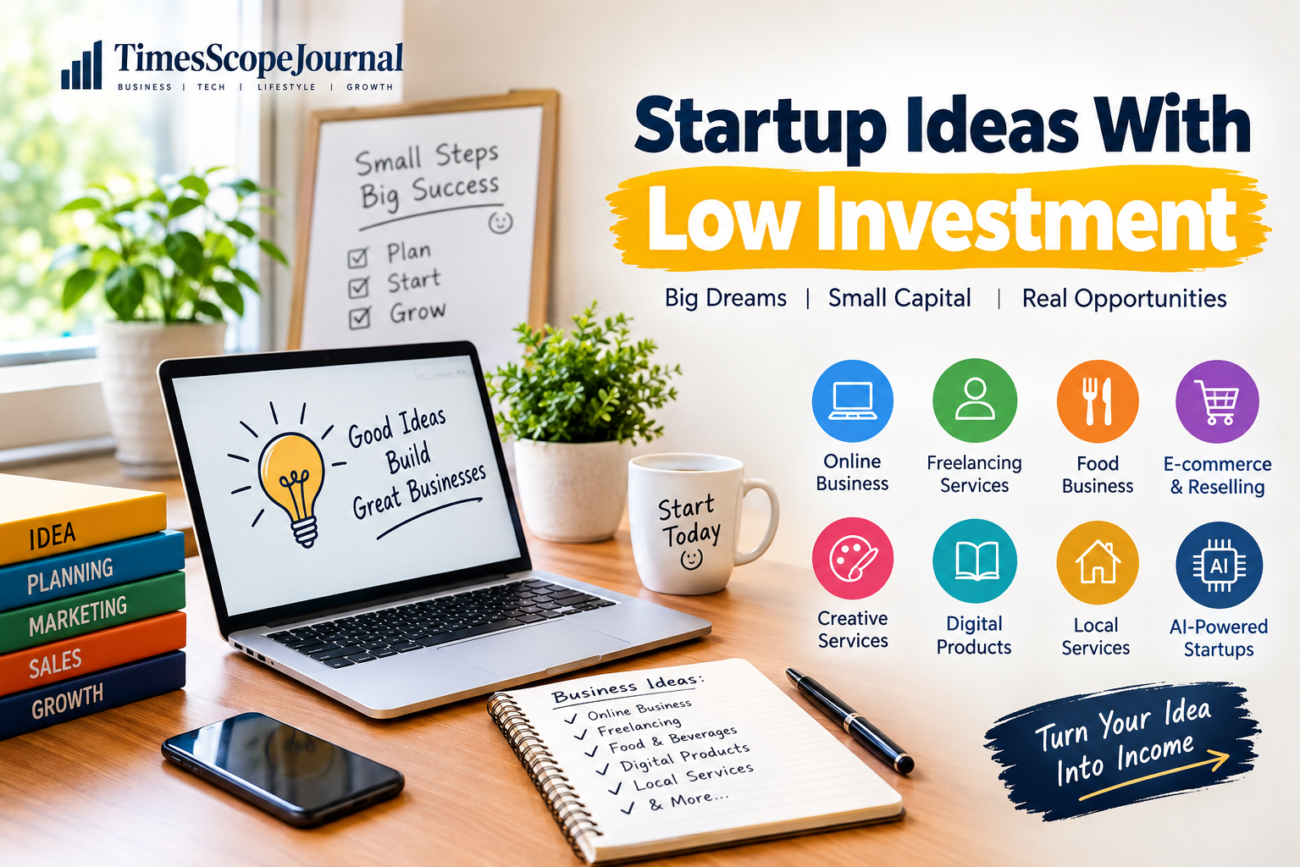
15 Best Startup Ideas With Low Investment to Start in 2026
Starting a business does not always require a large amount of capital. With the right idea, careful budgeting, and a clear understanding of your target customers, you can test a small business without making a major upfront investment.
For people searching for Startup Ideas With Low Investment, the most important question is not simply which business costs the least to start. A better question is which business can be tested with limited money while still offering a realistic path to customers, revenue, and growth.
In 2026, entrepreneurs can choose from service-based businesses, online businesses, food ventures, digital products, e-commerce, creative services, and local businesses.
This guide explores 15 practical Startup Ideas With Low Investment, explains what each business requires, and shows how you can test an idea before putting more money into it.
Why Consider a Low-Investment Startup?
Starting small can reduce the amount of money you put at risk while you learn how the market works.
A low-investment startup can allow you to:
- Test customer demand before expanding
- Start part-time while keeping another source of income
- Learn business operations gradually
- Avoid unnecessary inventory
- Improve your product or service based on customer feedback
- Reinvest early revenue into growth
However, low startup cost does not mean low effort.
A business can require little capital but still require significant time, skills, marketing, customer service, and consistent execution.
15 Startup Ideas With Low Investment
1. Digital Marketing Service
Small businesses need help reaching customers through search engines, social media, websites, email, and online advertising.
A digital marketing startup can begin with one specialized service rather than offering everything at once.
Potential services include:
- SEO
- Social media management
- Content marketing
- Email marketing
- Google Ads management
- Facebook and Instagram advertising
- Local SEO
- Content creation
Why It Can Be Started With Low Investment
The main assets are knowledge, a computer, internet access, software, and the ability to acquire clients.
You can start independently and later build an agency by adding specialized team members.
Best For
People with marketing, communication, analytics, or content skills.
2. Freelancing and Remote Services
Freelancing is one of the most flexible options for people who already have a marketable skill.
Popular services include:
- Graphic design
- Web development
- Copywriting
- Translation
- Video editing
- Virtual assistance
- SEO
- Data-related services
- Presentation design
Instead of trying to offer ten services, choose one skill and develop a strong portfolio around it.
How to Start
Create three to five sample projects that demonstrate what you can do.
Then use professional networks, freelance marketplaces, direct outreach, referrals, and social media to find potential customers.
The long-term opportunity is to move from selling individual tasks toward packages, retainers, or a small agency.
3. Online T-Shirt and Custom Apparel Business
Custom T-shirts and apparel can be sold through social media, marketplaces, websites, or local networks.
You do not necessarily need to purchase a large amount of inventory immediately.
You can test designs first, collect customer orders, and work with a reliable printing or production partner.
Potential Products
- T-shirts
- Hoodies
- Tote bags
- Caps
- Custom gifts
- Team apparel
- Event merchandise
Key Challenge
The market can be competitive, so your designs and target audience should be specific.
A store focused on a particular community, hobby, profession, or interest can be easier to position than a generic apparel store.
4. Home-Based Food or Snack Business
Food businesses can start on a small scale by focusing on a limited menu.
Possible products include:
- Cakes
- Desserts
- Snacks
- Lunch boxes
- Homemade frozen food
- Specialty drinks
- Traditional foods
Instead of preparing dozens of products, start with a few items that can be produced consistently.
What to Consider
Before launching, calculate:
- Ingredient costs
- Packaging
- Delivery
- Electricity or gas
- Wastage
- Labor
- Marketing
- Applicable food and business requirements
The selling price should cover the full cost of delivering the product, not just the ingredients.
5. Online Reselling Business
Online reselling allows entrepreneurs to sell products without necessarily manufacturing them.
You can source products from wholesalers or suppliers and sell through social media, marketplaces, or your own website.
Potential categories include:
- Clothing
- Accessories
- Home products
- Lifestyle items
- Beauty products
- Gifts
- Mobile accessories
How to Reduce Risk
Do not purchase a large inventory before testing demand.
Start with a small selection, track which products receive genuine orders, and gradually increase stock based on actual customer behavior.
6. Graphic Design and Video Editing Service
Businesses constantly need visual content for websites, advertisements, social media, presentations, product pages, and videos.
A creative service business can start with existing equipment and software.
Services You Can Offer
- Social media graphics
- Logo design
- Product images
- Short-form video editing
- YouTube editing
- Presentation design
- Advertisement creatives
- Promotional videos
Growth Opportunity
Instead of charging only per project, create monthly packages.
For example, a monthly package could include a fixed number of social media graphics and short videos.
This can make revenue more predictable than relying only on one-time projects.
7. Digital Product Business
Digital products are attractive because they do not require traditional physical inventory.
You can create and sell:
- E-books
- CV templates
- Business templates
- Spreadsheet tools
- Canva templates
- Notion templates
- Printable planners
- Educational materials
- Design resources
Why It Has Growth Potential
A physical product generally needs to be manufactured and delivered to every customer.
A digital product can be delivered electronically after purchase.
However, the biggest challenge is not production—it is finding customers and creating a product that solves a real problem.
8. Online Course or Tutoring Business
If you have expertise in a particular subject, you can turn that knowledge into an online education business.
Potential topics include:
- English
- Programming
- Graphic design
- Digital marketing
- School subjects
- Freelancing
- Photography
- Professional software
You can begin with one-on-one tutoring and later expand into group classes, recorded courses, workshops, or membership programs.
Start Narrow
Instead of creating a course for everyone, identify a specific learner and problem.
For example:
“English for job interviews” is more specific than simply “Learn English.”
9. Mobile Accessories Business
Mobile accessories are another possible low-to-moderate investment product category.
Potential products include:
- Phone cases
- Charging cables
- Screen protectors
- Phone stands
- Chargers
- Earphone accessories
- Power banks
You can sell through a physical location, social media, marketplace platforms, or a combination of online and offline channels.
Important Consideration
Product quality matters.
Low-quality accessories can lead to returns, complaints, and damaged customer trust.
Before committing to inventory, test suppliers and evaluate product quality.
10. Home Decor and Gift Business
Personalized and decorative products can be sold throughout the year, with additional demand around holidays, birthdays, weddings, anniversaries, and other occasions.
Possible products include:
- Customized gifts
- Photo frames
- Decorative items
- Handmade products
- Personalized mugs
- Wall decorations
- Gift boxes
Social media can be particularly useful because attractive product photography can help customers discover the products.
11. Photography and Videography Service
If you already have photography or video skills, you can build a service business around events, products, businesses, or individuals.
Possible niches include:
- Product photography
- Event photography
- Wedding photography
- Restaurant photography
- Social media videos
- Personal branding
- Corporate video
- Short-form content
You do not need to serve every market.
Specializing in one type of client can make your portfolio and marketing more focused.
12. Virtual Assistant Service
Small businesses and independent professionals often need administrative support without hiring a full-time employee.
A virtual assistant can provide:
- Email management
- Calendar management
- Data entry
- Online research
- Customer support
- Appointment scheduling
- Document organization
- Basic social media assistance
How to Grow
Start as an individual freelancer.
Once you have consistent demand, you can train additional assistants and turn the service into a small remote agency.
13. Print-on-Demand Business
Print-on-demand allows you to sell customized products while avoiding the need to maintain a large amount of inventory.
Products can include:
- T-shirts
- Mugs
- Posters
- Notebooks
- Tote bags
- Customized gifts
The business model can be tested with a limited number of designs.
What Matters Most
Success depends on more than uploading designs.
You need:
- A clear target audience
- Original designs
- Good product presentation
- Reliable production
- Customer service
- Effective marketing
14. Local Cleaning and Maintenance Service
Service businesses do not always require expensive equipment or inventory.
A small cleaning or maintenance business can serve homes, offices, shops, and other local customers.
Possible services include:
- Home cleaning
- Office cleaning
- Deep cleaning
- Move-in cleaning
- Move-out cleaning
- Basic maintenance
Why Local Focus Helps
You can start by serving a limited geographic area.
This reduces transportation time and allows you to build a reputation among nearby customers.
Satisfied customers can also generate referrals.
15. AI-Assisted Business Services
Artificial intelligence is creating opportunities for entrepreneurs who can help businesses use technology more effectively.
Instead of simply selling access to an AI tool, offer a specific business outcome.
For example:
- AI-assisted content services
- Workflow automation
- Customer-support systems
- AI research services
- Document processing
- Marketing automation
- AI-powered business reporting
The Important Difference
AI itself is not a guarantee of business success.
The value comes from solving a problem faster, more accurately, or more efficiently.
Businesses still need human oversight, quality control, data protection, and clear processes.
Low-Investment Startup Ideas: Quick Comparison
| Startup Idea | Main Requirement | Inventory Needed | Growth Potential |
|---|---|---|---|
| Digital Marketing | Marketing skills | No | High |
| Freelancing | Specialized skill | No | High |
| Online T-Shirt Business | Design + supplier | Usually | Medium-High |
| Home Food Business | Cooking + delivery | Yes | Medium-High |
| Online Reselling | Product sourcing | Yes | High |
| Graphic Design | Design skills | No | High |
| Digital Products | Expertise + creation | No | Very High |
| Online Course | Expertise | No | High |
| Mobile Accessories | Product sourcing | Yes | Medium |
| Home Decor/Gifts | Products/design | Usually | Medium-High |
| Photography | Camera/skills | No | Medium-High |
| Virtual Assistance | Administrative skills | No | High |
| Print-on-Demand | Design + supplier | Low | High |
| Cleaning Service | Equipment + labor | Low | Medium |
| AI Business Services | AI + business skills | No | High |
How Much Money Do You Actually Need?
There is no universal startup budget for these businesses.
The amount depends on whether you already own equipment, have relevant skills, need inventory, and plan to work from home or rent a physical location.
A useful way to divide your initial budget is into four categories:
1. Essential Equipment
This could include a laptop, smartphone, camera, cooking equipment, tools, or other business-specific equipment.
2. Initial Inventory
Product businesses may need money for their first stock order, packaging, and storage.
3. Customer Acquisition
Set aside some money for branding, content, advertising, transportation, or other customer-acquisition activities.
4. Emergency Reserve
Do not spend every available taka on the launch.
Keeping a reserve gives you flexibility if sales take longer than expected or an unexpected expense appears.
How to Choose the Right Low-Investment Startup
Not every low-cost business is suitable for every entrepreneur.
Before choosing an idea, consider these five factors.
Your Skills
Start with skills you already have whenever possible.
If you can design, write, teach, cook, edit videos, repair devices, or manage social media, your existing skills can reduce the learning curve.
Your Available Capital
Do not choose a business that requires more money than you can comfortably risk.
A low-investment model should still leave enough money for operating expenses and unexpected costs.
Customer Demand
Ask whether people actually need the product or service.
Search competitors, talk to potential customers, observe existing businesses, and test a small offer before making a major investment.
Time Availability
Some businesses can be run part-time, while others require daily operational involvement.
Consider how much time you can realistically dedicate every week.
Growth Potential
Think beyond the first sale.
Can you increase prices by improving value? Can you add employees? Can you create recurring subscriptions? Can you sell to a wider geographic market?
A business that can evolve may have more long-term flexibility than one that depends entirely on your personal time.
How to Validate a Startup Idea Before Spending More Money
One of the safest approaches is to validate your idea before making a large investment.
Step 1: Identify the Customer
Define exactly who you want to serve.
Step 2: Identify the Problem
Understand what they need, what they currently use, and what frustrates them.
Step 3: Study Competitors
Look at pricing, customer reviews, product quality, delivery, marketing, and service.
Step 4: Create a Small Offer
Do not build the biggest version of the business immediately.
Create a simple product or service and test it.
Step 5: Ask for Real Payment
People saying that an idea is “good” is not the same as people paying for it.
Actual purchases provide stronger evidence of demand.
Step 6: Measure and Improve
Track sales, costs, customer feedback, repeat purchases, and acquisition channels.
Then improve the business based on what you learn.
Common Mistakes in Low-Investment Startups
Spending the Entire Budget Immediately
A startup needs operating cash, not just launch capital.
Avoid spending everything on inventory, equipment, or branding before confirming demand.
Assuming High Margins Mean High Profit
A product may appear to have a large markup, but actual profit can be reduced by delivery, packaging, advertising, returns, platform fees, taxes, wastage, and other expenses.
Copying a Competitor
Competitor research is useful, but simply copying another business rarely creates a strong long-term advantage.
Find a way to serve customers differently.
Ignoring Customer Acquisition
A good product does not automatically attract customers.
Think about how people will discover your business before launching.
Expanding Too Quickly
Growth can create problems if your supply, quality, cash flow, or customer service cannot keep up.
Scale after you have evidence that the model works.
Frequently Asked Questions
What are the best Startup Ideas With Low Investment?
Potential options include freelancing, digital marketing, digital products, online tutoring, virtual assistance, graphic design, food businesses, online reselling, print-on-demand, and local services. The right option depends on your skills, capital, customer demand, and available time.
Can I start a business with a small amount of money?
Yes. Service-based businesses often require less upfront capital because you are primarily selling skills rather than inventory. Product-based businesses may require additional spending for stock, packaging, delivery, and storage.
Which low-investment business can be started from home?
Many options can be operated from home, including digital marketing, freelancing, graphic design, online tutoring, digital products, virtual assistance, content creation, and some food businesses where local requirements permit.
Is online business better than a physical business?
There is no universal answer. Online businesses can reach customers beyond your local area, while physical businesses can benefit from local demand and direct customer relationships.
How can I reduce the risk of starting a business?
Start with a small version of the idea, test demand, avoid unnecessary fixed costs, keep an emergency reserve, and reinvest based on actual customer demand.
How much profit can a low-investment startup make?
There is no reliable universal profit figure. Results depend on pricing, demand, operating costs, competition, customer acquisition, location, skills, and execution. Avoid treating advertised profit percentages as guaranteed outcomes.
Final Thoughts
Finding Startup Ideas With Low Investment is only the first step.
A successful startup is built by identifying a real customer problem, creating a useful solution, controlling costs, finding customers, and improving the business over time.
You do not necessarily need a large office, expensive equipment, or a huge inventory to begin. A focused service, digital product, small online store, or local business can often be tested on a much smaller scale.
The smartest approach is to start small, validate demand, track your numbers, and reinvest carefully.
Your first goal should not be to build the biggest business immediately.
Your first goal should be to prove that people are willing to pay for what you offer.
Once that happens, you have something much more valuable than an idea—you have the foundation of a business.
