
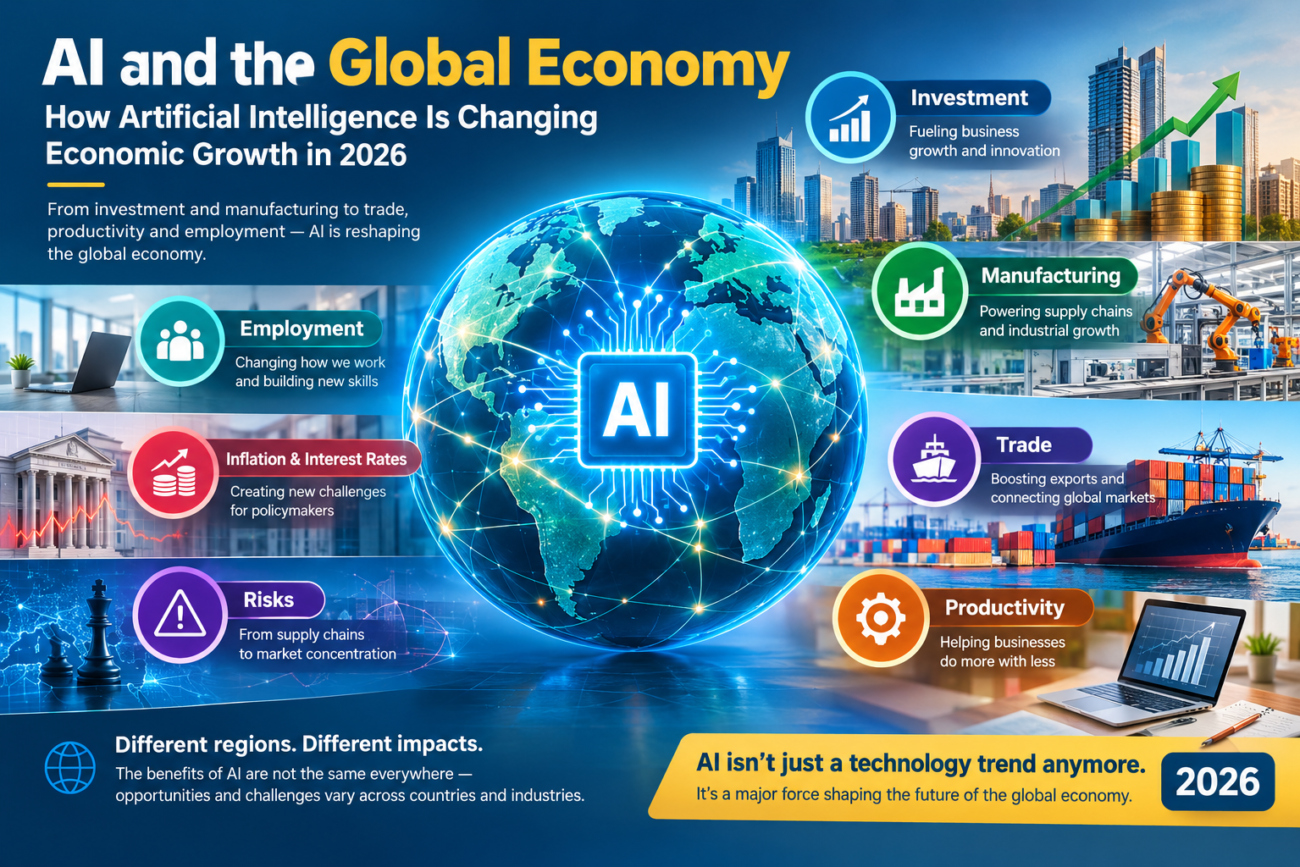
AI and the Global Economy: How Artificial Intelligence Is Changing Economic Growth in 2026
Artificial intelligence is no longer limited to chatbots, software, or technology companies. In 2026, AI is increasingly becoming an important part of the global economy, influencing business investment, manufacturing, international trade, productivity, employment, and economic policy.
As companies invest in data centers, semiconductors, software, computing infrastructure, and AI-powered systems, the economic impact of artificial intelligence is becoming easier to see. At the same time, economists and policymakers are still trying to understand how quickly these investments will translate into higher productivity and how they may affect jobs, inflation, and interest rates.
This raises an important question: Is AI becoming a long-term driver of global economic growth, or are some of its current economic benefits mainly the result of a temporary investment boom?
The answer is still developing. However, recent economic and manufacturing indicators provide several important clues.
How Is AI Changing the Global Economic Outlook?
AI is gradually moving from being a technology-sector trend to becoming a broader economic factor.
The global economy continues to face challenges including geopolitical uncertainty, changing commodity prices, inflation pressures, trade restrictions, and limited public finances. Against this background, AI-related investment and technology demand are creating additional economic activity in several regions.
The impact is not identical everywhere. Some countries are benefiting from AI infrastructure investment and technology exports, while others are seeing a smaller effect because of weaker investment, higher energy costs, or economic uncertainty.
This means the economic impact of AI should be viewed as a combination of investment, trade, productivity, employment, and policy changes rather than as a single trend.
Why AI Investment Matters to the US Economy
The United States has become one of the clearest examples of how AI investment can influence economic activity.
AI Infrastructure Is Supporting Business Investment
Companies are spending heavily on areas such as:
- Data centers
- Computer hardware
- Software
- Research and development
- AI infrastructure
- Advanced computing systems
According to the source material, spending in these areas began accelerating in early 2025. This helped offset weaker investment in other parts of the economy.
This is important because AI investment does not only benefit software developers. Building and operating AI infrastructure requires physical equipment, electricity, construction, advanced chips, networking systems, and other supporting industries.
As a result, AI can create economic activity across multiple parts of the supply chain.
AI Is Also Affecting Financial Markets
The influence of AI can also be seen through financial markets.
Since early 2024, a significant portion of the increase in the S&P 500 has been concentrated in a relatively small group of AI-related companies, according to the source. Rising equity valuations can increase household wealth and potentially support consumer spending through wealth effects.
However, this also creates another area of uncertainty: if expectations around AI companies change sharply, financial-market movements could affect the broader economy.
AI Is Expanding Beyond Software Into Manufacturing
One of the most important developments is that the AI investment cycle is not limited to software.
Manufacturing economies connected to AI development—including the US, mainland China, Japan, Taiwan, South Korea, and the Netherlands—have recorded stronger manufacturing production growth than the global benchmark since the end of 2025, according to the source material.
Why Manufacturing Matters
AI systems require a large amount of physical infrastructure.
That includes:
- Semiconductors
- Servers
- Storage equipment
- Networking hardware
- Advanced manufacturing equipment
- Data-center components
This creates demand for manufacturers and suppliers throughout the technology ecosystem.
The result is that AI can influence traditional economic indicators such as manufacturing output, new orders, exports, and business investment.
How AI Is Supporting Asia-Pacific Economies
The Asia-Pacific region has an especially important role in the AI supply chain.
Countries and economies involved in semiconductor manufacturing, electronics, servers, storage, and other technology products are benefiting from demand connected to AI infrastructure.
AI-Related Exports Are Supporting Growth
According to the source, strong technology exports from mainland China and other economies in the region have helped support economic activity, particularly where domestic demand has remained weaker.
This demonstrates an important feature of the AI economy: the benefits are distributed across an international supply chain.
A company developing an AI model may be based in one country, while the chips, servers, equipment, and components needed to operate that system can come from several others.
Taiwan and the Semiconductor Supply Chain
Taiwan is particularly important because of its position in semiconductor manufacturing.
The source notes that Taiwan recorded the sharpest increase in new export orders among PMI-covered manufacturing economies in June. The Netherlands also ranked highly, reflecting its role in advanced chipmaking equipment and inputs.
This shows that AI demand can affect both technology producers and the companies supplying the infrastructure behind them.
Is AI-Driven Export Growth Guaranteed to Continue?
Not necessarily.
One important issue is the difference between higher prices and higher physical volumes.
The source highlights concerns that some recent export gains may have been driven more by increased prices than by substantial increases in volumes. Semiconductor prices, supply shortages, freight costs, insurance costs, and longer delivery times can all affect the durability of AI-related export growth.
This distinction matters because strong revenue growth does not always mean that the underlying quantity of goods being produced and sold is increasing at the same rate.
Why Has Europe Seen a Smaller AI Investment Boost?
Europe has not experienced the same level of AI-driven investment momentum as the US.
The source material indicates that evidence of AI becoming a major driver of European investment during the first half of the year remained limited. Much of the AI investment occurring in Europe was also concentrated among large US-based organizations.
Several Factors Are Holding Investment Back
The factors identified include:
- Economic uncertainty
- Lower venture-capital investment
- Relatively high energy prices
- High infrastructure requirements
- Capital-intensive AI projects
AI infrastructure requires significant amounts of electricity and capital. Therefore, energy prices and financing conditions can strongly influence how quickly businesses expand AI investment.
Could AI Still Become Important for Europe?
Yes, the source describes AI as a potential medium-term upside factor for Europe.
AI adoption is already occurring among European businesses, although the pace varies. If investment conditions improve and adoption becomes broader, AI could contribute more significantly to productivity growth in European economies.
How Could AI Change the Labor Market?
The relationship between AI and employment is more complicated than simply saying that AI will either create or eliminate jobs.
Businesses are currently using AI heavily to improve efficiency and employee productivity.
According to the source, 64% of surveyed enterprises identified process efficiency as an AI objective, while 59% identified employee productivity. By comparison, 24% identified head-count reduction.
This suggests that many organizations are initially using AI as a tool to help employees rather than immediately replacing large numbers of workers.
AI Adoption May Change How People Work
AI can assist with tasks such as:
- Summarization
- Translation
- Data management
- Information processing
- Routine analysis
- Workflow automation
This can change the type of work employees perform without necessarily eliminating the entire job.
The source also reports that only 22% of tracked AI projects target a fully autonomous end state, suggesting that human involvement remains important across many implementations.
Could AI Eventually Reduce Employment?
There are signs that AI’s employment impact deserves attention.
The source reports that AI’s net global employment impact has shifted modestly negative over the previous 12 months, with another small negative impact expected over the following year.
However, the effect is unlikely to be identical across every industry or occupation.
The speed of change can depend on:
- Employee skills
- Data quality
- Business investment
- AI reliability
- Management decisions
- The level of automation
- Customer requirements
For this reason, the labor-market effects of AI are likely to develop unevenly.
What Does AI Mean for Inflation and Interest Rates?
AI could create an unusual challenge for central banks.
If AI increases productivity and expands the economy’s ability to produce goods and services, it could potentially increase supply without creating the same inflationary pressure associated with demand growth.
But the transition itself can require significant investment.
Companies may need to spend heavily on computing infrastructure, energy, data centers, software, and skilled workers before productivity gains become visible.
The source therefore describes AI as a policy wildcard, rather than something that automatically means lower interest rates or higher interest rates.
Why Productivity Matters
Suppose businesses can produce more output with the same amount of labor because of AI.
That could increase productivity.
But policymakers need to determine:
- How quickly productivity is improving
- Whether the improvement is temporary or long-lasting
- Whether AI increases overall economic capacity
- How AI affects wages and employment
- Whether AI investment increases demand and prices
These questions make AI increasingly relevant to monetary-policy discussions.
What Are the Biggest Risks to the AI Growth Story?
AI has significant economic potential, but several risks could affect how sustainable the current growth cycle becomes.
1. Investment Could Outrun Productivity
Large AI infrastructure projects can increase economic activity immediately, while productivity benefits may take longer to appear.
If expected productivity improvements do not materialize, some investment could eventually prove less valuable than anticipated.
2. Supply-Chain Constraints
AI infrastructure depends heavily on:
- Semiconductors
- Servers
- Storage
- Electricity
- Data-center equipment
- Specialized components
Shortages or rising costs could slow AI deployment and increase expenses.
3. Financial-Market Concentration
If AI-related companies represent a large share of market gains, changes in investor expectations could have broader financial consequences.
4. Workforce and Skills Gaps
AI adoption requires people who can implement, manage, evaluate, and integrate AI systems.
A shortage of appropriate skills could slow adoption even when companies have the financial resources to invest.
5. AI Projects May Not Deliver Immediate Returns
The source reports that only 46% of AI initiatives launched during the previous year were considered on track to achieve positive ROI within 12 months, while 37% were live and delivering value.
This highlights an important point: AI investment alone does not guarantee successful business outcomes.
AI’s Economic Impact Will Not Be the Same Everywhere
One of the clearest lessons from current data is that AI’s economic impact varies significantly by geography and industry.
Countries deeply connected to semiconductor manufacturing and technology hardware may benefit from AI-related exports.
Countries with strong software industries may benefit from AI development and enterprise adoption.
Meanwhile, economies with high energy costs, weaker investment conditions, or limited access to capital may experience a slower transition.
This creates a global economy in which AI could increase opportunities for some regions while creating adjustment challenges for others.
What Should Businesses Watch as AI Adoption Grows?
Businesses looking at AI should pay attention to more than the latest AI model or technology announcement.
Several economic indicators can provide a better picture of whether AI is creating lasting value:
Business Investment
Are companies continuing to increase spending on AI infrastructure, software, and research?
Productivity
Are businesses actually producing more output with the same resources?
Employment
Are companies using AI to augment workers, automate tasks, or reduce head count?
Trade
Are AI-related exports increasing because of greater production volumes or mainly because of higher prices?
Supply Chains
Can semiconductor, energy, server, and data-center supply keep up with demand?
Return on Investment
Are AI projects generating measurable financial or operational benefits?
These indicators can help distinguish a sustainable AI-driven economic transformation from a short-term investment cycle.
The Future of AI and the Global Economy
Artificial intelligence is becoming increasingly connected to the real economy.
Its influence can already be seen in US investment, technology manufacturing, Asia-Pacific exports, semiconductor demand, business productivity, and workforce planning.
But the long-term economic outcome is not predetermined.
The future impact of AI will depend on how quickly businesses adopt the technology, whether productivity improvements become widespread, how governments respond, whether supply chains can support growing demand, and how workers adapt to changing roles.
AI may ultimately become much more than a technology trend. It could influence the way countries compete, businesses invest, workers develop skills, and policymakers manage economic growth.
Final Thoughts
The economic impact of AI is becoming increasingly visible in 2026, but the story is still developing.
AI investment is supporting economic activity in several major economies, while technology-related exports are providing additional support to parts of Asia-Pacific. At the same time, Europe has experienced a more limited investment effect, and questions remain about productivity, employment, supply chains, financial markets, and the sustainability of AI-related growth.
The most important question is no longer simply whether AI will affect the economy.
It is how deeply AI will reshape economic growth, productivity, trade, investment, and employment over the years ahead.
As AI adoption continues, businesses, workers, investors, and policymakers will need to watch the data closely rather than rely only on expectations.
