
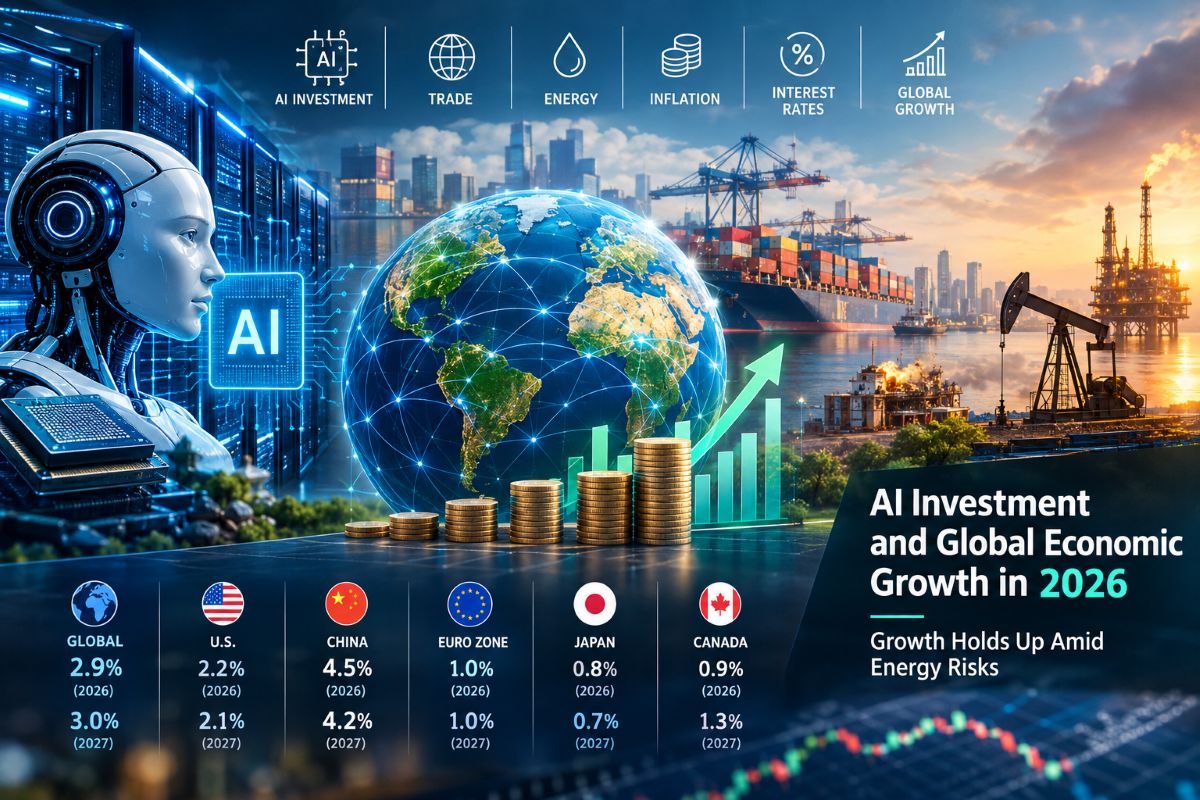
AI Investment and Global Economic Growth in 2026: Growth Holds Up Amid Energy Risks
Artificial intelligence investment has become an increasingly important source of global economic activity in 2026, helping support investment, production and international trade even as higher energy costs and geopolitical uncertainty create new pressure.
According to the Organisation for Economic Co-operation and Development (OECD), the global economy is projected to grow 2.9% in 2026, slightly higher than its previous 2.8% projection. Growth is expected to reach 3.0% in 2027, although the outlook remains exposed to energy-market disruptions, inflation and financial-market risks.
AI Investment Becomes a Key Source of Global Growth
Investment in artificial intelligence infrastructure is playing an important role in supporting economic activity this year.
Spending on data centres, advanced computing equipment and semiconductors is creating demand across multiple industries. The OECD says continued AI-related activity has helped sustain investment, production and trade across several economies.
The impact is also spreading through international supply chains. Countries that manufacture semiconductors and other technology components are benefiting from strong demand connected to AI infrastructure.
Recent trade data also shows the strength of this trend. South Korea’s semiconductor exports have been supported by strong global demand linked to AI investment, highlighting the growing connection between AI spending and international trade.
AI investment is supporting economic activity through increased spending on data centers, semiconductors and advanced computing infrastructure. Our analysis of AI investment and global economic growth in 2026 explores how this technology-driven spending is affecting the wider global economy.
Global Growth Remains Resilient Despite Energy Shock
The global economy has faced significant pressure from disruptions in energy markets during 2026. Higher oil and gas prices have increased costs for households and businesses while adding to inflationary pressure.
However, the OECD says the wider economic impact has so far been partly cushioned by alternative energy supplies, inventory releases, additional production outside the Gulf region and weaker oil demand in some major economies.
These factors, combined with strong AI-related investment, have helped prevent a sharper slowdown in global economic activity.
Global Economy Faces a More Complicated 2027 Outlook
Although the 2026 growth projection was revised slightly upward, the outlook remains uncertain.
The OECD projects global GDP growth of 3.0% in 2027, compared with its earlier projection of 3.1%. Stronger price pressures, weaker real income growth and higher interest rates could limit economic momentum.
Energy markets will remain one of the most important factors to watch. A prolonged disruption to oil and gas supplies could push energy prices higher, increasing production costs and reducing household purchasing power.
Inflation Could Remain Elevated
Higher energy prices are also creating challenges for inflation.
The OECD projects G20 headline inflation at 4.1% in 2026, before easing to 3.6% in 2027. Higher energy and food prices could keep inflation elevated for longer if supply disruptions continue.
For businesses, higher input costs can affect margins and investment decisions. For consumers, rising energy and food prices can reduce disposable income and limit spending.
This creates a difficult environment for central banks, which need to balance inflation control against the risk of weakening economic activity.
United States Benefits From Strong AI Investment
The United States remains one of the major beneficiaries of the AI investment cycle.
The OECD projects US economic growth of 2.2% in 2026 and 2.1% in 2027. Strong AI-related investment is expected to provide support even as consumer spending and real income growth face pressure.
Investment in data centres and technology equipment has also contributed to economic activity. Separate US GDP data reported by Reuters showed that business investment in AI infrastructure was an important part of second-quarter economic growth.
Asia’s Technology Sector Gains From AI Demand
AI investment is also influencing economies across Asia, particularly countries with major semiconductor and technology manufacturing industries.
Japan and South Korea have benefited from stronger technology exports, while China and other Asian economies remain important parts of the broader technology supply chain. The OECD specifically identifies technology production and exports as important channels through which AI investment is supporting growth.
South Korea’s semiconductor export performance provides another example of how AI-related demand is affecting global trade.
Europe Faces Energy and Interest-Rate Pressure
The European economy faces a different combination of challenges.
The OECD projects euro-area growth at 1.0% in both 2026 and 2027. Higher energy prices and interest rates are expected to weigh on economic activity, although defence-related spending and a potential easing of energy prices could provide support.
Europe is particularly exposed to energy-market disruptions because higher gas and electricity costs can quickly affect manufacturing, transportation and household budgets.
Rising Bond Yields Add Another Risk
Energy prices and inflation are not the only concerns for the global economy.
Long-term government bond yields have risen substantially in many economies, increasing borrowing costs for governments and businesses. The OECD also points to increased fiscal pressures and heavy borrowing needs as risks to the economic outlook.
Higher borrowing costs can make new investments more expensive and may also put pressure on financial-market valuations.
AI Investment Also Carries Economic Risks
AI is supporting growth, but the investment cycle itself is not without risks.
Technology companies are making substantial investments based on expectations of future AI-related revenues and productivity gains. If those returns take longer than expected to materialize, investment could slow and financial-market valuations could come under pressure.
The OECD warns that disappointing returns from AI investment could affect not only technology companies but also connected industries such as engineering and construction.
At the same time, faster adoption of AI that produces significant productivity improvements could provide an upside to economic growth beyond current projections.
What Could Shape the Global Economy Next?
Several factors will determine whether the global economy maintains its current resilience:
- AI investment: Continued spending on data centres, semiconductors and computing infrastructure could support growth.
- Energy prices: Prolonged oil and gas disruptions could increase inflation and reduce economic activity.
- Interest rates: Higher borrowing costs could slow investment and consumer demand.
- Global trade: Tariffs and export restrictions could create additional supply-chain uncertainty.
- AI productivity: Faster adoption of AI could increase productivity and strengthen economic growth.
- Financial markets: Rising bond yields and weaker-than-expected AI returns could create additional market volatility.
The OECD estimates that a combination of major adverse shocks—including higher energy prices and tighter financial conditions—could reduce global growth by 0.7 percentage points in 2027 and increase global consumer-price inflation by 1.1 percentage points in its illustrative scenario.
Conclusion
The global economy in 2026 is being shaped by two powerful and competing forces. AI investment is supporting production, technology trade and economic activity, while energy-market disruptions, inflation, higher borrowing costs and geopolitical uncertainty are creating new challenges.
The OECD currently projects global growth at 2.9% in 2026 and 3.0% in 2027. Whether that outlook holds will depend heavily on energy-market conditions, inflation trends, financial conditions and how effectively businesses turn large AI investments into productivity and economic gains.
For businesses and investors, the broader message is that AI is becoming an increasingly important part of the global growth story—but its impact will continue to interact with energy markets, trade, interest rates and wider economic conditions.
