
Google Signs 20-Year Nuclear Power Deal With Constellation Energy to Fuel AI Growth
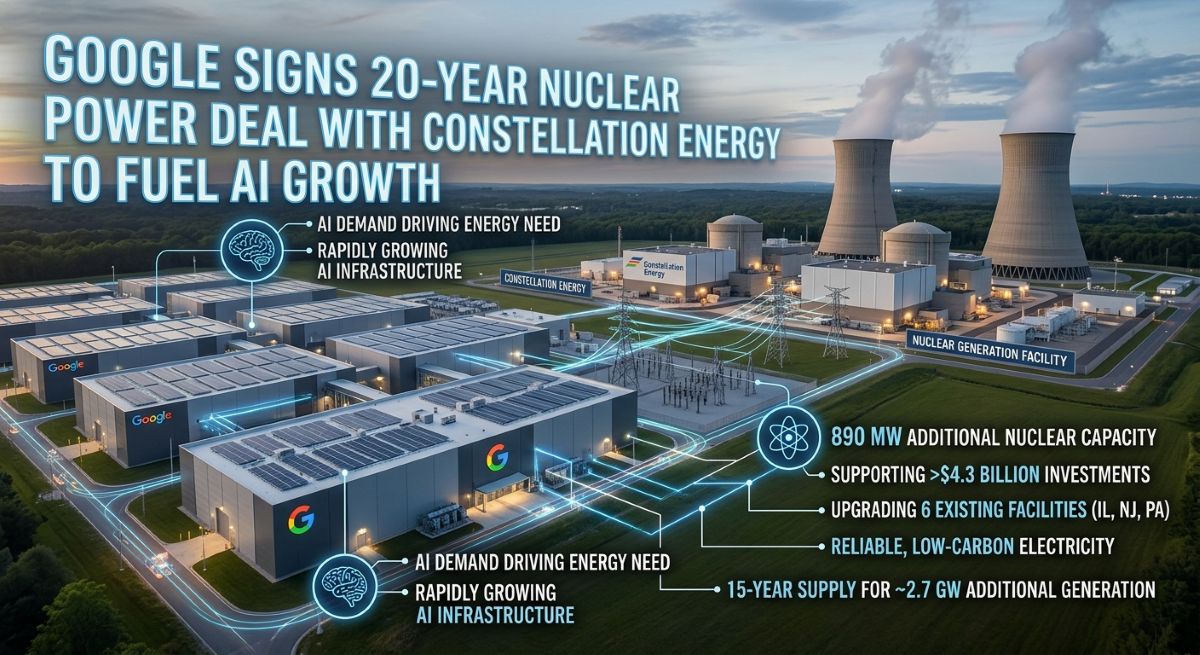
Google has signed a major 20-year nuclear power agreement with Constellation Energy as the technology giant looks to secure reliable electricity for the rapidly growing demands of artificial intelligence. The agreement is expected to bring 890 megawatts of additional nuclear capacity online while supporting more than $4.3 billion in investments to upgrade existing reactors.
The deal highlights how the expansion of AI is creating new demand for dependable electricity. As data centers become larger and more energy-intensive, technology companies are increasingly looking beyond traditional power sources to secure long-term supplies of reliable, low-carbon electricity.
Google and Constellation Energy Announce Long-Term Nuclear Deal
Under the agreement, Google will purchase power from Constellation Energy through a 20-year power purchase agreement. The additional nuclear capacity will come from upgrades at six existing nuclear facilities located across Illinois, New Jersey and Pennsylvania.
Constellation plans to modernize equipment at its nuclear plants, including turbines, steam generators and digital control systems. These improvements are designed to increase the amount of electricity that existing reactors can produce without requiring the construction of entirely new facilities.
The investment will support upgrades across 11 Constellation-owned nuclear units, with the first increased capacity expected to become available in 2028.
Nuclear Power Becomes More Important as AI Expands
The rapid growth of artificial intelligence is changing the energy requirements of major technology companies. AI training and inference require large data centers filled with advanced computing equipment, which can consume substantial amounts of electricity.
Google has been expanding its AI infrastructure and cloud operations, making access to dependable electricity increasingly important. Nuclear energy can provide continuous power generation, making it attractive for data centers that require electricity around the clock.
Unlike some renewable sources that depend on weather conditions, nuclear reactors can operate continuously for extended periods. This reliability is one reason major technology companies are increasingly exploring long-term nuclear power agreements.
Google Will Also Secure Additional Electricity Supply
The agreement with Constellation goes beyond the 890 MW nuclear capacity expansion.
Google and Constellation have also agreed to a separate 15-year energy supply arrangement covering approximately 2.7 gigawatts of additional generation in the PJM power market.
Together, the agreements represent about 3.6 gigawatts of electricity supply arrangements. The long-term contracts provide Constellation with greater revenue visibility while giving Google greater certainty over its future electricity needs.
For Google, securing power through long-term agreements could become increasingly important as competition for electricity grows in regions where data centers are expanding rapidly.
Google Brings AI Software Into the Nuclear Energy Deal
The agreement also includes a technology component.
Constellation will use Google’s Gemini Enterprise software to support several areas of its operations. These include site selection, outage management and infrastructure protection.
The use of AI tools within energy infrastructure demonstrates how the relationship between technology and power generation is becoming increasingly connected.
AI can potentially help energy companies analyze large amounts of operational data, improve maintenance planning and identify problems more efficiently. For Google, providing AI technology as part of the broader relationship could also create opportunities to demonstrate the technology in critical infrastructure environments.
Big Tech Is Increasing Its Focus on Nuclear Energy
Google is not the only major technology company turning toward nuclear power.
Amazon recently signed a long-term agreement with Constellation Energy that includes nuclear power from the company’s Maryland facilities. The deal is expected to support billions of dollars in infrastructure investment.
Microsoft has also entered into a 20-year agreement involving the restart of a previously shuttered nuclear reactor at Three Mile Island. The facility is expected to provide electricity for Microsoft’s operations once it returns to service.
Meta has similarly pursued nuclear power agreements as it expands its data center infrastructure and AI capabilities.
These deals show a broader trend across the technology industry: companies building large-scale AI infrastructure need increasingly reliable sources of electricity.
Why Constellation Energy Benefits From the Agreement
For Constellation Energy, the Google agreement provides more than a new customer.
Long-term power purchase agreements give energy companies greater certainty about future revenue. That visibility can make it easier to justify major investments in existing nuclear facilities.
The $4.3 billion investment supported by Google’s agreement could help Constellation increase output from its existing reactor fleet while extending the economic value of those facilities.
The company is also positioned to benefit from growing electricity demand created by data centers, AI applications and other technology infrastructure.
Existing Nuclear Plants Could Offer a Faster Path to More Power
One important aspect of the agreement is that much of the additional capacity will come from existing nuclear facilities.
Upgrading operating reactors can potentially be faster than developing completely new nuclear plants. Existing facilities already have infrastructure, grid connections and established operating systems.
That makes reactor uprates and modernization an attractive option as electricity demand rises.
For technology companies, the ability to secure additional generation from existing plants may be particularly valuable because AI infrastructure is expanding faster than many new energy projects can be developed.
Nuclear Stocks React to the Google Deal
The agreement also attracted strong attention from investors.
Constellation Energy shares rose sharply following the announcement, while other nuclear-related companies also benefited from renewed interest in the sector.
Investors have increasingly viewed nuclear power as a potential beneficiary of the AI boom because data center operators need dependable electricity to support increasingly powerful computing systems.
However, not every nuclear technology company benefits in the same way. Companies developing small modular reactors and other next-generation nuclear technologies still face regulatory, financing and construction challenges.
The Google-Constellation agreement therefore provides a strong signal of demand for nuclear electricity, but it does not eliminate the risks associated with developing new nuclear technologies.
Small Modular Reactors Could Become Part of the AI Energy Strategy
Large existing nuclear plants are not the only technology being considered for future data center power.
Several companies are developing small modular reactors, commonly known as SMRs. These smaller nuclear systems are designed to produce less electricity than traditional large reactors and could eventually provide more flexible power options.
Technology companies and energy developers have shown growing interest in SMRs because future data centers may need electricity in locations where conventional power infrastructure is limited.
However, many SMR projects remain in development and must overcome licensing, financing and construction hurdles before they can provide commercial electricity at scale.
What the Deal Means for the Future of AI Infrastructure
The agreement between Google and Constellation Energy demonstrates that the AI expansion is becoming an energy story as well as a technology story.
As companies deploy more AI models, cloud services and data centers, electricity demand is likely to become an increasingly important part of infrastructure planning.
This could lead to greater investment in nuclear power, renewable energy, grid infrastructure, energy storage and other technologies capable of supporting large-scale computing.
For Google, the long-term agreement provides access to dependable nuclear electricity. For Constellation, it creates a major commercial commitment that can support investment in its reactor fleet.
A Growing Connection Between Technology and Energy
The Google-Constellation agreement reflects a broader transformation taking place across the technology and energy industries.
AI companies need enormous computing infrastructure, while energy companies need large customers willing to support long-term investments in electricity generation.
Those interests are increasingly meeting through long-term power agreements.
As artificial intelligence continues to expand, the ability to secure reliable electricity could become just as important as access to advanced chips, data centers and cloud computing capacity.
Conclusion
Google’s 20-year nuclear power agreement with Constellation Energy marks another major step in the technology industry’s growing reliance on nuclear energy.
The deal will support 890 megawatts of additional nuclear capacity and more than $4.3 billion in upgrades to existing reactors. A separate 15-year agreement covering 2.7 gigawatts of electricity further strengthens the partnership.
More broadly, the deal shows how the rapid growth of AI is reshaping energy demand. Google, Amazon, Microsoft and Meta are among the major technology companies exploring nuclear power as they build increasingly energy-intensive infrastructure.
As AI development accelerates, reliable and scalable electricity is likely to remain a critical part of the technology industry’s next phase of growth.
