
Google September 2026 Spam Update Enters Final Phase as Search Volatility Returns
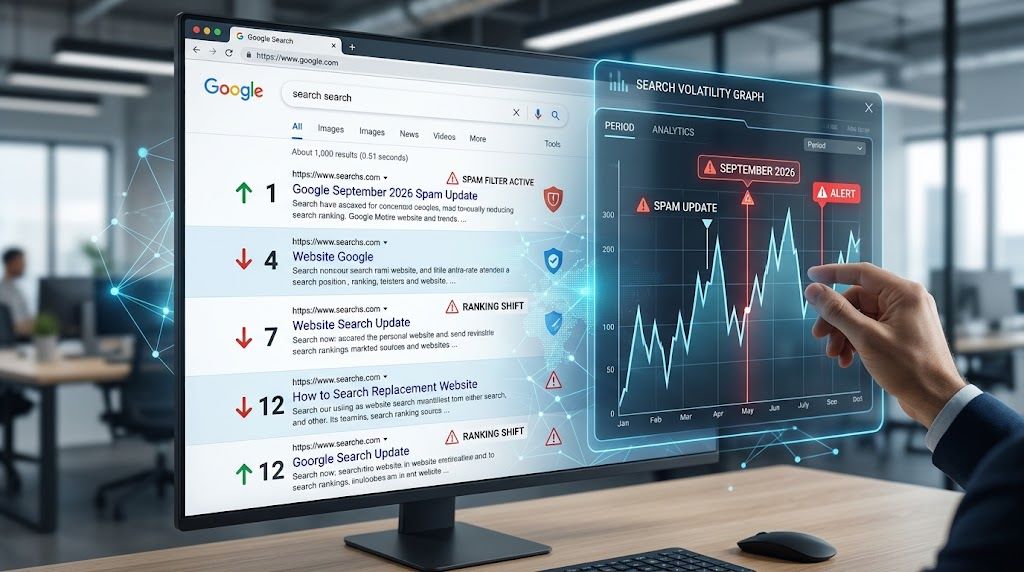
Google’s September 2026 Spam Update appears to be entering its final stage after another period of increased search volatility between October 4 and October 6. The update, which began on September 24, has already produced several periods of ranking movement and traffic fluctuations across websites.
Google officially said the September 2026 spam update applies globally and to all languages, with the rollout potentially taking up to two weeks.
As the expected rollout window approaches its end, website owners and SEO professionals are closely monitoring rankings, organic traffic, Google Discover visibility and other search performance signals.
Google September 2026 Spam Update: What We Know
The September 2026 Spam Update began on September 24, 2026, according to Google’s Search Status Dashboard.
Unlike several earlier spam updates released during 2026, Google indicated that this rollout could take up to two weeks to complete. That makes this update notably longer than the March, June and August 2026 spam updates.
The update is also different because ranking changes have appeared to occur in multiple periods rather than as one short burst of volatility.
Key Update Details
- Start date: September 24, 2026
- Expected rollout: Up to two weeks
- Global coverage: Yes
- Languages affected: All languages
- Update type: Spam update
- Latest reported volatility: October 4–6
- Expected rollout window: Around October 8, based on Google’s two-week estimate
The October 8 date should be treated as an estimate rather than an official completion date. Google has to mark the rollout complete on its Search Status Dashboard before the update can be considered officially finished.
Why Search Rankings Are Moving in Multiple Waves
One of the most noticeable characteristics of this update is the repeated movement in search results.
Reports from SEO tracking platforms and the search community indicate that volatility appeared during several periods following the September 24 launch. Search Engine Roundtable reported another increase in volatility around October 4–6, describing it as a possible final phase of the update.
This does not necessarily mean Google is running separate updates.
Instead, the longer rollout can produce different periods of ranking movement as Google’s systems process and reassess websites.
A Timeline of the Update
September 24: Google officially launched the September 2026 Spam Update.
September 25–27: Early ranking and traffic changes were reported across parts of the SEO community.
September 30–October 1: Another period of increased search volatility was reported.
October 4–6: Search tracking tools and industry discussions showed another increase in volatility.
Around October 8: This represents the approximate end of Google’s two-week rollout window, although the official completion date remains dependent on Google’s status dashboard.
What SEO Tracking Tools Are Showing
Several third-party SEO monitoring platforms have reported increased SERP volatility during the latest phase.
Tools commonly used by SEO professionals include:
- Semrush
- Mozcast
- AccuRanker
- Similarweb
- Sistrix
- Wincher
- SERPstat
- DataForSEO
- Mangools
- CognitiveSEO
These tools can help identify unusual movement in search results, but they do not explain exactly why an individual website gained or lost rankings.
That distinction is important.
A spike in an SEO volatility tool indicates that search results are changing. It does not automatically prove that every ranking change was caused by the spam update.
Did Google Confirm What the Update Targets?
Google has not publicly provided a detailed list of specific spam techniques being targeted by the September 2026 update.
The official announcement confirms that it is a spam update, that it applies globally and to all languages, and that the rollout may take up to two weeks.
Therefore, website owners should avoid assuming that one particular SEO technique is responsible for ranking changes without checking their website against Google’s spam policies.
This is especially important for publishers producing large amounts of content.
Does the Update Target AI-Generated Content?
There is currently no official Google statement saying that the September 2026 Spam Update specifically targets AI-generated content.
Using AI does not automatically make a webpage spam.
The more important question is whether the content provides genuine value to users or whether it is produced primarily to manipulate search rankings.
For publishers, this means simply rewriting existing news stories with minor wording changes may not be enough to create strong search content.
A better approach is to add:
- Original analysis
- Clear context
- Verified facts
- Useful explanations
- Relevant statistics
- Expert or authoritative sources
- Strong editorial structure
- Meaningful updates when new information becomes available
How to Check Whether Your Website Was Affected
If your website experienced a sudden traffic or ranking decline, do not immediately assume that the spam update caused it.
Start by examining Google Search Console.
1. Compare Organic Clicks
Compare your recent search performance with the period immediately before September 24.
Look for significant changes in:
- Total clicks
- Impressions
- Average position
- CTR
A sharp decline beginning around the update’s volatility periods deserves closer investigation.
2. Check Individual Pages
Do not look only at total website traffic.
Identify which URLs experienced the largest changes.
You may find that:
- Some pages lost rankings
- Some pages remained stable
- Other pages gained visibility
This can provide more useful information than looking at the overall traffic number.
3. Review Your Top Keywords
Check whether your most important keywords experienced ranking changes.
If many unrelated keywords declined at the same time, an algorithmic change may be one possible explanation.
However, seasonality, competition, news trends and changes in search demand can also affect rankings.
4. Look at Traffic Sources
For publishers, Google Search may not be the only source of traffic.
Also check:
- Google Discover
- Google News
- Direct traffic
- Referral traffic
- Social traffic
This can help determine whether the impact is limited to traditional Google Search or affects other Google surfaces as well.
What Should Website Owners Do During the Final Phase?
The safest approach is to avoid making large-scale SEO changes simply because rankings are moving during the rollout.
If you completely rewrite dozens of pages while the update is still running, it becomes difficult to determine whether later ranking changes came from Google’s update or from your own changes.
Instead, use this period for an SEO audit.
Review Your Content Quality
Ask whether every important page provides something useful that readers cannot easily get from dozens of similar pages.
For news publishers, this could mean adding more context, original reporting, reliable sources and clear explanations.
Remove Low-Value Content
Review pages that have little traffic, little useful information or substantial duplication.
Do not remove content simply because it has low traffic. First determine whether it serves a legitimate purpose.
Check for Spam Policy Risks
Review your website against Google’s spam policies and look for practices that could create quality or trust problems.
This is more useful than trying to guess a specific ranking signal from third-party volatility charts.
What About Websites That Lost Traffic?
A traffic decline during the update does not automatically mean that a website has been penalized.
Algorithmic ranking changes and manual actions are different.
A website can lose visibility because Google’s systems reassess the quality or relevance of pages without receiving a manual action.
That is why diagnosis should come before major changes.
Could Rankings Recover After the Update?
Yes, ranking positions can change again after a major algorithmic adjustment.
The end of the rollout does not necessarily mean that every website will immediately return to its previous rankings.
Google’s systems continuously evaluate search results, and websites can gain or lose visibility for many reasons.
If a site has genuine quality issues, improving those areas is more sustainable than attempting to reverse-engineer a temporary ranking fluctuation.
What the September 2026 Update Means for Publishers
For news and content publishers, the latest spam update reinforces the importance of producing content for readers rather than simply producing pages designed to capture search traffic.
Publishing more articles is not necessarily better.
A smaller number of well-researched articles can provide more long-term value than a large collection of thin, repetitive pages.
Publishers should particularly focus on:
- Originality
- Accuracy
- Clear authorship
- Strong sourcing
- Helpful explanations
- Relevant internal linking
- Proper article structure
- Fast and accessible pages
- Avoiding repetitive or mass-produced low-value content
Final Thoughts
Google’s September 2026 Spam Update is entering its expected final rollout window, with another period of search volatility reported between October 4 and October 6.
Google officially confirmed that the update began on September 24, applies globally and to all languages, and may take up to two weeks to complete.
The recent volatility may represent the final stage of the rollout, but the official completion should be determined by Google’s Search Status Dashboard rather than third-party tracking tools.
For website owners, the best response is not to panic over short-term ranking changes. Instead, monitor Search Console, review affected pages, check content quality and make improvements based on Google’s published spam guidance.
Once the rollout is officially complete, a clearer comparison of before-and-after search performance should provide a much better picture of which websites were genuinely affected.
