

What Jobs Will AI Replace? Jobs Most at Risk and the Future of Work
Artificial intelligence is no longer something people only talk about as a technology of the future. It is already changing how businesses operate, how employees complete everyday tasks, and how companies think about productivity.
AI can write emails, summarize documents, analyze data, answer customer questions, generate images, translate languages, and even assist with computer programming. As these tools become easier to use, one question keeps coming up: What jobs will AI replace?
The answer is more complicated than simply saying that AI will take millions of jobs. In many cases, AI is not replacing an entire occupation. Instead, it is taking over specific tasks within a job. A customer service representative may still be needed, for example, but an AI chatbot could handle many routine questions before a human gets involved.
Some occupations are more exposed to automation than others. Jobs built around repetitive digital tasks are generally easier for AI systems to assist with or automate. Meanwhile, careers that depend heavily on human trust, physical work, creativity, leadership, empathy, or unpredictable environments can be much harder to automate completely.
The future of work is therefore likely to involve a mixture of job displacement, job transformation, and new opportunities. Understanding that difference is more useful than simply asking whether AI will replace humans.
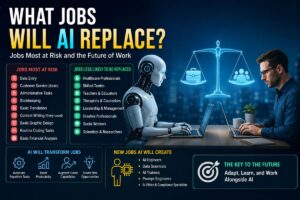
Will AI Really Replace Human Jobs?
AI can certainly replace some tasks that humans currently perform. But replacing a task is not the same thing as eliminating an entire job.
Consider an accountant. Software can categorize transactions, process invoices, identify unusual spending patterns, and prepare parts of a financial report. That does not necessarily mean the accountant disappears. Instead, the accountant may spend less time on routine processing and more time reviewing information, advising clients, handling complicated financial situations, and making professional judgments.
The same pattern can be seen in marketing, writing, programming, customer service, design, and many administrative roles.
AI Is More Likely to Replace Tasks Than Entire Jobs
There are four different things that can happen when AI enters a workplace.
Task automation happens when AI takes over one specific activity. For example, an employee may use AI to summarize a long document instead of reading and summarizing it manually.
Job transformation happens when AI changes how an employee performs most of their responsibilities. A writer may use AI for research and initial drafts while concentrating more on editing, interviews, fact-checking, and original ideas.
Job elimination happens when technology can perform enough of an occupation’s core responsibilities that an employer no longer needs as many workers in that role.
New job creation happens when technology creates demand for work that did not previously exist or was much less important.
This is why predicting the future of employment is difficult. A technology can remove one type of work while creating another.
What Makes a Job Vulnerable to AI?
Not every job has the same level of exposure to AI.
Jobs are generally easier to automate when they involve:
- Repetitive tasks
- Predictable processes
- Rule-based decisions
- Digital information
- Large amounts of structured data
- Routine communication
- Work that can be completed entirely through software
For example, entering information from thousands of documents into a database is relatively predictable. An AI system can process large volumes of digital information quickly, making this type of work more exposed to automation.
By contrast, repairing a complicated electrical system inside an old building requires physical movement, judgment, observation, and adaptation to conditions that may not be predictable. That makes complete automation much more difficult.
What Jobs Are Most Likely to Be Replaced by AI?
AI exposure does not automatically mean an occupation will disappear. However, some jobs contain a larger proportion of tasks that AI systems can already assist with or automate.
Here are some of the areas most likely to experience significant changes.
Data Entry Jobs
Data entry is one of the clearest examples of work that can be affected by automation.
Traditional data entry often involves taking information from forms, invoices, documents, emails, or spreadsheets and putting it into another system. Modern AI-powered tools can extract information from documents, recognize text from images, classify files, and move structured information between systems.
Optical character recognition, document processing, and machine learning can reduce the amount of manual work required.
Humans may still be needed to check unusual cases or correct mistakes. But when thousands of similar records need to be processed, businesses have a strong incentive to automate as much of the workflow as possible.
Telemarketing and Basic Customer Service
Customer service is another area where AI is becoming increasingly useful.
Chatbots and voice-based AI systems can answer common questions, provide basic information, check order status, schedule appointments, and guide customers through simple problems.
For a business receiving thousands of similar questions every day, automation can provide immediate responses without requiring a human employee for every interaction.
That does not mean human customer service disappears.
Customers with unusual complaints, complicated requests, emotional situations, or problems involving multiple systems may still want to speak with a real person. Human representatives can also handle situations where understanding context and emotion matters.
The likely change is that AI handles more routine interactions while humans focus on the cases that require judgment.
Administrative and Clerical Jobs
Administrative work includes many tasks that AI assistants can help automate.
Examples include:
- Scheduling meetings
- Organizing information
- Drafting routine emails
- Preparing documents
- Summarizing meetings
- Managing calendars
- Sorting files
- Creating basic reports
An employee who previously spent hours preparing meeting notes may now use AI to produce a first draft within minutes.
The role may therefore become less about manually completing routine administrative tasks and more about coordination, communication, organization, and decision-making.
Bookkeeping and Routine Accounting
Accounting contains both highly repetitive tasks and responsibilities that require professional judgment.
AI-powered financial software can assist with transaction categorization, invoice processing, expense tracking, reconciliation, and reporting.
For small businesses, automation can reduce the amount of manual bookkeeping required.
However, financial decisions can have serious consequences. Tax rules, unusual transactions, regulatory requirements, audits, business strategy, and complex financial situations may still require experienced professionals.
The accountant of the future may spend less time entering numbers and more time interpreting them.
Basic Translation Jobs
AI translation has become increasingly capable of handling routine language tasks.
Simple documents, common business communication, product information, and straightforward translations can often be processed much faster with AI than through traditional manual workflows.
However, language is about more than replacing one word with another.
Legal documents, medical information, literature, advertising campaigns, culturally sensitive material, and specialized technical content can require context and subject expertise.
A human translator may therefore shift from translating every sentence manually to reviewing AI-generated translations, correcting errors, managing terminology, and handling work where nuance matters.
Entry-Level Content Writing
Generative AI has had a major effect on content production.
AI tools can create:
- Product descriptions
- Basic blog drafts
- Short summaries
- Simple marketing copy
- Social media ideas
- Basic SEO content
This creates pressure on writers whose work consists mainly of producing large quantities of predictable text.
But good writing is not simply putting sentences together.
Original reporting, interviews, personal experience, expert analysis, fact-checking, strong storytelling, and a distinctive brand voice still require human involvement.
A writer who only produces generic text may face more competition from AI. A writer who understands a subject deeply and can produce useful, original, trustworthy information has a different advantage.
Add an internal link here to your article about content writing, SEO, blogging, or AI content.
Basic Graphic Design
AI image and design tools are changing the market for simple visual content.
Businesses can now create basic social media graphics, presentation visuals, advertising concepts, and marketing materials much faster than before.
This could reduce demand for some highly repetitive design work.
Experienced designers, however, do more than create an image. They understand branding, visual hierarchy, audience psychology, storytelling, client requirements, and creative direction.
AI may become another tool in the designer’s workflow rather than a complete replacement for the profession.
Routine Coding and Software Development Tasks
Software development is another field experiencing rapid AI-assisted change.
AI coding tools can help developers:
- Generate code
- Complete code
- Explain unfamiliar code
- Find potential bugs
- Write repetitive functions
- Create simple applications
- Generate tests
- Assist with documentation
This does not mean software engineers are becoming unnecessary.
Real software projects involve architecture, security, databases, scalability, user requirements, testing, maintenance, business decisions, and systems that do not always behave as expected.
A developer who understands programming deeply can use AI to speed up routine work while still taking responsibility for the final product.
🔗 INTERNAL LINK: Link AI coding tools or AI in software development to your relevant technology article.
Basic Financial Analysis
AI is particularly good at processing large amounts of information quickly.
In finance, AI can assist with:
- Data analysis
- Pattern detection
- Report generation
- Forecasting
- Financial summaries
- Identifying unusual activity
But financial analysis is not only about finding patterns.
Professionals must consider economic conditions, business strategy, regulations, risk, uncertainty, and the consequences of a decision.
AI can provide useful analysis, but high-stakes financial decisions still benefit from human oversight.
Which Jobs Are Less Likely to Be Replaced by AI?
Some occupations are harder to automate because they depend on qualities that current AI systems cannot easily reproduce in the physical world or within complex human relationships.
These include physical adaptability, empathy, trust, leadership, and judgment in unpredictable situations.
Healthcare Professionals
Healthcare is likely to become increasingly AI-assisted, but that does not mean doctors, nurses, therapists, and care workers will simply disappear.
AI can help with administrative work, information analysis, documentation, and decision support.
But healthcare also requires communication, physical examination, empathy, trust, ethical judgment, and responsibility.
A patient may want accurate information, but they also need someone who can listen, understand their concerns, explain difficult choices, and take responsibility for their care.
Skilled Trades
Electricians, plumbers, mechanics, construction workers, and HVAC technicians work in environments that are often unpredictable.
Every building, vehicle, pipe system, or electrical installation can present different problems.
A skilled worker may need to inspect a situation, identify an unexpected issue, use physical tools, and adapt their approach immediately.
Robotics may eventually automate parts of some trades, but completely replacing skilled workers is much more difficult than automating a digital workflow.
Teachers and Educators
AI can already assist with tutoring, lesson planning, research, practice exercises, and personalized learning.
But teaching is not only information delivery.
Teachers motivate students, manage classrooms, recognize when a student is struggling, provide encouragement, and build relationships.
A student may ask a question that has nothing to do with the textbook. Understanding why that student asked the question can be just as important as providing the correct answer.
AI may become a powerful educational assistant, while teachers remain responsible for the human side of education.
Therapists and Counselors
Therapy depends heavily on trust, empathy, emotional understanding, and human connection.
AI can provide conversational support and information, but human professionals remain important when people face complicated emotional situations that require professional judgment and responsibility.
The more a job depends on genuine human relationships, the harder complete automation becomes.
Leadership and Management Roles
Managers and executives make decisions in environments filled with uncertainty.
They have to resolve conflicts, motivate employees, understand organizational culture, communicate difficult decisions, and take responsibility for outcomes.
AI can provide data and recommendations, but leadership is not simply a calculation problem.
People still need leaders they can communicate with and trust.
Which Industries Will Be Most Affected by AI?
The impact of AI will vary considerably between industries and even between individual jobs within the same industry.
| Industry | Potential AI Impact | Major Areas of Change |
| Customer Service | High | Chatbots and voice automation |
| Finance | High | Analysis, reporting and administration |
| Marketing | High | Content, personalization and analytics |
| Media | High | Content production and editing |
| Technology | High | Coding and software development |
| Healthcare | Medium | Administration and decision support |
| Education | Medium | Tutoring and personalized learning |
| Construction | Low–Medium | Planning and robotics |
| Skilled Trades | Lower | Physical and unpredictable work |
The important point is that industry-level exposure does not mean every employee in that industry faces the same risk.
For example, AI may transform accounting without eliminating accountants. It may transform software development without eliminating software engineers. It may transform journalism without eliminating journalists.
The tasks inside the job matter.
Why AI Cannot Easily Replace Every Job
AI has impressive capabilities, but it also has important limitations.
AI Lacks Human Empathy
AI can recognize patterns in language and generate responses that sound empathetic. But human relationships involve trust, experience, context, and genuine social connection.
This matters in healthcare, education, counseling, management, sales, and many other professions.
AI Struggles With Unpredictable Physical Environments
Software can operate in a controlled digital environment.
The physical world is different.
A plumber entering an old house does not know exactly what they will find behind a wall. A mechanic may discover several interacting problems in a vehicle. A construction worker may need to adapt to weather, materials, tools, and changing site conditions.
Physical unpredictability makes automation harder.
AI Still Needs Human Oversight
AI systems can make mistakes.
They can produce incorrect information, misunderstand context, reflect biases in their training data, or generate confident answers that are not supported by evidence.
This is why people need to review important AI-generated outputs rather than assuming that every answer is correct.
Humans Remain Responsible for Important Decisions
When a decision affects someone’s health, finances, employment, legal rights, or safety, responsibility matters.
Organizations may use AI to support decision-making, but someone still needs to understand the information, evaluate the risks, and take responsibility for the final outcome.
What Jobs Will AI Create?
The discussion around AI often focuses on jobs that could disappear. But technological change can also create entirely new forms of work.
Some growing or emerging roles include:
AI Engineers:AI engineers build and implement artificial intelligence systems for businesses and products.
Machine Learning Engineers:These professionals develop systems that learn from data and improve their performance.
AI Product Managers:AI product managers help companies turn AI capabilities into useful products and services.
AI Safety Specialists:As AI systems become more powerful, organizations need people focused on reliability, safety, testing, and responsible deployment.
AI Governance and Compliance Specialists:Businesses need professionals who understand how AI should be managed, documented, monitored, and used responsibly.
AI Data Specialists:AI systems depend on high-quality data. Professionals who manage, prepare, evaluate, and organize data remain important.
AI Automation Consultants:Companies often know they want to use AI but do not know where to begin. Automation specialists can identify repetitive workflows and recommend practical AI solutions.
Human-AI Collaboration Specialists:As AI becomes part of ordinary workplaces, businesses may need people who understand how humans and AI systems can work together effectively.
The broader lesson is that technology can change the type of work people do rather than simply reducing the total need for human contribution.
How AI Will Change Jobs Instead of Eliminating Them
The most realistic future may not be a workplace where humans compete directly against AI.
It may be a workplace where people who know how to use AI effectively have an advantage over people who do not.
The Rise of AI-Augmented Workers
An AI-augmented worker uses AI to handle certain tasks while remaining responsible for judgment, creativity, communication, and decisions.
For example, a marketer might use AI to analyze customer feedback and generate initial campaign ideas. The marketer still decides which ideas fit the brand and audience.
A programmer may use AI to generate repetitive code while reviewing the output and designing the overall system.
A journalist may use AI to organize research while personally verifying facts and conducting interviews.
The technology changes the workflow, but the human role remains important.
One Worker May Be Able to Do More
AI can increase the amount of work one person can complete.
A small marketing team can produce more drafts. A developer can prototype ideas faster. An accountant can process more financial information. A designer can explore more concepts.
This could allow smaller teams and businesses to accomplish things that previously required larger departments.
New Responsibilities Will Appear Inside Existing Jobs
Employees may increasingly be expected to:
- Supervise AI outputs
- Verify information
- Improve AI-generated work
- Manage AI workflows
- Protect data
- Evaluate AI performance
- Make final decisions
That means learning how to work with AI may become as important as learning how to use previous generations of workplace software.
What Skills Will Become More Valuable in the AI Era?
As AI becomes better at routine tasks, skills that complement AI may become more valuable.
Critical Thinking
Workers need to question AI outputs rather than accepting them automatically.
Creativity
AI can generate many ideas quickly, but people still need to decide which ideas are meaningful, appropriate, and original.
Communication
Strong communication remains important because businesses are built around people.
Problem-Solving
Real-world problems are often messy. They rarely arrive in the exact format an AI system expects.
Emotional Intelligence
Understanding people, resolving conflict, and building trust are difficult to reduce to automation.
Leadership
Organizations still need people who can make decisions, motivate teams, and take responsibility.
Adaptability
Technology changes quickly. A skill that is valuable today may be less valuable tomorrow.
AI Literacy
People do not necessarily need to become AI engineers. But understanding what AI can do, where it fails, and how to use it responsibly can become an important workplace skill.
The goal is not simply to compete against AI. It is to learn how to use AI while strengthening the abilities that make human workers valuable.
How to Protect Your Career From AI
Nobody can predict exactly which jobs will change fastest. But workers can take practical steps to make themselves more adaptable.
1. Learn AI Tools Relevant to Your Industry
Do not try to learn every AI tool. Start with the tools that are actually useful in your field.
2. Develop Skills AI Struggles to Replicate
Communication, leadership, creativity, relationship-building, and complex problem-solving can complement AI skills.
3. Build Strong Domain Expertise
Knowing how to use AI is useful. Knowing how your industry works is even more valuable.
A person who understands both the technology and the business problem can often use AI more effectively than someone who only knows how to generate prompts.
4. Learn to Verify AI-Generated Information
AI output should be checked, especially when accuracy matters.
Learn how to verify facts, identify unsupported claims, and compare information with reliable sources.
5. Improve Communication and Leadership Skills
Technical ability alone is not enough for many careers.
People who can explain ideas clearly, work with teams, negotiate, and lead projects will continue to have valuable skills.
6. Keep Improving Your Problem-Solving Ability
Instead of focusing only on completing tasks, learn to understand why a task exists and how the entire process works.
7. Build a Portfolio of Real Work
Projects demonstrate what you can actually do.
A portfolio can be especially valuable when technology changes quickly because it shows your ability to learn and apply new tools.
8. Keep Learning as Technology Changes
The most important career skill may ultimately be adaptability.
The workers who continue learning are more likely to be prepared when their industry changes.
How Students and Young Professionals Can Prepare for AI
Students entering the workforce are likely to encounter AI in almost every major industry.
That does not mean they should avoid traditional careers. Instead, they should understand how technology is changing those careers.
Start by learning the fundamentals of AI and digital technology. Then combine those skills with a specific area of expertise.
For example, someone interested in marketing could learn digital marketing, analytics, content strategy, and AI tools.
Someone interested in programming could learn software development while also learning how AI coding assistants work.
Someone interested in business could study finance or management while learning how AI can improve business processes.
Students should also build real projects instead of relying entirely on certificates.
AI can help with learning, brainstorming, research, and practice, but students still need to develop their own understanding.
The strongest future professionals may not be those who know the most about AI alone. They may be people who combine AI literacy with genuine expertise in another field.
AI vs. Humans: Who Is Better at What?
AI and humans have different strengths.
| Task | AI Advantage | Human Advantage |
| Data processing | Speed | Context |
| Repetitive work | Automation | Oversight |
| Pattern recognition | Large-scale analysis | Interpretation |
| Creativity | Idea generation | Original direction |
| Empathy | Limited | Strong |
| Physical work | Limited | Adaptability |
| Strategic decisions | Data assistance | Judgment |
| Accountability | Limited | Strong |
| Communication | Scale | Relationships |
This comparison shows why the future is unlikely to be as simple as “AI versus humans.”
In many workplaces, the more useful question is:
How can humans and AI work together effectively?
A person who uses AI to remove repetitive work can spend more time on tasks that require judgment, creativity, and relationships.
When Will AI Start Replacing More Jobs?
There is no single date when AI will suddenly replace large numbers of occupations.
Automation is usually gradual.
Jobs Already Experiencing Automation
Some areas are already heavily influenced by AI and automation, including:
- Data processing
- Customer support
- Content generation
- Administrative work
- Document processing
- Routine analysis
Jobs Likely to Change Significantly
Jobs with large amounts of predictable digital work may experience substantial changes as AI systems improve.
The important question is not only whether AI can perform a task. Businesses also have to consider cost, reliability, security, regulation, customer expectations, and whether automation actually improves the workflow.
Jobs That May Remain Human-Centered
Work involving physical environments, care, leadership, trust, and complex judgment may remain more dependent on humans.
However, “safer from AI” does not mean “completely protected from technological change.”
AI can still change how these workers perform their jobs.
Will AI Cause Mass Unemployment?
AI could reduce demand for certain types of work, particularly where companies can automate large portions of a workflow.
That creates genuine concerns for workers.
Entry-level employees may be particularly affected if companies use AI to handle tasks that were traditionally assigned to junior workers. Some employees may also find it difficult to transition into new roles quickly.
At the same time, AI can create new occupations, increase productivity, enable new businesses, and create services that were previously too expensive or difficult to provide.
The final outcome will depend on several factors, including how quickly companies adopt AI, how governments and educational institutions respond, and how effectively workers can develop new skills.
It is therefore too early to describe AI as either purely a job destroyer or purely a job creator.
It can be both.
Frequently Asked Questions About AI and Jobs
What jobs will AI replace first?
Jobs involving repetitive, predictable, and highly digital tasks are among the most exposed to AI automation. Data entry, routine customer support, basic content production, and some administrative tasks are examples.
What jobs are most at risk from AI?
Jobs with large amounts of repetitive information processing and predictable workflows tend to have higher exposure. However, exposure does not automatically mean the entire occupation will disappear.
Will AI replace programmers?
AI is likely to automate more routine programming tasks, such as code generation, debugging assistance, and documentation. Software engineers will still be needed for architecture, security, complex systems, testing, and business decisions.
Will AI replace writers?
AI can produce basic written content, but human writers remain important for original reporting, expertise, interviews, storytelling, fact-checking, and distinctive brand communication.
Will AI replace teachers?
AI can assist teachers with lesson planning, tutoring, and personalized learning. However, teaching also requires mentorship, classroom management, emotional support, and human relationships.
Will AI replace accountants?
AI can automate many bookkeeping and accounting tasks, but accountants can still provide professional judgment, financial advice, compliance support, and oversight.
What jobs are safest from AI?
Jobs involving complex human relationships, physical adaptability, leadership, empathy, and unpredictable environments may be harder to automate completely.
What jobs will AI create?
AI is creating demand for roles related to AI engineering, machine learning, AI governance, AI safety, data management, AI product development, and automation.
Will AI replace office workers?
AI may automate many office tasks, including document preparation, scheduling, data processing, and routine communication. Office workers who learn to use AI may instead see their roles change.
How soon will AI replace jobs?
There is no reliable single timeline for job replacement. Different industries, companies, and occupations will adopt AI at different speeds.
How can I prepare for AI replacing my job?
Learn AI tools relevant to your profession, strengthen your industry knowledge, improve communication and problem-solving skills, and develop the ability to adapt as your job changes.
Final Verdict: Will AI Replace Jobs or Transform Them?
AI will replace some tasks. It may reduce demand for certain occupations, particularly those built around repetitive and predictable work. At the same time, it will change many existing jobs and create new opportunities.
The idea that AI will simply “take everyone’s jobs” misses what is actually happening.
A customer service worker may use AI instead of answering every routine question manually. A programmer may use AI to write repetitive code. A designer may use AI to explore concepts. An accountant may automate data processing. A journalist may use AI to organize research.
In each case, the job can change without the human role disappearing.
The bigger shift may be toward human-AI collaboration.
Workers who understand their profession and know how to use AI effectively could have an advantage over those who ignore the technology. At the same time, skills such as critical thinking, creativity, communication, empathy, leadership, and problem-solving remain important because they complement what AI does well.
So, what jobs will AI replace?
Some will disappear or become smaller. Many more will change.
The most important question for workers is not simply “Will AI replace my job?” It is “Which parts of my job can AI do, and what can I learn to become more valuable alongside it?”
That shift in perspective may be one of the most important career lessons of the AI era.
