
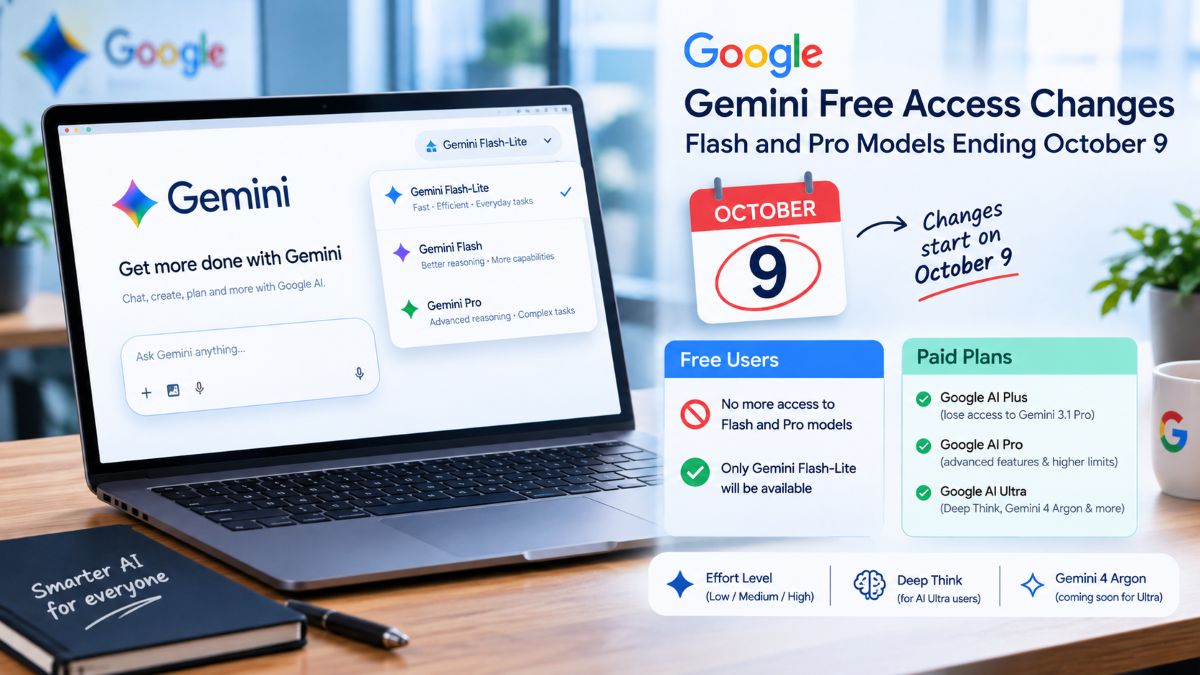
Google Gemini Free Access Changes: Flash and Pro Models Ending October 9
Google is preparing to change how people access its Gemini AI platform, with major differences coming for users who rely on the service without a paid subscription. Starting October 9, free Gemini users will lose direct access to the Gemini Flash and Pro models and will instead use Gemini Flash-Lite for their regular prompts.
The change could affect users who depend on Gemini for writing, research, coding, studying and other AI-powered tasks. While Flash-Lite is designed to provide efficient everyday assistance, users looking for more advanced capabilities may need to consider one of Google’s paid AI plans.
What Is Changing for Free Gemini Users?
Google’s upcoming update will simplify model access for people using Gemini without a subscription.
Currently, users can choose between different Gemini models from the model selection menu. After October 9, free users will no longer have access to Gemini Flash and Pro through the same options.
Instead, their requests will be handled by Gemini Flash-Lite, Google’s more cost-efficient model.
The change means free users may still be able to use Gemini for everyday questions, writing tasks and general assistance, but advanced model access will become more limited.
Gemini Flash-Lite Will Become the Main Free Model
Gemini Flash-Lite is positioned as a lightweight and cost-effective model within Google’s Gemini lineup.
It is designed for situations where users need fast responses without requiring the highest level of reasoning or processing power.
For everyday activities such as generating ideas, summarizing information, drafting text or asking general questions, the model may be sufficient. However, users who regularly work with complex instructions or demanding projects could notice a difference compared with higher-tier models.
What Happens to Gemini Flash and Pro?
Gemini Flash offers capabilities beyond the lightweight Flash-Lite experience, while Gemini Pro is aimed at more demanding tasks that require stronger reasoning.
Pro is particularly useful for activities involving complex mathematics, coding and large amounts of information across different formats.
With the upcoming change, free users will no longer be able to select these models in the same way. This could be especially important for students, developers, researchers and professionals who use Gemini for more complicated workflows.
Paid Google AI Plans Will Also See Changes
The changes are not limited to free users.
Google AI Plus subscribers will also lose access to the Gemini 3.1 Pro model under the new model-access structure.
Google’s paid plans are designed to provide users with greater access to more capable AI models and higher usage limits.
For people who depend on advanced Gemini features for coding, research or document analysis, upgrading to a higher-level subscription may become more attractive.
Google AI Pro and AI Ultra Offer More Advanced Access
Google AI Pro is positioned as a higher-tier subscription for users who need more advanced Gemini capabilities.
The plan is aimed at people who use AI for demanding tasks such as coding, studying, research and working with large collections of documents or other media.
Google AI Ultra sits above the Pro tier and provides higher usage limits along with access to Google’s most advanced capabilities.
For heavy AI users, the difference between free and paid plans could therefore become more significant following the October 9 changes.
New “Effort Level” Settings Are Coming
Alongside the model-access changes, Google is introducing new effort level controls.
Users will be able to select different levels of effort, including:
- Low
- Medium
- High
The idea is to allow users to decide how much processing effort Gemini should use when answering a request.
A higher effort level can produce more thorough responses for demanding tasks, but it can also consume more of a user’s available usage allowance.
This gives users greater control over how they use their Gemini limits.
AI Ultra Users Get a Deep Think Option
Google is also offering an additional option for AI Ultra subscribers.
The Deep Think setting is intended for users who want Gemini to use its strongest reasoning capabilities for particularly challenging tasks.
This could be useful for complex problems where a quick response is less important than deeper analysis.
However, access to these advanced capabilities will remain connected to Google’s higher subscription tier.
Gemini 4 Argon Is Also Coming
Google says AI Ultra subscribers will eventually receive access to Gemini 4 Argon when the model becomes generally available.
At present, the model is limited to Google’s Fairwind Program for governments and trusted partners.
Its broader release could give Ultra subscribers access to another advanced Gemini capability as Google’s AI model lineup continues to expand.
What Does This Mean for Gemini Users?
The biggest takeaway is that Google’s free Gemini experience is becoming more limited when it comes to advanced models.
For casual users, the change may not make a major difference. Flash-Lite should continue to handle many everyday AI requests.
However, people who use Gemini for advAs competition in the AI industry continues to grow, other companies are also introducing advanced models for coding, cybersecurity, multimodal tasks, and enterprise use. Mistral Large 4 is one example of this growing generation of advanced AI modelsanced coding, complex mathematics, research or extensive document analysis may need to consider a paid plan.
The change also shows how major AI companies are increasingly separating basic AI access from premium models with stronger reasoning and higher usage limits.
Should Free Gemini Users Upgrade?
Whether an upgrade is necessary will depend on how someone uses Gemini.
If you mainly use the chatbot for simple questions, writing assistance, brainstorming or basic summaries, the free experience may still be enough.
On the other hand, users who regularly depend on advanced reasoning, coding support or large-file analysis may benefit from access to higher-tier models.
Before upgrading, users should consider how frequently they use Gemini and whether the additional capabilities justify the subscription cost.
Google Is Moving Toward a More Tiered AI Experience
Google’s latest Gemini changes highlight a broader trend across the AI industry: free users receive access to essential capabilities, while more powerful models and higher limits are increasingly placed behind subscriptions.
The October 9 update will make Gemini Flash-Lite the main model for free users while giving paying customers access to different levels of advanced functionality.
For users, the important question will be whether the free model meets their needs or whether advanced AI capabilities are worth paying for.
As Google’s Gemini ecosystem continues to evolve, model performance, usage limits and subscription benefits are likely to remain important factors for anyone choosing an AI assistant.
