
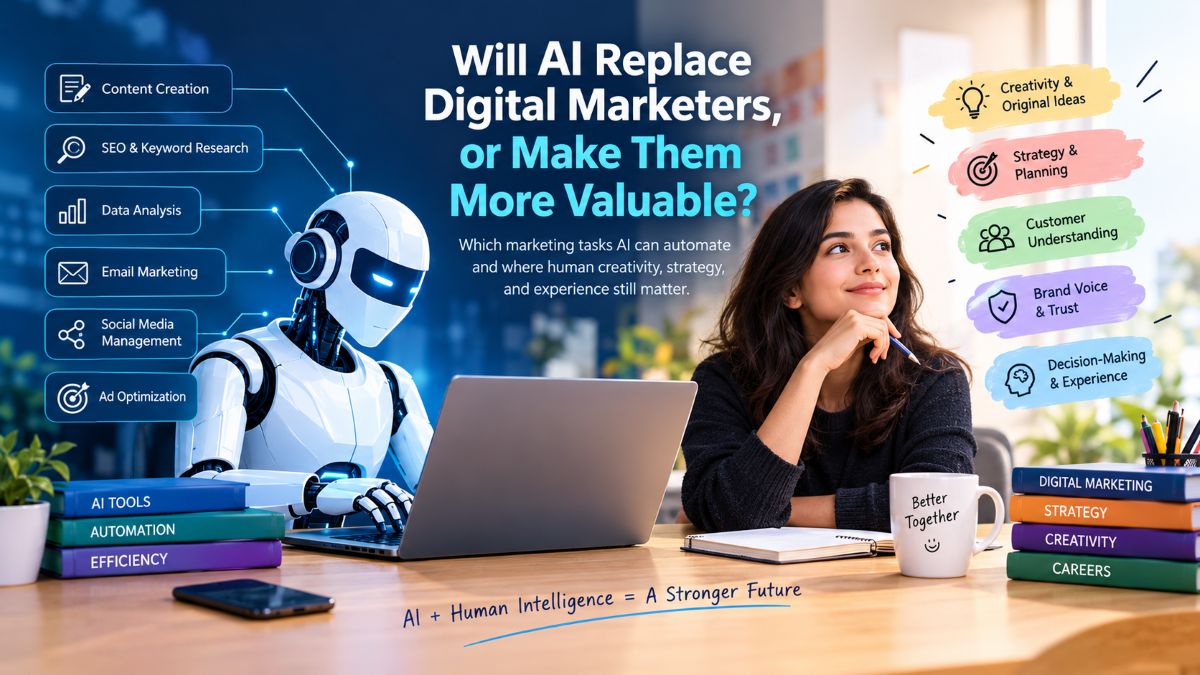
Will AI Replace Digital Marketers, or Make Them More Valuable?
Artificial intelligence (AI) is transforming the way businesses approach digital marketing. From content creation and search engine optimization (SEO) to paid advertising and customer data analysis, AI-powered tools are helping marketers complete tasks faster and make more informed decisions. As these technologies continue to evolve, an important question arises: Will AI replace digital marketers, or will it make their skills more valuable?
The answer is more complex than a simple yes or no. AI can automate many repetitive marketing tasks, but successful marketing also requires creativity, strategic thinking, emotional intelligence, and a deep understanding of customer behavior. The future of digital marketing will likely favor professionals who know how to combine AI technology with human expertise.
How AI Is Changing Digital Marketing
Traditional digital marketing often involves hours of research, content development, campaign monitoring, and performance reporting. AI is changing these workflows by helping marketers process information, generate ideas, identify patterns, and automate routine activities.
For example, marketers can use AI to analyze search trends, develop content outlines, generate advertising variations, segment audiences, and summarize campaign results. Tasks that once required considerable manual effort can now be completed more efficiently with the right tools and human oversight.
However, efficiency alone does not guarantee success. Marketers must still determine whether the information is accurate, whether the content meets audience needs, and whether a campaign supports the company’s business objectives.
AI is transforming not only digital marketing but also business operations and economic growth. Understanding the broader impact of artificial intelligence on the global economy can help businesses recognize how emerging technologies are changing industries and creating new opportunities.
Marketing Tasks AI Can Automate
AI is particularly useful for tasks that involve repetitive processes, large amounts of data, or structured workflows. Understanding these capabilities helps marketers identify where automation can improve productivity.
1. Content Research and Creation
AI tools can help generate blog topic ideas, create article outlines, draft social media captions, and suggest content improvements. They can also summarize research materials and help marketers organize information.
However, AI-generated content still requires human review. Marketers need to verify facts, add original insights, maintain a consistent brand voice, and ensure that the final content provides genuine value to readers.
2. SEO and Keyword Research
AI can support keyword clustering, search intent analysis, content gap identification, and on-page SEO recommendations. These capabilities can help marketers organize keyword research and identify potential content opportunities.
Nevertheless, SEO success depends on more than keywords. Search intent, content quality, website performance, internal linking, competition, and user experience all influence how effectively a website serves its audience. Human expertise remains important when turning research into a practical SEO strategy.
3. Data Analysis and Performance Reporting
Digital marketing campaigns generate data from website visits, search impressions, clicks, conversions, and advertising platforms. AI can help analyze these datasets, identify patterns, and summarize performance.
Instead of spending excessive time preparing reports, marketers can focus on interpreting the results and deciding what to improve. The quality of those decisions still depends on accurate data, appropriate measurement, and business context.
4. Email Marketing and Personalization
AI can assist with audience segmentation, email subject line suggestions, message personalization, and campaign timing. It can also help marketers develop different messages for customers at different stages of the buying journey.
Human oversight is still necessary to ensure that personalization feels relevant, respects customer privacy, and reflects the brand’s communication standards.
5. Paid Advertising and Social Media Management
AI-powered advertising platforms can help optimize bids, identify audience patterns, test creative variations, and recommend budget adjustments. Social media tools can also assist with post scheduling, caption generation, and content planning.
Yet marketers must still decide what the brand should communicate, which audiences matter most, how much risk is acceptable, and whether campaign performance supports broader business goals.
Why Human Creativity Still Matters
Although AI can generate content and recommendations, marketing is not simply a process of producing words or analyzing numbers. Strong marketing connects a brand with real people through meaningful messages and useful experiences.
Original Thinking and Storytelling
AI can generate multiple ideas in seconds, but marketers must determine which ideas are distinctive, relevant, and appropriate for their audience. Human experience and creative judgment help transform ordinary information into memorable brand stories.
Emotional Intelligence
Customers make decisions based on a combination of practical needs, personal preferences, emotions, and trust. Understanding these motivations requires empathy and careful interpretation of human behavior.
Brand Identity and Communication
Every business has its own values, voice, positioning, and audience expectations. Human marketers help ensure that campaigns communicate these characteristics consistently across websites, social media, email, and advertising channels.
Strategic Decision-Making
AI can recommend actions based on available data, but recommendations are not the same as strategy. Marketers must evaluate market conditions, competitors, company resources, customer expectations, and long-term objectives before making important decisions.
Will AI Replace SEO Specialists and Content Marketers?
AI is changing SEO and content marketing, but it does not automatically eliminate the need for specialists. Instead, it is changing which skills are most valuable.
For SEO professionals, routine research and reporting may become more automated. Greater value may come from understanding search intent, developing content strategies, improving website architecture, evaluating technical issues, and measuring business outcomes.
Content marketers may spend less time producing initial drafts and more time conducting original research, interviewing experts, developing distinctive perspectives, editing content, and building audience trust.
The important distinction is between using AI to produce more content and using it to create better content. Publishing large volumes of generic material is not a reliable substitute for relevance, accuracy, originality, and usefulness.
How Digital Marketers Can Stay Competitive in the AI Era
Digital marketers do not need to compete with AI at every task. They need to understand where AI helps, where it falls short, and how to use it responsibly.
Here are six practical ways to remain valuable in the evolving marketing industry.
1. Learn Relevant AI Tools: Understand how AI can support content creation, keyword research, analytics, advertising, and workflow automation.
2. Strengthen Strategic Thinking: Learn to connect marketing activities with business goals, customer needs, revenue, and long-term growth.
3. Develop Analytical Skills: Go beyond reporting numbers. Learn to interpret data, identify meaningful trends, and recommend measurable improvements.
4. Improve Creativity and Storytelling: Build the ability to develop original ideas, communicate clearly, and create content that reflects real audience needs.
5. Build Strong SEO Fundamentals: Understand search intent, technical SEO, content quality, internal linking, website usability, and performance measurement instead of relying entirely on automated recommendations.
6. Practice Human Oversight: Check AI-generated information for factual errors, unsupported claims, repetitive language, and potential privacy concerns before using it in campaigns.
Marketers who combine these skills can use AI to increase efficiency while maintaining quality and accountability.
The Future of Digital Marketing: Human Skills and AI Working Together
The future of digital marketing is likely to involve closer collaboration between people and intelligent tools. AI will continue to support research, automation, personalization, and analysis, while human professionals will guide the creative and strategic decisions that shape successful campaigns.
This shift may also change the expectations employers have of marketing professionals. Rather than valuing only the ability to perform repetitive tasks, businesses may increasingly prioritize adaptability, critical thinking, communication, data literacy, and the ability to turn AI-assisted work into measurable results.
For beginners, this creates an opportunity to learn AI tools alongside core marketing principles. For experienced marketers, it provides a reason to strengthen strategic and analytical abilities while reconsidering time-consuming workflows.
AI will not make every marketing role more valuable automatically. Professionals who rely entirely on routine tasks may face greater pressure to adapt. Those who continuously learn, exercise sound judgment, and understand the needs of customers and businesses will be better positioned to respond to change.
Conclusion
Will AI replace digital marketers, or make them more valuable? AI will automate some marketing activities and reshape others, but the future of the profession depends on how people adapt to these changes.
AI can accelerate research, generate initial content, analyze data, and support campaign optimization. Human marketers bring creativity, empathy, strategic thinking, accountability, and contextual understanding to the process.
The strongest approach is not to choose between human intelligence and artificial intelligence. It is to combine their strengths.
AI can help marketers work faster, but human expertise helps ensure they are working toward the right goals. Digital marketers who embrace AI while continuously improving their own skills can remain relevant and create greater value for businesses in the years ahead.
Tags: AI, Marketing, Digital Marketing, Artificial Intelligence, Careers
