
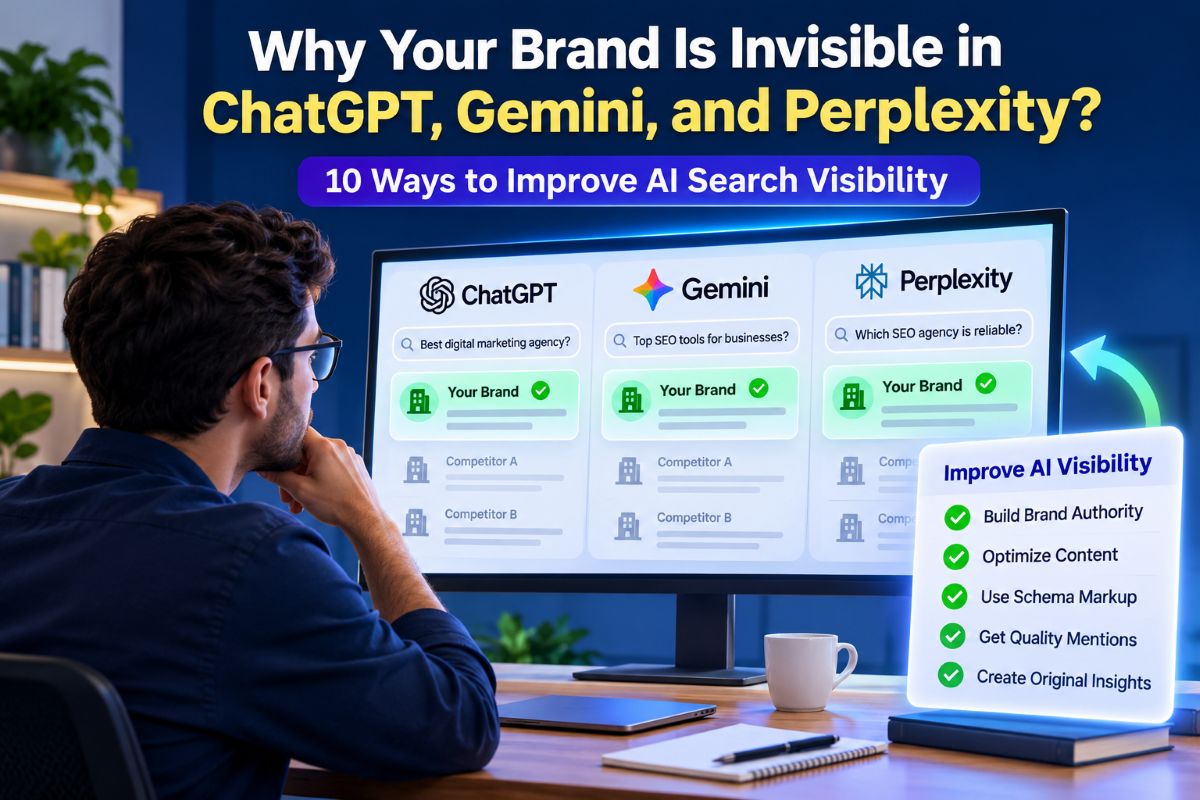
Why Your Brand Is Invisible in ChatGPt, Gemini, and Perplexity: 10 Ways to Improve AI Search Visibility
Introduction
The way people discover businesses online is changing. Instead of relying exclusively on traditional search engines, users increasingly ask AI-powered platforms such as ChatGPT, Google Gemini, and Perplexity for recommendations, product comparisons, business information, and expert advice.
This shift creates a new challenge for businesses: a website can rank in traditional search results but still remain absent from AI-generated answers. When users ask an AI platform to recommend a service provider or explain a topic, only a selection of available sources and brands may appear in the response.
AI search visibility refers to how frequently and accurately a business appears in AI-generated answers, recommendations, and cited sources. Improving this visibility requires more than adding keywords to website pages. Businesses need clear information, useful content, credible references, consistent brand details, and a technically accessible website.
Understanding why your brand is missing from ChatGPT, Gemini, or Perplexity is the first step toward building a stronger digital presence. This guide explains the most common causes of low AI visibility and provides practical strategies to help businesses improve their chances of being discovered.
Key Takeaways
- Traditional search rankings do not guarantee visibility in AI-generated answers.
- Clear website content helps AI systems understand your business, products, services, and expertise.
- Consistent business information and credible third-party mentions can strengthen brand recognition.
- Structured data can clarify relationships between your organization, website, services, and authors.
- Original research, helpful comparisons, and evidence-based explanations make content more valuable to readers and potential citations.
- Technical accessibility, relevant content updates, and ongoing monitoring are important parts of an AI visibility strategy.
- Small businesses can compete by developing focused expertise and publishing genuinely useful information.
1. Your Brand Has Not Established Enough Online Trust
One possible reason your brand does not appear in AI-generated answers is that your online presence provides limited evidence of credibility.
AI-powered search experiences may draw information from multiple sources, depending on the platform, query, and available retrieval mechanisms. If your website is the only place where your business is mentioned, users and automated systems may have fewer independent sources to verify your expertise.
A professional-looking website is a useful starting point, but it should be supported by accurate company information, real customer feedback, relevant professional experience, and evidence of successful work.
What Trust Signals Should Your Brand Build?
Businesses should focus on developing a consistent and verifiable digital presence.
Important trust signals include:
- Genuine customer reviews and testimonials.
- Detailed service pages explaining what the business provides.
- Author biographies that demonstrate relevant expertise.
- Case studies with clear methods and measurable results.
- Accurate company contact information.
- Relevant media coverage and industry references.
- Consistent business profiles across reputable platforms.
- Transparent editorial policies and reliable supporting sources.
For example, a digital marketing agency that publishes detailed case studies, explains its methodology, and maintains consistent company information gives prospective customers more useful evidence than an agency website containing only promotional claims.
However, no individual trust signal guarantees inclusion in AI responses. The goal is to establish a credible online presence that supports both human decision-making and machine understanding.
How to Improve Brand Credibility
Start by reviewing your website’s About, Contact, Services, and author pages. Make sure they explain who you are, what you do, whom you serve, and why customers should trust your business.
Then review your external business profiles and correct outdated or inconsistent details. Encourage satisfied customers to leave honest reviews without purchasing or fabricating feedback.
2. Your Business Is Missing From Relevant Third-Party Sources
Publishing content on your own website is important, but it does not always provide enough independent context for people researching your brand.
AI search platforms may use external sources when answering questions about companies, comparing services, or recommending products. If your business is absent from relevant industry publications, comparison pages, professional discussions, and review platforms, its wider reputation may be difficult for potential customers to evaluate.
Which External Sources Matter?
Focus on platforms that are genuinely relevant to your industry and audience, including:
- Established industry publications.
- Reputable review websites.
- Professional associations and directories.
- Relevant podcasts and interviews.
- Independent product or service comparisons.
- Expert discussions and professional communities.
- Credible news websites.
- Research reports and industry studies.
- Relevant business profiles and professional networks.
The objective is not to place your brand everywhere on the internet. Instead, prioritize sources that provide meaningful information about your business and reach the people you want to serve.
How to Build a Stronger External Presence
Create useful resources that publishers and industry professionals have a reason to reference. Original research, expert commentary, detailed case studies, and practical guides can provide value beyond a standard promotional article.
You can also contribute knowledgeable answers to relevant industry discussions and collaborate with credible publishers.
Avoid buying fake reviews, creating artificial discussions, or publishing large numbers of low-quality guest posts solely to generate brand mentions. These tactics can damage credibility and do not guarantee better AI visibility.
3. Your Website Content Is Difficult to Understand
Even a technically accessible website can struggle to communicate its value if its content is vague, disorganized, or unnecessarily complicated.
AI-powered systems that retrieve and summarize web content need to identify the main subject, understand the relationships between ideas, and locate information relevant to a user’s question. Clear writing makes these tasks easier while also improving the reading experience.
For example, consider these two statements:
Unclear statement:
“We provide innovative solutions that help modern businesses achieve better outcomes in an increasingly competitive digital environment.”
Clear statement:
“Our SEO services help businesses improve website structure, target relevant search queries, and create content that addresses customer needs.”
The second statement explains the service more directly. It gives readers a clearer understanding of what the company does.
How to Make Website Content Easier to Understand
Use these content principles:
- Answer the main question near the beginning of each section.
- Use descriptive headings that explain the section’s purpose.
- Keep paragraphs focused on one main idea.
- Define technical terms when introducing them.
- Use numbered steps for processes.
- Use tables when comparing features or options.
- Support important claims with relevant evidence.
- Remove repetitive introductions and unnecessary filler.
- Explain the practical implications of complex topics.
Use Question-Based Headings Naturally
Question-based headings can align your content with the way people seek information through conversational search.
Examples include:
- Why Is My Business Not Appearing in ChatGPT?
- How Can I Improve My Brand’s AI Search Visibility?
- Does Schema Markup Help AI Search?
- How Can Small Businesses Build Brand Authority?
- What Is the Difference Between SEO and Generative Engine Optimization?
These headings should reflect questions your audience genuinely asks. Adding questions that the article does not answer will not improve its usefulness.
4. Your Website Lacks Clear Structured Data and Entity Information
Search engines and other automated systems need to understand what a website represents. Structured data can help communicate information about an organization, an article, a product, a service, an author, and other supported entities.
Schema markup uses standardized formats, commonly JSON-LD, to describe information on a page. When implemented correctly, it can clarify details that might otherwise be harder to interpret from page content alone.
However, structured data is not a direct guarantee of inclusion in ChatGPT, Gemini, or Perplexity. Different AI platforms use different systems, and not every platform relies on website schema in the same way.
Which Schema Types Should You Consider?
| Schema type | Potential purpose |
|---|---|
| Organization | Identifies a company and relevant organizational details. |
| WebSite | Describes the website and its identity. |
| Article | Communicates information about an article or blog post. |
| Person | Describes an author or other person. |
| Product | Provides supported product details. |
| LocalBusiness | Describes eligible local businesses and their details. |
| Service | Describes a service when the relevant schema properties are supported. |
| BreadcrumbList | Represents a page’s position in the website hierarchy. |
Choose schema based on the actual content of each page. Do not add irrelevant schema types or mark up information that users cannot verify on the page.
How to Improve Entity Clarity
Keep your business name, official website, logo, contact information, and service descriptions consistent across your website and relevant external profiles.
Create a detailed About page and clearly connect authors with their published work. Where appropriate, use valid structured data to represent these relationships.
Validate your implementation with available structured-data testing tools and correct errors before deploying changes.
5. Your Content Does Not Provide Enough Citation Value
A page can contain relevant keywords and still offer little reason for another source to reference it.
Citation-worthy content helps answer a question accurately, supplies useful evidence, explains a process, or provides information that is difficult to find elsewhere. AI-generated answers may cite sources that contribute directly to answering the user’s question, although citation decisions vary by platform.
Content that repeats general advice without examples, evidence, or meaningful detail may have difficulty distinguishing itself from competing pages.
What Makes Content More Useful as a Source?
Consider including the following elements:
- Clear definitions of important concepts.
- Original research and documented findings.
- Verified statistics with publication dates and sources.
- Practical examples and case studies.
- Step-by-step instructions.
- Comparisons that explain meaningful differences.
- Expert analysis supported by evidence.
- Updated information about changing products or services.
- FAQs that address specific audience questions.
For example, instead of writing only that website speed is important, explain how to measure page performance, identify common technical bottlenecks, and prioritize improvements based on their likely impact.
Whenever you publish statistics, identify the original source and avoid presenting estimates as established facts. If you use internal business data, explain how it was collected and what its limitations are.
The stronger your content’s practical value, the more useful it becomes to readers, publishers, and systems that retrieve information to answer specific questions.
6. Your Brand Identity Is Inconsistent Across the Internet
AI search visibility can be affected when publicly available information about a business is inconsistent or ambiguous.
For example, your website might use one company name, a professional directory might display another, and an outdated social profile might point to an unrelated domain. These inconsistencies can make it harder for customers to determine which information is authoritative.
Similar problems arise when businesses have several websites, duplicate profiles, unclear service descriptions, or outdated contact details.
How to Strengthen Brand Identity
Follow these steps:
- Establish one official business name and use it consistently.
- Maintain an accurate and accessible About page.
- Link to official social and professional profiles from your website where appropriate.
- Keep contact details and service descriptions current.
- Review duplicate or outdated business listings.
- Clearly identify authors and contributors.
- Use consistent logos and brand descriptions across relevant channels.
- Ensure that external references point to the correct website.
If your company has multiple locations, create accurate location information for each eligible branch. Avoid creating misleading profiles or pages for locations where your business does not genuinely operate.
A consistent identity helps customers recognize your business and provides clearer context for automated systems attempting to connect related information.
7. Your Website Has Technical Accessibility Problems
Content quality cannot compensate for every technical issue. If important pages cannot be crawled, accessed, or rendered properly, the information they contain may be less discoverable.
Different AI platforms use different combinations of search indexes, retrieval systems, and automated crawlers. Their access requirements are not identical, so technical checks should be based on the platform you want to reach.
Common Technical Issues That Deserve Attention
Blocked crawling: Robots directives, access controls, or server rules may prevent some automated systems from accessing public pages.
Incorrect indexing directives: An unintended noindex directive can prevent a page from being indexed by search engines that respect it.
Broken internal links: Important pages may be difficult to discover if links are missing or lead to errors.
Server errors: Repeated 5xx errors, timeouts, or unreliable hosting can interfere with page access.
JavaScript-dependent content: Some systems may have difficulty accessing important information that appears only after complex client-side processing.
Poor mobile usability: Difficult navigation and unreadable layouts can reduce the usefulness of a page for visitors.
Duplicate or canonicalization problems: Conflicting URL versions can complicate the identification of the preferred page.
How to Audit Technical Accessibility
Start with Google Search Console to investigate indexing problems and review important pages. Check your XML sitemap, canonical tags, robots directives, server responses, and internal links.
Review the official documentation for the AI platform you are targeting before changing crawler permissions. Allow only the access that makes sense for your business and privacy requirements.
Do not expose private dashboards, customer records, or restricted content merely to increase AI visibility. Public discoverability should apply only to information intended for public access.
8. Your Content Strategy Is Too Broad or Repetitive
Businesses sometimes publish articles on many unrelated topics without establishing clear expertise in any particular area. Others produce dozens of similar pages that answer essentially the same question.
This approach can create a fragmented website with limited depth, overlapping keywords, and few resources that comprehensively address customer needs.
A focused content strategy can help your website demonstrate meaningful knowledge about a defined subject area.
Build Topic Clusters Around Customer Needs
Suppose your business provides SEO services. Rather than publishing unrelated articles about every marketing trend, organize your content around connected topics.
A useful structure might include:
Pillar page: A comprehensive guide to search engine optimization.
Supporting articles:
- Technical SEO audit checklist.
- On-page SEO best practices.
- Internal linking strategies.
- Keyword research for service businesses.
- SEO content planning.
- Website indexing troubleshooting.
- Measuring organic search performance.
Link these articles together where the connections are relevant. Each page should provide distinct value rather than repeating the same explanations.
How Topical Depth Helps
A well-organized topic cluster gives readers multiple ways to explore a subject. It also helps search engines understand the relationships between related pages.
For AI visibility, the practical advantage is that your website can provide detailed answers to a broader set of relevant questions within your area of expertise.
However, publishing more articles does not automatically improve visibility. Prioritize accuracy, originality, and completeness instead of content volume alone.
9. Your Brand Is Not Publishing Original Insights
Many websites compete by rewriting information that already appears across the internet. Although summaries and introductory guides can be useful, repeated information alone gives readers fewer reasons to choose one source over another.
Original insights can make your website more distinctive and provide information that other publishers may find worth referencing.
Examples of Original Content You Can Publish
Depending on your industry and available resources, consider creating:
- Original customer surveys.
- Industry benchmark reports.
- Expert interviews.
- Documented case studies.
- Product testing and comparisons.
- Firsthand tutorials.
- Data visualizations based on verified datasets.
- Analysis of publicly available industry trends.
- Research into recurring customer problems.
For example, an SEO agency could publish a case study documenting how it improved the technical performance of a website. The report could explain the initial problems, the changes made, the measurement period, and the results.
The findings should be accurate and appropriately qualified. Do not invent research, customer results, or performance statistics to make an article appear authoritative.
Turn Expertise Into Useful Resources
Ask your team which questions customers repeatedly raise. Identify which answers require experience, testing, or detailed explanation rather than a simple summary.
Develop those answers into resources with practical examples and supporting evidence. This approach can improve your content’s value even when you do not have the budget to conduct large-scale research.
10. You Are Not Measuring AI Search Visibility
Without monitoring, it is difficult to determine whether your AI visibility efforts are producing meaningful results.
Traditional SEO reports track metrics such as organic clicks, impressions, rankings, and conversions. These remain valuable, but they do not fully describe how a brand appears in AI-generated answers.
AI visibility requires additional checks that consider brand mentions, citations, recommendation context, and the accuracy of the information presented.
What Should You Measure?
| Metric | What it tells you |
|---|---|
| Brand mention frequency | How often your business appears in a defined set of AI responses. |
| Citation frequency | How often your website is linked or cited in those responses. |
| Share of visibility | How your brand compares with selected competitors across the same prompts. |
| Mention accuracy | Whether AI responses describe your business correctly. |
| Source-page performance | Which pages appear most often in relevant AI citations. |
| Referral traffic | Visits attributed to identifiable AI platforms where analytics can measure them. |
| Conversions | Leads, sales, or other meaningful outcomes associated with relevant visits. |
| Search performance | Organic impressions, clicks, and indexing trends from traditional search tools. |
Create a Repeatable AI Visibility Test
Build a list of questions your potential customers might ask. For example:
- Which SEO agencies help small businesses?
- What should I look for when choosing an SEO provider?
- Which tools can help diagnose technical SEO issues?
- How do I improve organic visibility for a service business?
- What are the differences between SEO, AEO, and GEO?
Run the same prompts periodically across ChatGPT, Gemini, and Perplexity. Record which brands appear, which sources are cited, whether your company is mentioned accurately, and how the results change over time.
AI responses can vary with the query, date, available sources, location settings, and other factors. Use consistent testing conditions and evaluate patterns across multiple prompts instead of drawing conclusions from a single response.
A Practical 30-Day Plan to Improve AI Search Visibility
Improving visibility is an ongoing process, but a structured first month can help you identify and address the most important problems.
Week 1: Audit Your Brand and Website
- Review your homepage, About page, and main service pages.
- Check that your company name and contact information are consistent.
- Identify outdated pages and unclear service descriptions.
- Review indexing status, internal links, and technical accessibility.
- Record your current AI visibility for a selected set of customer questions.
Goal: Establish a baseline and identify the most significant weaknesses.
Week 2: Improve Existing Content
- Rewrite vague introductions with direct answers.
- Improve heading hierarchy and paragraph structure.
- Add useful examples and evidence.
- Create comparison tables where appropriate.
- Update outdated facts and remove unsupported claims.
- Add relevant internal links between connected articles.
Goal: Make important pages more useful, clear, and easy to navigate.
Week 3: Strengthen Authority and Brand Consistency
- Review relevant professional profiles and business directories.
- Correct inaccurate external business information.
- Request honest customer feedback through appropriate channels.
- Identify credible industry publications and relevant partnership opportunities.
- Develop a plan for original research, expert commentary, or case studies.
Goal: Build a more credible and consistent presence beyond your website.
Week 4: Validate, Publish, and Measure
- Review structured data and correct implementation errors.
- Check website access using relevant platform documentation.
- Publish or improve a resource that answers an important customer question.
- Repeat your AI visibility tests using the same prompts.
- Compare brand mentions, citations, website traffic, and conversions with your baseline.
Goal: Identify which changes deserve further investment.
At the end of the month, prioritize the improvements that address clear problems. Continue monitoring results instead of assuming that every optimization will produce an immediate increase in AI citations.
SEO vs. AEO vs. GEO: What Is the Difference?
The terms SEO, AEO, and GEO are often used when discussing search visibility, but they describe overlapping areas of work.
| Approach | Primary focus | Examples of activities |
|---|---|---|
| SEO | Improving discoverability in traditional search engines. | Technical optimization, relevant content, internal linking, and keyword research. |
| AEO | Making information useful and accessible for direct answers. | Clear definitions, question-focused content, concise explanations, and structured answers. |
| GEO | Improving the chances of content being represented or cited in generative AI responses. | Original research, clear content structure, credible references, and monitoring AI citations. |
These are useful working distinctions rather than completely separate disciplines. Many activities support more than one approach.
For example, improving page accessibility can support SEO and make content easier for other systems to retrieve. Publishing a well-researched guide can serve traditional search users while also providing information that may be useful in AI-generated answers.
The best strategy combines technical reliability, audience-focused content, credible evidence, and measurement rather than treating each acronym as an isolated marketing channel.
Common Mistakes That Can Hurt AI Search Visibility
Businesses looking to appear in AI answers sometimes adopt tactics that create more work without solving the underlying problem.
Publishing Large Volumes of Low-Quality Content
Producing many similar articles can dilute the quality of a website. Focus on answering meaningful questions with original, accurate information.
Stuffing Keywords Into Every Paragraph
Repeatedly inserting phrases such as “ChatGPT SEO,” “AI search optimization,” or “GEO services” can make content unnatural. Use relevant terminology where it helps explain the subject.
Buying Fake Reviews or Brand Mentions
Artificial reputation signals can undermine customer trust. Build genuine relationships and seek authentic feedback instead.
Treating Schema Markup as a Guarantee
Valid structured data helps describe content but does not guarantee indexing, rankings, AI citations, or recommendations.
Ignoring Traditional SEO
AI-powered discovery does not make website accessibility, useful content, technical health, and conventional search performance irrelevant.
Expecting Immediate Results
AI search systems and their source selection can change. Improvements in content and reputation may take time to be reflected in visibility reports, and some changes may not produce measurable results.
Frequently Asked Questions
Why Is My Brand Not Showing Up in ChatGPT?
Your brand may have limited public information, unclear business details, weak topical relevance, or insufficient visibility in sources relevant to a user’s question. Technical access and the way ChatGPT retrieves information for a particular response can also matter. Review your website, external references, and performance across a consistent set of relevant prompts.
How Can I Get My Website Cited by Perplexity?
Create accurate, relevant, well-structured pages that directly answer useful questions. Support factual claims with credible sources, make important pages accessible, and publish information that provides genuine value. Perplexity’s source selection depends on the specific query and its retrieval process, so no particular format guarantees a citation.
Does Google Ranking Guarantee Visibility in Gemini?
No. Strong organic search performance can support discoverability, but it does not guarantee that a website or brand will appear in every Gemini response. Visibility depends on the query, available information, retrieval mechanisms, and the context of the answer.
Does Schema Markup Improve AI Search Visibility?
Schema markup can help eligible systems interpret information about your organization, pages, products, and other entities. However, its effects vary by platform, and adding schema alone does not guarantee AI citations or recommendations.
Can Small Businesses Compete With Larger Brands in AI Search?
Yes, although results are not guaranteed. Smaller businesses can focus on specific customer needs, demonstrate firsthand expertise, publish original information, maintain accurate business profiles, and earn genuine mentions from relevant sources. Specialization can help a business become a useful resource within its niche.
How Often Should I Check AI Search Visibility?
A monthly review is a reasonable starting point for many businesses, with more frequent checks for fast-changing industries or important commercial queries. Use consistent prompts and record changes in mentions, citations, accuracy, and referral traffic.
What Is the Difference Between an AI Mention and an AI Citation?
An AI mention occurs when a response names or describes your brand. An AI citation generally means the response references a source, often through a link. A company can be mentioned without a link, and a website can be cited without its brand being recommended. Tracking both provides a more complete picture of visibility.
Should I Create Separate Content for Every AI Platform?
Usually, start by creating high-quality content for your audience rather than building separate versions for each platform. Focus on accuracy, accessibility, clear explanations, and useful evidence. Make platform-specific adjustments only when reliable documentation or measured results justify them.
Conclusion
A brand that does not appear in ChatGPT, Gemini, or Perplexity may need to improve several areas of its digital presence. The problem could involve unclear website content, limited external references, inconsistent business information, technical accessibility, or a lack of useful material that directly answers customer questions.
There is no single optimization technique that guarantees inclusion in AI-generated answers. Instead, businesses should build a strong foundation through useful content, technical reliability, consistent brand information, credible references, and ongoing measurement.
Start by identifying the questions your customers ask most often. Check whether your website answers those questions clearly, whether the supporting information is accurate, and whether relevant sources provide a consistent picture of your business.
For more updates on artificial intelligence and technology, explore the latest news and insights on TimesScopeJournal.
Then measure your progress across traditional search and AI-powered platforms. By improving the quality and clarity of your online presence over time, you can give potential customers more opportunities to discover your brand while building a stronger foundation for long-term search visibility.
