
OpenAI Expands ChatGPT Advertising With Visual Ads and Advanced Brand Safety Tools
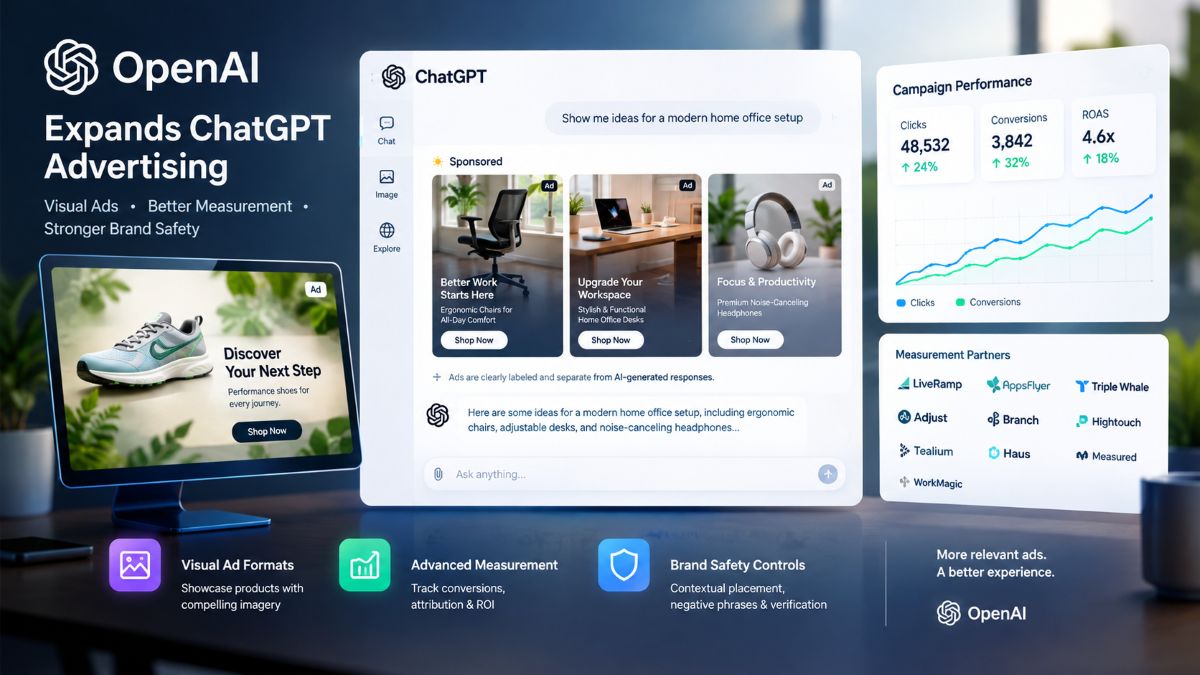
OpenAI Expands ChatGPT Advertising as the company introduces new visual ad formats, marketing measurement integrations, and brand safety controls. Announced on October 5, 2026, the expansion highlights OpenAI’s efforts to develop advertising as a revenue source while maintaining a clear distinction between sponsored content and AI-generated responses.
The new advertising capabilities are designed to help businesses showcase products, measure campaign performance, and reach relevant audiences within ChatGPT. The move also raises important questions about user experience, advertising transparency, and the future of AI-powered digital marketing.
OpenAI Introduces Visual Advertising in ChatGPT
OpenAI is expanding its advertising capabilities with image-based formats designed to appear alongside ChatGPT’s image-generation experience. According to the announcement, initial testing is planned for selected advertisers in the United States later in October 2026.
Unlike conventional text advertisements, visual ad formats can help brands communicate product features, demonstrate how products are used, and provide customers with visual inspiration. This approach could be particularly useful for retail businesses, consumer products, lifestyle brands, and other companies that depend on visual presentation.
The distinction between advertising and AI-generated content remains central to the new format. OpenAI says advertisements will be clearly labeled and separated from generated results, helping users identify promotional material rather than confuse it with an AI response.
How Visual Ads Could Change the Advertising Experience
Visual advertising could make product discovery more interactive by allowing brands to present relevant imagery in an environment where users already explore ideas and ask questions.
For example, a customer researching home office equipment may benefit from discovering a desk accessory or ergonomic product through a clearly labeled advertisement. Similarly, a user exploring design inspiration could encounter visual promotions relevant to their interests.
However, the effectiveness of these formats will depend on relevance, presentation, and user trust. Ads that feel intrusive or unrelated to a conversation could undermine the experience, while transparent and useful promotions may offer value to both consumers and advertisers.
OpenAI Expands Its Advertising Measurement Partnerships
Measuring advertising performance is essential for businesses that need to understand whether campaigns generate meaningful results. OpenAI is expanding its advertising ecosystem through integrations and collaborations with third-party measurement, attribution, and analytics providers.
The companies identified in the announcement include LiveRamp, AppsFlyer, Triple Whale, Adjust, Branch, Hightouch, and Tealium. OpenAI is also working with analytics partners, including Haus, Measured, and WorkMagic, on measurement initiatives.
These integrations are intended to help advertisers connect campaign activity with outcomes such as conversions, customer acquisition, and sales performance.
Conversion Tracking and Campaign Attribution
Conversion tracking helps businesses determine whether an advertising campaign leads to a desired action, such as a purchase, registration, app installation, or qualified lead.
Attribution tools can help marketers connect clicks and other campaign interactions with subsequent customer actions. Depending on the integration and data available, businesses may gain a clearer understanding of which advertising activities contribute to their objectives.
This capability is especially important for companies comparing ChatGPT advertising with established channels such as search advertising, social media campaigns, and display advertising.
Measuring Incremental Business Growth
OpenAI has also described pilot programs focused on measuring incremental results, including geographic testing approaches. These methods aim to estimate whether advertising generates additional business outcomes beyond what might have happened without the campaign.
For advertisers, incremental measurement can be more informative than clicks or impressions alone. A campaign may attract attention without generating additional sales, so businesses need reliable ways to assess its actual contribution.
The announcement cited early results from participating brands, including WeightWatchers. However, individual pilot outcomes should not be treated as guarantees of future advertising performance.
New Brand Safety Controls Aim to Protect Users and Advertisers
Advertising inside a conversational AI platform creates challenges that differ from those associated with traditional websites and social networks. Conversations can involve sensitive personal circumstances, emotional difficulties, health concerns, and other topics where commercial messages may be inappropriate.
To address these risks, OpenAI has outlined contextual advertising controls designed to prevent ads from appearing alongside sensitive or emotionally vulnerable user prompts.
Negative Phrases and Contextual Restrictions
Eligible advertisers are expected to receive access to a feature called “Negative Phrases.” This tool is designed to help brands restrict ad appearances around specified terms.
For example, a company may want to avoid having its advertisements associated with particular sensitive subjects or contexts that conflict with its brand values.
Contextual restrictions can give advertisers greater control over where their campaigns appear. Nevertheless, effective brand safety requires more than keyword blocking because the meaning of a conversation often depends on context rather than individual words.
Independent Verification and Brand Protection
OpenAI has identified DoubleVerify and Integral Ad Science (IAS) in connection with independent verification pilots. Such partnerships can help support advertising quality, suitability assessment, and greater confidence in campaign placement.
For advertisers, independent verification can be an important part of evaluating whether campaigns meet agreed standards. The exact capabilities and coverage of these pilots will depend on their implementation and the services made available.
Maintaining clear advertising labels, appropriate placement restrictions, and dependable measurement will be essential as ChatGPT advertising develops.
Why ChatGPT Advertising Matters for Digital Marketing
The expansion of ChatGPT advertising reflects a broader change in how businesses may reach customers through AI-powered platforms. Consumers increasingly use conversational tools to research products, compare options, explore ideas, and seek recommendations.
For marketers, these behaviors create a potential opportunity to reach audiences in a new digital environment. However, advertising in conversational AI should not be viewed as a direct replacement for established marketing channels.
Businesses exploring AI-powered marketing can also learn how AI is transforming the global economy and creating new opportunities for digital businesses.
New Opportunities for Product Discovery
Visual advertisements may help businesses introduce products when users are exploring related ideas. Brands could potentially use this format to communicate product benefits, highlight distinctive features, and encourage further research.
The opportunity will depend on the availability of targeting options, advertising policies, campaign formats, and measurable outcomes. Businesses should evaluate these factors before allocating significant budgets to the channel.
Better Measurement for Marketing Decisions
Expanded measurement integrations could help advertisers compare campaign performance against business goals. Instead of relying exclusively on engagement metrics, marketers can assess indicators such as conversion rates, acquisition costs, and incremental sales when those measurements are available.
A balanced measurement strategy should also account for attribution limitations, customer privacy, and differences between advertising platforms.
Greater Importance of Transparency and Trust
Trust is particularly important in AI-powered conversations because users often expect answers to be relevant, helpful, and clearly presented.
OpenAI says advertising will remain separate from its conversational responses and will not influence the answers generated by ChatGPT. Preserving that distinction will be important for user confidence as the advertising ecosystem expands.
Clear labels and appropriate placement controls can help users distinguish commercial messages from ordinary AI-generated content.
How Advertisers Can Prepare for ChatGPT Ads
Businesses interested in exploring this advertising channel can take several practical steps before launching campaigns.
1. Define Clear Campaign Objectives
Determine whether the primary goal is product discovery, website traffic, lead generation, app installations, or direct sales. Clear objectives make it easier to evaluate campaign performance.
2. Prepare Strong Visual Assets
Brands considering image-based advertising should develop high-quality product images and creative materials that communicate benefits quickly. Visual assets should accurately represent the advertised product and follow the platform’s advertising requirements.
3. Establish Reliable Measurement
Where supported, connect suitable conversion and attribution tools before campaigns begin. Confirm which events can be tracked, how performance will be reported, and whether the available data supports meaningful comparisons.
4. Review Brand Safety Requirements
Identify sensitive subjects and placement contexts that could conflict with the brand. Advertisers should review available restrictions and verification options before committing substantial spending.
5. Compare Results With Other Channels
Evaluate ChatGPT campaigns alongside existing search, social, and display advertising efforts. Use consistent business objectives where possible, while recognizing that attribution methods and reporting capabilities may differ across platforms.
What OpenAI’s Advertising Expansion Means for the Future
OpenAI’s latest advertising developments suggest that conversational AI platforms are becoming a more significant consideration for digital marketers. Visual placements, measurement integrations, and brand safety controls could help make ChatGPT a more structured advertising environment for eligible businesses.
Still, long-term success will depend on factors that extend beyond the availability of new ad formats. Advertisers will need evidence of measurable results, while users will expect relevant experiences, clear disclosures, and appropriate protection for sensitive conversations.
The initial rollout will provide an opportunity to evaluate how visual advertising performs in practice. Its broader impact will become clearer as more advertisers participate and additional performance data becomes available.
Frequently Asked Questions
What are ChatGPT visual ads?
ChatGPT visual ads are image-based advertising formats designed to help businesses showcase products and services within the ChatGPT experience. The format described by OpenAI is intended to appear alongside its image-generation feature and remain clearly distinguished from AI-generated content.
When will OpenAI begin testing visual ads?
According to the October 5, 2026 announcement described in the source material, testing is planned to begin later in October for selected advertisers in the United States.
Will advertisements influence ChatGPT’s answers?
OpenAI says advertising content will remain separate from ChatGPT’s generated responses and will not influence those responses.
Which companies are involved in ChatGPT ad measurement?
The announcement identifies companies including LiveRamp, AppsFlyer, Triple Whale, Adjust, Branch, Hightouch, and Tealium, along with analytics partners such as Haus, Measured, and WorkMagic.
How will OpenAI address advertising brand safety?
The announced measures include contextual placement controls, a “Negative Phrases” feature for eligible advertisers, and independent verification pilots involving DoubleVerify and Integral Ad Science.
Conclusion
OpenAI’s expansion of ChatGPT advertising combines visual promotional formats with broader measurement capabilities and additional brand safety measures. These developments could create new opportunities for businesses seeking to reach audiences through AI-powered product discovery.
For advertisers, the priority should be to test the channel carefully, measure meaningful business outcomes, and maintain strong standards for creative quality and brand suitability. For OpenAI, balancing monetization with transparency and user trust will be crucial to the long-term development of advertising inside ChatGPT.
