
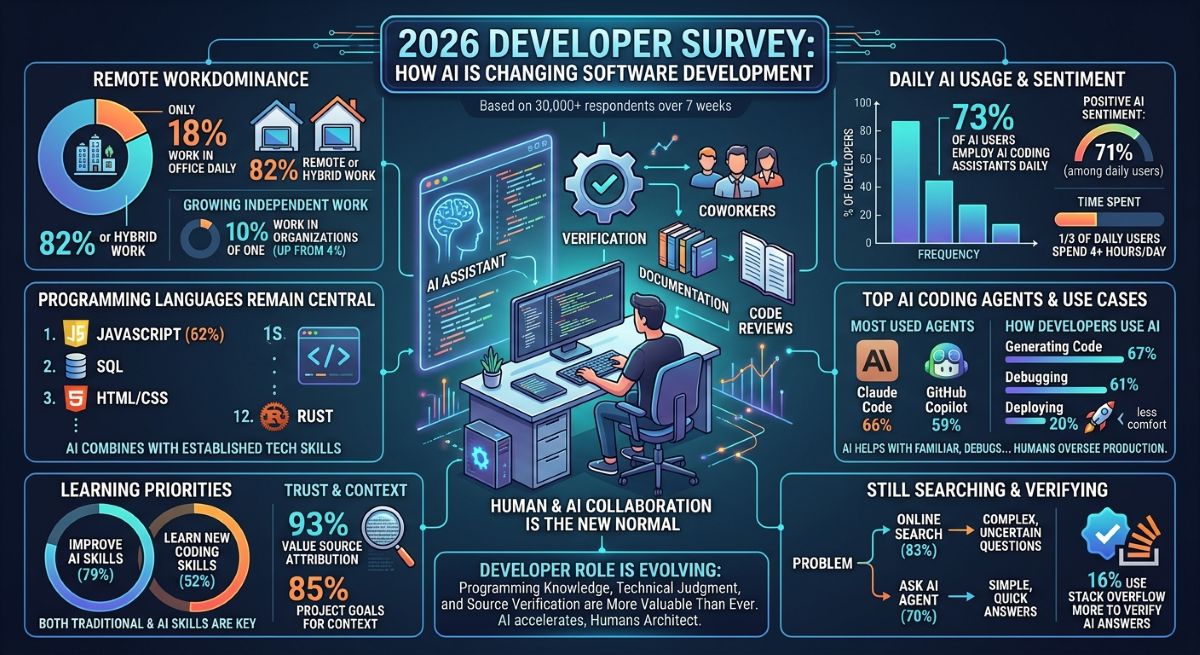
2026 Developer Survey Reveals How AI Is Changing Software Development
The latest 2026 Developer Survey provides a detailed look at how software developers are working, learning, choosing technologies, and using artificial intelligence. With more than 30,000 respondents participating over seven weeks, the survey highlights several major changes across the technology industry.
One of the clearest trends is the growing role of AI in everyday software development. At the same time, developers continue to rely heavily on traditional programming languages, documentation, coworkers, and online search when solving problems and building software.
Developers Are Changing How They Work
The modern workplace looks very different for many software developers compared with the years before 2020. According to the 2026 survey, only 18% of developers work from an office every day.
Remote and hybrid work have therefore become important parts of the developer experience. Changes in hiring, economic conditions, and the growing adoption of AI tools have also influenced how developers and employers approach software engineering.
The survey also reveals an interesting shift toward smaller organizations. The percentage of respondents working in an organization of one increased from 4% to 10%.
This may indicate that more developers are experimenting with independent work, freelancing, consulting, or building businesses on their own. The availability of AI-powered development tools could make it easier for individuals to handle tasks that previously required larger teams.
Programming Languages Remain Highly Important
Although artificial intelligence is transforming software development, traditional programming technologies remain central to developers’ work.
JavaScript remains the most widely used programming language, with 62% of respondents reporting its use. SQL moved ahead of HTML/CSS to take the second position, while Python remained among the most widely used technologies.
Rust also continued to gain ground, reaching the 12th position among the most-used programming languages in the survey.
These results suggest that AI has not replaced conventional programming skills. Instead, developers are increasingly combining established programming technologies with AI-powered tools to improve productivity.
AI Has Become a Daily Development Tool
Artificial intelligence is now deeply integrated into software development workflows.
Among respondents who use AI coding assistants or agents, 73% use them every day. In addition, around one-third of daily AI users report spending four or more hours per day using AI tools.
The survey also found that 62% of all respondents have at least somewhat positive views of AI. Among developers who use AI tools every day, positive sentiment rises to 71%.
This suggests that frequent exposure to AI may be associated with greater acceptance of the technology among developers.
Coding Agents and Chatbots Lead AI Usage
Developers are using several types of AI tools, but coding agents and chatbots are particularly popular.
Around 66% of AI users rely on coding agents, while 63% use chatbots. These tools are becoming part of the development process rather than simply being used for occasional experimentation.
Among coding agents, Claude Code is used by 66% of respondents, while GitHub Copilot reaches 59%.
The results demonstrate how quickly AI-assisted development has moved into mainstream software engineering.
How Developers Use AI for Coding
Developers are primarily using AI for tasks where the technology can provide immediate assistance without completely replacing human judgment.
The most common use cases include:
- Generating code in familiar areas — 67%
- Debugging — 61%
- Deploying, operating, or troubleshooting production systems — 20%
This difference is important. Developers appear much more comfortable asking AI to help create or debug familiar code than allowing AI to independently manage production environments.
Human oversight therefore remains an important part of professional software development.
Developers Still Turn to Search Engines for Answers
Despite the rapid growth of AI assistants, traditional search remains extremely important.
The survey found that 83% of technologists search online for answers, while 70% ask an AI agent.
This shows that AI has not eliminated search engines. Instead, developers are increasingly using both approaches depending on the problem they are trying to solve.
For straightforward questions, AI can provide quick explanations and examples. For more complex or uncertain information, developers may still search the web and examine original sources.
Stack Overflow’s Role Is Changing
The growth of AI is also changing how developers interact with technical communities such as Stack Overflow.
According to the survey, 64% of respondents say they visit Stack Overflow less for simple questions. At the same time, 16% say they visit more often to verify the sources behind AI-generated answers.
This represents an important change in how developers consume technical information.
Instead of relying exclusively on community websites for direct answers, developers may increasingly use AI to find an initial solution and then visit established technical sources to verify whether that information is accurate.
AI Skills Are Now a Major Learning Priority
Developers are also changing what they choose to learn.
A significant 79% of respondents want to improve their AI-related skills. This reflects the growing expectation that software professionals understand how to work effectively with AI systems.
However, traditional programming has not disappeared from developers’ learning plans.
About 52% of respondents are still learning new coding skills, showing that programming fundamentals and conventional development knowledge remain important.
The future developer therefore appears likely to need both strong programming skills and the ability to work effectively with AI.
Trust and Context Matter in AI Development
As AI becomes more deeply embedded in software engineering, developers are paying greater attention to the quality and reliability of the information provided to AI systems.
The survey found that 93% of respondents consider source attribution important for trusting AI-generated information.
Developers also identify project goals and requirements as major sources of useful context, at 85%, followed by code and documentation at 73%.
This highlights a fundamental challenge with AI-assisted development: better AI output depends heavily on providing accurate and relevant context.
Developers Still Rely on Human Expertise
AI may be powerful, but developers continue to rely heavily on people and existing technical resources.
For work-related answers, 72% of respondents turn to coworkers, while 63% use code and comments and 60% rely on internal documentation.
This demonstrates that AI is becoming another layer of the development workflow rather than completely replacing human expertise.
Experienced developers, technical teams, documentation, and organizational knowledge continue to play a major role in solving difficult engineering problems.
Quality Matters More Than AI Cost for Many Developers
As organizations increase their use of AI, the cost of tokens and model usage has become another consideration.
However, developers appear to prioritize quality over cost when selecting models and designing prompts. Around 75% prioritize quality, compared with 38% who consider cost important.
Organizations are also introducing different strategies to control AI spending.
These include:
- 38% setting limits on AI usage
- 28% reviewing AI spending data
- 27% using different models for different tasks
- 25% limiting which employees can use AI
At the same time, 21% of respondents say their organizations are increasing AI spending, showing that some businesses view AI investment as a strategic priority rather than simply an expense.
What the 2026 Developer Survey Means for the Future
The 2026 Developer Survey presents a technology industry undergoing a significant transition.
AI is becoming a daily development companion, but developers are not abandoning programming fundamentals, search engines, documentation, coworkers, or technical communities.
The rapid expansion of AI investment and global economic growth in 2026 is also influencing how businesses approach technology and software development.
Instead, the development workflow is becoming more interconnected.
Developers are using AI to generate familiar code, debug problems, learn new skills, and accelerate everyday tasks. Meanwhile, humans remain responsible for context, verification, architecture, decision-making, and many production-critical activities.
The rise of independent developers and one-person organizations also suggests that AI could lower some of the barriers to building software products and small technology businesses.
Key Takeaways From the 2026 Developer Survey
The survey highlights several important trends:
- 18% of developers work from an office every day.
- 10% now work in organizations of one, up from 4%.
- JavaScript remains the most-used programming language.
- 73% of AI coding-assistant users use these tools daily.
- 79% want to improve their AI skills.
- 83% still use online search for answers.
- 70% ask AI agents for answers.
- 93% value source attribution when trusting AI information.
- 75% prioritize AI quality over cost when selecting models and prompts.
- Traditional coding skills remain important despite rapid AI adoption.
Final Thoughts
The 2026 Developer Survey makes one thing clear: artificial intelligence is changing software development, but it is not eliminating the need for developers.
Instead, the role of the developer is evolving. Programming knowledge, technical judgment, collaboration, documentation, and source verification are becoming even more valuable as AI becomes a larger part of the development process.
The developers who can combine strong software engineering fundamentals with effective AI usage may be best positioned for the next stage of the technology industry.
For anyone following the future of software development, the 2026 survey offers a useful snapshot of where developers are today—and where the industry may be heading nex
