
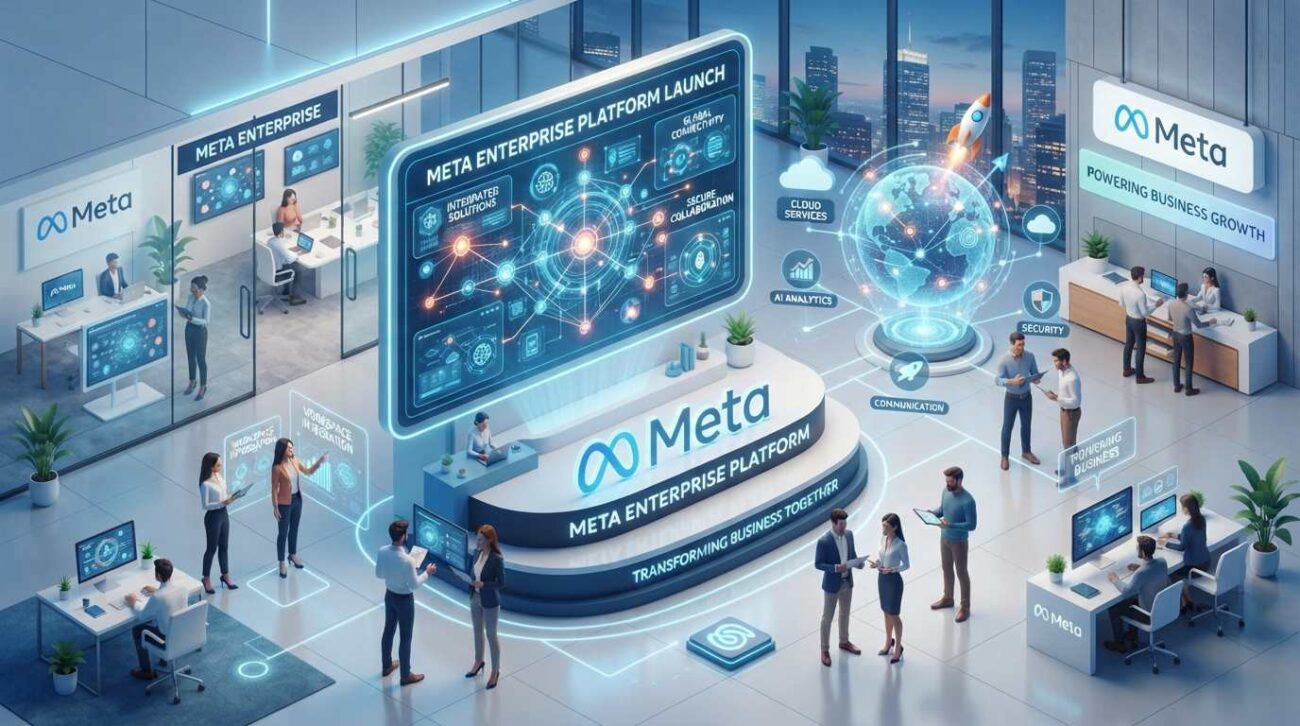
Meta is taking a major step into the enterprise artificial intelligence market with the launch of Meta Enterprise Platform, a new business initiative designed to bring the company’s AI technologies, agents, developer tools and infrastructure to businesses.
Announced on September 28, 2026, the initiative represents a broader shift in Meta’s AI strategy. Instead of focusing primarily on consumer-facing AI experiences, Meta is now building a dedicated business around helping companies use AI for customer service, operations, software development, automation and growth.
The initial technology lineup in
cludes Muse, Meta Business Agent, Muse API and Muse Code. Meta has appointed Chirantan “CJ” Desai, the former CEO and president of MongoDB, as Chief Enterprise Platform Officer to lead the new organization. Desai will report directly to Meta founder and CEO Mark Zuckerberg.
The announcement comes at a time when enterprise AI is becoming one of the most competitive areas in technology. Microsoft, Google, Amazon, OpenAI, Anthropic and other companies are already competing to provide AI models, agents and software infrastructure to businesses.
Meta’s new platform therefore marks more than another AI product launch. It signals an attempt to turn Meta’s growing AI capabilities into a dedicated enterprise business.

What Is Meta Enterprise Platform?
Meta Enterprise Platform is a new business initiative focused on making Meta’s AI technology available to companies and developers.
According to Meta, the platform will combine several parts of its AI technology stack, including advanced AI models, AI agents, large-scale infrastructure and tools built from Meta’s experience working with businesses and advertisers.
The initial focus is on four major products:
- Muse
- Meta Business Agent
- Muse API
- Muse Code
Meta says these technologies are intended to help businesses use AI to grow, automate work, serve customers and transform business operations.
However, it is important to distinguish between what Meta has announced and what is already commercially available. The September announcement describes the enterprise strategy and product direction, but Meta has not publicly provided a complete enterprise pricing structure, packaging model or detailed availability for every component.
That means businesses interested in the platform will still need to wait for more information about deployment, contracts, administration, security controls and pricing.
Muse: The AI Agent at the Center of Meta’s Strategy
One of the most important components of Meta Enterprise Platform is Muse, Meta’s new personal AI agent.
Meta introduced Muse earlier in September 2026 as an AI system designed not only to answer questions but also to perform tasks on behalf of users.
Muse can work across applications and handle real-world activities such as sending emails and booking travel. Meta built Muse around a dedicated secure virtual machine called Muse Secure VM, which is designed to separate the agent and user data while allowing the agent to interact with applications.
The enterprise opportunity is significant because the same basic concept can be applied to business workflows.
Instead of simply asking an AI chatbot for information, companies could use AI agents to perform multi-step tasks. For example, an enterprise agent could potentially help organize information, support customer interactions, automate repetitive processes or assist employees with operational work.
Meta is therefore moving toward an AI model in which the assistant does not simply generate content—it can become an active software layer capable of completing tasks.
Meta Business Agent for Customer Service
Another important part of Meta’s enterprise strategy is Meta Business Agent.
Meta introduced Business Agent earlier in 2026 as an AI system designed to help businesses interact with customers across Meta platforms.
The company says Business Agent can help businesses deliver personalized customer experiences and respond to customers. Meta also introduced a Business Agent Platform that provides infrastructure for companies to build, customize and deploy business agents at scale.
This is particularly relevant because Meta already operates enormous communication platforms such as WhatsApp, Messenger, Instagram and Facebook.
For businesses, AI agents connected to these channels could potentially handle a wide range of customer interactions.
For example, an AI business agent could help answer frequently asked questions, provide product information, assist customers before a purchase and support basic service requests.
Meta says more than one million businesses were already using a Meta Business Agent on WhatsApp and Messenger as of its June announcement.
That existing business ecosystem gives Meta an important starting point for its enterprise AI strategy.
Muse API: Bringing Meta AI Into Business Software
The Muse API is another key component of Meta Enterprise Platform.
An API can allow developers to connect AI capabilities to their own software, applications and workflows. In Meta’s new enterprise strategy, Muse API is intended to help businesses and developers incorporate Meta’s AI technology into their own products and systems.
This is an important difference between a consumer AI assistant and an enterprise AI platform.
A consumer might open an AI application and interact with it directly. A business, however, often needs AI to work inside existing systems.
For example, companies may want AI integrated with internal applications, customer-support software, productivity systems or custom business tools.
Meta has not yet released all of the commercial and technical details surrounding Muse API, so businesses will need to evaluate its documentation, pricing, security controls and integration options as Meta expands the platform.
Muse Code and AI-Powered Software Development
Meta is also bringing Muse Code into the enterprise platform.
AI-assisted software development has become one of the fastest-growing areas of enterprise AI. Developers increasingly use AI systems to generate code, explain existing software, identify problems and assist with development workflows.
Meta’s inclusion of Muse Code suggests that the company wants its enterprise platform to address developers as well as business users.
This could make the platform relevant to technology organizations that want AI assistance throughout the software development lifecycle.
Instead of treating coding AI as an isolated product, Meta appears to be positioning it as one component of a broader enterprise AI stack.
Why CJ Desai Is Leading Meta Enterprise Platform
Meta’s choice of CJ Desai is one of the most notable parts of the announcement.
Desai joins Meta from MongoDB, where he served as CEO and president. Before MongoDB, he held senior leadership roles at Cloudflare and spent nearly eight years at ServiceNow, including serving as president and chief operating officer.
His background is heavily focused on enterprise software, infrastructure and business technology.
At Meta, Desai becomes Chief Enterprise Platform Officer and reports directly to Mark Zuckerberg.
That reporting structure highlights the importance Meta is placing on the new business.
The move also had an immediate effect on MongoDB. Reuters reported that MongoDB shares fell about 18% following the announcement of Desai’s departure, while MongoDB appointed former CEO Dev Ittycheria as interim CEO as it searches for a permanent replacement.
For Meta, bringing in an executive with experience at ServiceNow, Cloudflare and MongoDB provides enterprise software experience that complements its consumer technology background.
Meta’s Enterprise AI Strategy Goes Beyond Chatbots
The biggest change represented by Meta Enterprise Platform is the move from traditional AI assistants toward AI agents and AI-powered business systems.
Traditional chatbots primarily respond to questions.
AI agents are designed to go further. They can potentially understand a goal, plan multiple steps, interact with software and complete tasks.
Meta’s recent Muse development reflects this shift.
The company says Muse can work on behalf of users and handle tasks rather than simply providing text responses. Meta has also expanded Muse toward small businesses, allowing it to connect with tools including Asana, Box, Canva, Dropbox, Figma, QuickBooks, Klaviyo, Notion, Shopify, Slack, Stripe and Zoom, as well as Facebook and Instagram business accounts.
This broader integration strategy could become particularly important for enterprise customers.
The more business context an AI agent can access, the more useful it can potentially become for operational tasks.
Meta’s Small-Business Push Strengthens the Enterprise Strategy
Meta is not limiting its AI ambitions to large corporations.
On September 29, the company introduced Muse for Small Business, expanding Muse with connections to popular business applications.
Meta says businesses can give Muse goals such as running parts of their business or finding new customers. It can also connect to existing business tools so that it understands information about the company and its operations.
Meta says users remain in control, with actions such as publishing, sending or spending requiring approval.
This approach gives Meta an opportunity to reach businesses of different sizes.
Small businesses may need automation but often lack large IT departments. Larger enterprises, meanwhile, may need more sophisticated integrations, security and administrative controls.
Meta Enterprise Platform could eventually serve both ends of that market.
Why Meta Is Entering Enterprise AI Now
Meta’s move comes during an enormous increase in spending on artificial intelligence.
The company has invested heavily in AI models, computing infrastructure, data centers and AI products.
The Financial Times reported that Meta planned capital expenditure of up to $145 billion in 2026, much of it connected to its AI infrastructure expansion.
Enterprise AI provides Meta with another potential commercial channel for those investments.
Meta has historically generated most of its revenue from advertising across Facebook, Instagram and other platforms.
Enterprise AI could provide additional ways to monetize the company’s technology beyond advertising.
The company already has relationships with hundreds of millions of businesses through its advertising ecosystem. Meta is now attempting to extend those relationships into AI-powered software and services.
Meta vs Microsoft, Google, Amazon, OpenAI and Anthropic
The enterprise AI market is becoming increasingly crowded.
Microsoft has its enterprise software ecosystem and AI services. Google combines AI with cloud infrastructure and productivity applications. Amazon has AWS and enterprise cloud customers. OpenAI and Anthropic are also building increasingly sophisticated AI products for professional and business users.
Meta enters the market with a different combination of strengths.
Its biggest advantages include its huge consumer platforms, relationships with businesses and advertisers, AI research capabilities, infrastructure investment and growing experience with AI agents.
However, enterprise customers typically demand more than an impressive AI demonstration.
They need security, privacy, reliability, compliance, identity management, administration, data governance, integration capabilities and predictable pricing.
Those details will be important for Meta as the Enterprise Platform develops.
Security and Privacy Will Be Critical
Enterprise AI creates significant security and privacy requirements.
Companies may want AI systems to access internal documents, customer information, financial data, source code and business applications.
Meta says security and privacy are being built into its enterprise products from the beginning. CJ Desai specifically highlighted security and privacy as part of the platform’s development.
Muse itself was designed with a dedicated secure virtual machine and user-controlled access as part of its architecture.
Still, enterprise buyers will need detailed technical information before deploying AI at scale.
Questions around data isolation, retention, permissions, compliance, model training, auditability and administrator controls will matter as much as the AI capabilities themselves.
What Businesses Should Watch Next
Meta Enterprise Platform is still developing, and several important questions remain unanswered.
Businesses will likely want to know:
- How much will Muse and Muse API cost?
- Which enterprise features will be available at launch?
- What security and compliance certifications will be supported?
- How will enterprise data be isolated?
- What administrative controls will IT teams receive?
- Which third-party applications will receive integrations?
- How will Meta handle model customization?
- What service-level commitments will enterprise customers receive?
- Will Meta offer dedicated enterprise support?
- How will Muse Code compete with established AI coding platforms?
Meta’s announcement establishes the direction, but the answers to these questions will determine how quickly enterprises can adopt the platform.
What Meta Enterprise Platform Means for the Future of AI
Meta Enterprise Platform represents an important evolution in Meta’s AI strategy.
The company is no longer treating AI only as a feature inside Facebook, Instagram, WhatsApp or consumer applications. It is building a dedicated enterprise business around AI agents, APIs, coding tools and business automation.
Muse provides the agent foundation. Meta Business Agent connects AI with customer interactions. Muse API can provide developers with access to Meta’s AI capabilities, while Muse Code targets software development.
Together, these products point toward a future where AI becomes part of everyday business operations rather than remaining a standalone chatbot.
The appointment of CJ Desai further demonstrates Meta’s focus on enterprise software and business customers. His experience at MongoDB, Cloudflare and ServiceNow gives the new organization a leader with a background in enterprise technology and infrastructure.
For businesses, the most important development may not be any single Meta product. It is the possibility that Meta is building a complete AI platform where agents, business communication, APIs, coding tools and infrastructure work together.
Final Thoughts
Meta Enterprise Platform is Meta’s latest attempt to turn its massive investment in artificial intelligence into a broader enterprise business.
With Muse, Meta Business Agent, Muse API and Muse Code forming the initial technology stack, the company is targeting businesses and developers that want AI to perform real work, interact with customers and become part of existing software workflows.
The appointment of former MongoDB CEO CJ Desai gives the initiative an experienced enterprise leader, while Meta’s existing relationships with millions of businesses provide a large potential customer base.
But the platform is still at an early stage. Pricing, availability, enterprise administration, deployment options and detailed security controls remain important areas to watch.
What is already clear is that Meta wants enterprise AI to become a major part of its next phase—not simply an additional feature inside its social platforms.
As AI agents move from answering questions to performing tasks, Meta Enterprise Platform could become part of the larger shift toward agentic AI, AI-powered business automation and software that works alongside employees rather than simply responding to them.
More inforemation visite : Timesscopejournal
