
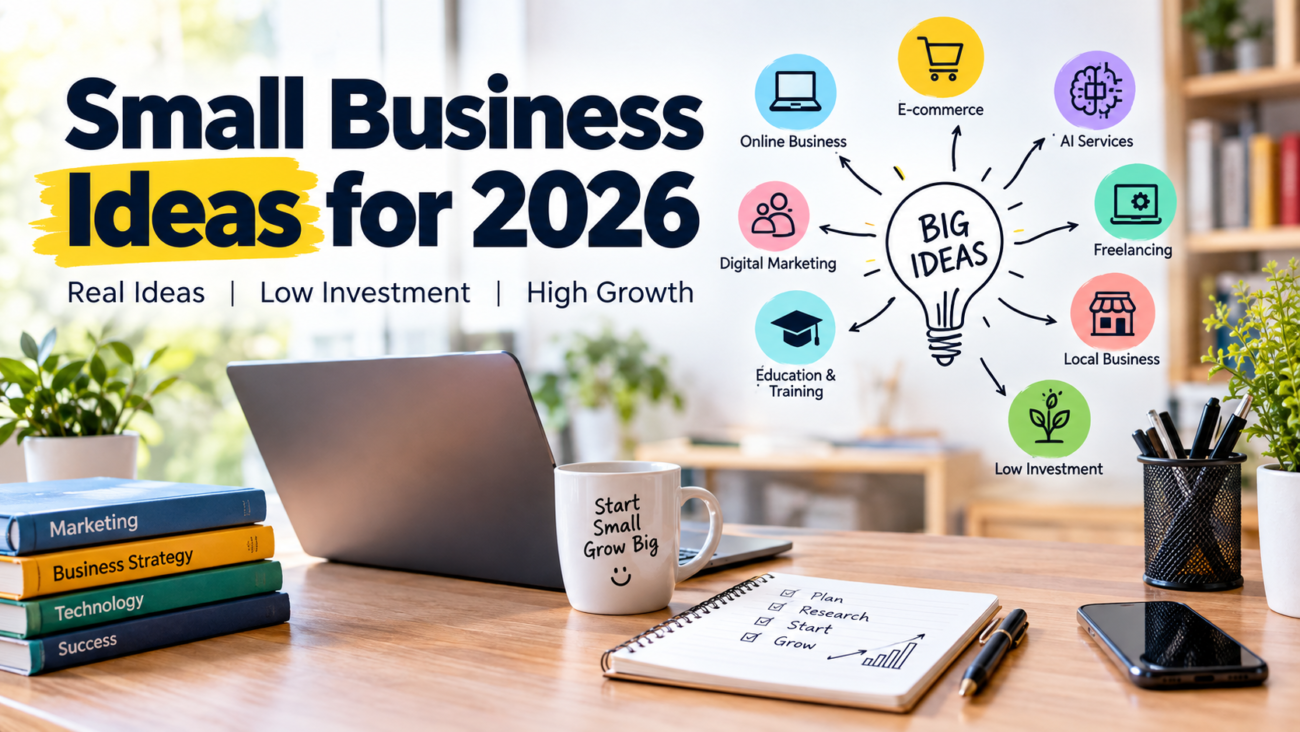
Small Business Ideas for 2026: 25 Profitable Businesses You Can Start
Starting a business in 2026 does not necessarily require a large office, expensive equipment, or a huge amount of capital. Digital tools, artificial intelligence, social media, online payments, and remote work have created new opportunities for people who want to build a small business around their skills and interests.
If you are searching for Small Business Ideas for 2026, the most useful approach is not simply to look for a business with a low startup cost. A better approach is to find an idea that solves a real problem, has customers willing to pay, and can grow without increasing expenses too quickly.
From AI-powered services and freelancing to online stores, food businesses, education, and local services, there are many possibilities for new entrepreneurs.
Here are 25 practical Small Business Ideas for 2026 worth exploring.
Why Start a Small Business in 2026?
The way people buy products and services continues to change. Customers increasingly discover businesses through search engines, social media, marketplaces, messaging apps, and online communities.
At the same time, entrepreneurs can use AI and cloud-based tools to handle tasks such as content creation, customer support, research, scheduling, design, marketing, and administration.
This means a small business can start with a focused service or product and gradually expand as demand grows.
However, no business idea guarantees profit. Your results will depend on market demand, pricing, execution, competition, customer service, and your ability to adapt.
25 Small Business Ideas for 2026
1. AI-Powered Content Service
Businesses need articles, social media posts, product descriptions, newsletters, video scripts, and marketing content.
You can build a small content service using AI tools to speed up research and drafting while providing human editing, fact-checking, brand voice, and quality control.
Best for: Writers, marketers, and content creators.
Startup requirement: Computer, internet connection, AI and editing tools.
How to grow: Start with one niche such as restaurants, real estate, e-commerce, or local businesses.
2. Social Media Management
Many small businesses have Facebook, Instagram, TikTok, or other social accounts but do not have enough time to manage them consistently.
A social media management business can provide content planning, posting, basic graphic design, community management, and performance reporting.
Instead of trying to serve everyone, choose a specific customer group and develop packages around its needs.
Best for: Social media professionals and creative freelancers.
Revenue model: Monthly client retainers.
3. Freelance Web Design
Small businesses still need websites, landing pages, online stores, booking pages, and portfolio websites.
You can begin by offering simple websites to local businesses and gradually add services such as maintenance, SEO, analytics, and conversion optimization.
A niche-focused approach can make the business easier to market.
For example, you could specialize in websites for restaurants, consultants, real estate agents, clinics, or small retailers.
4. SEO Consulting
Search engine optimization can be offered as a standalone service or as part of a digital marketing business.
A small SEO consultancy can help businesses with keyword research, on-page optimization, technical improvements, content planning, internal linking, and local search visibility.
The important thing is to avoid promising guaranteed rankings. SEO results depend on competition, website quality, content, authority, and many other factors.
Best for: People with strong SEO knowledge and analytical skills.
5. Digital Product Store
Digital products can include:
- E-books
- Templates
- Checklists
- Spreadsheets
- Presentation templates
- Design assets
- Study materials
- Business documents
- Printable planners
One advantage of digital products is that the same product can potentially be sold multiple times without manufacturing physical inventory.
The challenge is creating something genuinely useful and finding the right audience.
6. Online Course Business
If you have expertise in a valuable subject, you can turn that knowledge into an online course.
Potential topics include programming, graphic design, English language learning, marketing, accounting, photography, freelancing, or professional skills.
Start with a narrow problem rather than creating a huge course immediately.
For example, a course focused on “How to Create Your First WordPress Website” can target a clearer audience than a general course called “Everything About Websites.”
7. Virtual Assistant Service
Small companies and independent professionals often need help with repetitive administrative work.
A virtual assistant can handle tasks such as:
- Email management
- Calendar scheduling
- Data entry
- Research
- Customer communication
- Document organization
- Basic social media work
You can start independently and eventually create a small virtual assistant agency.
8. Video Editing Business
Short-form video has become an important part of online marketing.
You can offer editing services for YouTube videos, TikTok videos, Instagram Reels, advertisements, podcasts, educational content, and business presentations.
A strong portfolio is often more valuable than offering dozens of unrelated services.
Choose a specific type of video and become known for it.
9. Niche E-Commerce Store
Instead of creating a general online store with hundreds of unrelated products, consider building a niche store around a specific customer group.
Examples include:
- Home organization products
- Pet accessories
- Fitness accessories
- Handmade gifts
- Desk accessories
- Baby products
- Hobby products
The key is to research demand, supplier reliability, delivery costs, returns, and customer acquisition before investing heavily in inventory.
10. Print-on-Demand Business
Print-on-demand allows entrepreneurs to sell customized products without maintaining a large inventory.
Possible products include T-shirts, mugs, posters, notebooks, tote bags, and other customized items.
The business depends heavily on design quality and marketing, so simply uploading generic designs is unlikely to be enough.
A focused theme or audience can help differentiate the store.
11. Affiliate Marketing Website
Affiliate marketing involves promoting products or services and receiving a commission when qualifying purchases or actions occur.
A successful affiliate website usually focuses on a specific topic rather than publishing random product links.
For example, a website might focus on:
- Home office equipment
- Software
- Photography equipment
- Educational resources
- Business tools
Useful comparison articles, tutorials, reviews, and buying guides can help attract relevant visitors.
12. Online Tutoring
Online tutoring remains a practical business model for people with teaching expertise.
You can teach school subjects, languages, programming, test preparation, music, or professional skills.
The business can begin with one-on-one classes and later expand into group sessions, recorded courses, or downloadable learning materials.
13. Home-Based Bakery
A home bakery can serve customers with cakes, cookies, desserts, snacks, and customized products.
Social media can be particularly useful for displaying finished products and attracting local customers.
Before starting, research local food regulations, ingredient costs, packaging requirements, delivery arrangements, and pricing.
Your profit is not simply the selling price minus ingredient costs. Packaging, delivery, electricity, labor, marketing, and wastage should also be included.
14. Cloud Kitchen or Food Delivery Business
A small food operation can start with a limited menu instead of maintaining a large restaurant.
Choose a few products that can be prepared consistently and delivered without significant quality loss.
Potential niches include lunch boxes, snacks, desserts, healthy meals, regional cuisine, or specialty drinks.
Customer reviews and repeat orders can become important growth drivers.
15. Mobile Accessories Store
Mobile accessories are another possible product-based business.
Products may include:
- Phone cases
- Charging cables
- Screen protectors
- Chargers
- Stands
- Power banks
- Other compatible accessories
Combining a physical location with online sales can provide multiple customer acquisition channels.
However, product quality and supplier reliability are critical because low-quality accessories can generate returns and customer complaints.
16. Local Cleaning Service
Residential and commercial cleaning can be started as a service-based business without a large office.
Possible services include:
- Home cleaning
- Office cleaning
- Deep cleaning
- Move-in cleaning
- Move-out cleaning
- Post-event cleaning
A small team can initially serve a limited geographic area and expand after establishing repeat customers.
17. Photography and Video Services
Photography and videography can be useful for weddings, corporate events, restaurants, product launches, social media content, and personal branding.
Rather than competing only on price, consider specializing in a particular type of photography or video production.
For example, product photography for online sellers can become a specific niche.
18. Graphic Design Service
Businesses need logos, social media graphics, brochures, advertisements, packaging designs, presentations, and other visual materials.
A freelance designer can start with individual projects and later create a small design agency.
Using templates and AI-assisted tools can improve productivity, but original design thinking and understanding a client’s brand remain important.
19. Local Delivery Service
Local businesses often need reliable delivery support for documents, food, products, flowers, medicines where legally permitted, and other goods.
A small delivery operation can focus on a specific area instead of attempting to cover an entire city from the beginning.
The business model should account for fuel, vehicle maintenance, rider payments, route efficiency, failed deliveries, and customer support.
20. Event Planning Service
Event planning can serve birthdays, weddings, corporate events, conferences, private parties, and community programs.
You do not necessarily need to own every piece of equipment yourself.
Instead, you can coordinate photographers, decorators, caterers, venues, entertainers, and rental suppliers.
The value comes from organization, supplier relationships, communication, and reliable execution.
21. Resume and LinkedIn Profile Service
Job seekers often need help presenting their experience clearly.
A professional resume service can provide resume editing, formatting, cover-letter assistance, LinkedIn profile optimization, and interview preparation.
The service should focus on truthful representation of the customer’s experience rather than making unrealistic claims.
22. Subscription Box Business
A subscription business delivers selected products to customers on a recurring schedule.
Possible concepts include:
- Snacks
- Books
- Stationery
- Beauty products
- Hobby products
- Pet products
- Specialty food
The major challenge is maintaining customer retention while controlling product, packaging, delivery, and acquisition costs.
23. Home Repair and Maintenance Service
People regularly need help with repairs and maintenance.
Depending on local licensing requirements and your qualifications, a business can specialize in services such as painting, electrical work, plumbing, appliance maintenance, furniture repair, or general home maintenance.
Trust is especially important in this type of business, so transparent pricing and reliable service can help generate repeat customers and referrals.
24. Pet Care Business
Pet owners may need services such as grooming, walking, sitting, boarding, cleaning, and pet accessories.
A small operator can start with one service and expand as the customer base grows.
Local demand, animal-handling skills, safety procedures, and applicable regulations should be considered before launching.
25. Business Automation Service
Small companies often spend time on repetitive tasks such as lead collection, appointment reminders, customer follow-ups, reporting, and document processing.
An automation consultant can help businesses connect their existing tools and reduce repetitive manual work.
Services may include workflow automation, CRM setup, chatbot implementation, reporting systems, and automated notifications.
This is one area where technical knowledge and an understanding of business processes can create a strong service offering.
How to Choose the Right Small Business Idea
Having 25 ideas is useful, but choosing one requires more than looking at which business sounds profitable.
Ask yourself five questions before investing money.
1. What problem does the business solve?
A business needs customers with a problem, need, or desire that they are willing to pay to address.
2. Who is the customer?
Define your customer as specifically as possible.
“Everyone” is not a useful target market.
A better example would be “small restaurants that need social media content” or “university students looking for affordable tutoring.”
3. What will it cost to start?
Calculate the actual startup requirements, including equipment, software, inventory, marketing, licenses, transportation, packaging, and operating expenses.
4. How will you get your first customers?
Before launching, identify realistic acquisition channels.
These could include:
- Google Search
- Social media
- Referrals
- Local networking
- Marketplaces
- Partnerships
- Direct outreach
- Existing communities
5. Can the business grow?
Consider whether you can increase revenue without increasing costs at the same rate.
A service business might grow by adding employees, creating packages, raising prices as expertise improves, or turning services into digital products.
Low-Investment vs. Product-Based Businesses
Not every business requires the same amount of capital.
Service businesses such as tutoring, SEO, design, consulting, and virtual assistance can often begin with relatively limited equipment because you are selling expertise and time.
Product businesses generally require more planning because inventory, packaging, storage, delivery, returns, and supplier relationships can affect cash flow.
For beginners, understanding the difference between revenue, profit, cash flow, and operating expenses is essential.
How to Validate a Business Idea Before Spending Money
One of the biggest mistakes new entrepreneurs make is spending heavily before confirming demand.
Instead, start with a small experiment.
Create a simple offer and show it to potential customers.
Ask:
- Would you buy this?
- What problem does it solve?
- What would make you choose it?
- What price seems reasonable?
- What alternatives are you currently using?
If possible, try to get actual paying customers before making a large investment.
Real customer behavior provides stronger evidence than compliments or social media likes.
Common Mistakes to Avoid in 2026
Choosing an Idea Only Because It Is Trending
AI, e-commerce, creator businesses, and other trends can create opportunities, but a trend alone does not create a sustainable business.
Ignoring Customer Acquisition
A great product can still fail if customers cannot find it.
Plan your marketing and distribution strategy before launching.
Competing Only on Price
Low prices can attract customers, but they can also make it difficult to cover costs.
Look for ways to compete through quality, specialization, convenience, speed, service, or expertise.
Starting Too Big
You do not always need a large office, huge inventory, or complicated website on day one.
Start with the smallest practical version of your business and learn from customers.
Depending Completely on AI
AI can improve productivity, but it does not replace market research, customer relationships, quality control, or business judgment.
Use technology as a tool rather than treating it as the entire business strategy.
Frequently Asked Questions
What are the best Small Business Ideas for 2026?
The right idea depends on your skills, available capital, target market, and location. AI services, digital marketing, web development, online education, niche e-commerce, content services, and local services are among the areas entrepreneurs can explore.
What is the easiest small business to start?
Service businesses are often simpler to test because they may require less inventory and infrastructure. Freelancing, tutoring, virtual assistance, consulting, and certain digital services can be started on a small scale.
Can I start a business with a small budget?
Yes. Many service and digital businesses can be tested with limited initial spending. However, you should calculate recurring expenses and customer acquisition costs before deciding how much capital you need.
Is AI a good business opportunity in 2026?
AI can create opportunities in areas such as automation, content production, customer support, data analysis, software, and marketing. The strongest opportunities generally focus on solving a specific customer problem rather than simply selling access to an AI tool.
Should I start an online or offline business?
There is no single answer. Online businesses can reach customers beyond your local area, while offline businesses can benefit from local demand and personal relationships. A hybrid model can also combine online marketing with local delivery or physical services.
Final Thoughts
There are many Small Business Ideas for 2026, but the idea itself is only the beginning.
A sustainable business usually comes from understanding a specific customer, solving a real problem, controlling costs, building trust, and consistently improving the offer.
Instead of trying to launch five ideas at once, choose one problem, identify a specific audience, create a simple offer, and test it with real customers.
The goal is not simply to find a business idea that looks profitable on paper. The goal is to discover an opportunity that matches your skills, resources, market, and ability to execute—and then build it step by step.
Start small, validate early, listen to customers, and scale when the numbers support it.
