
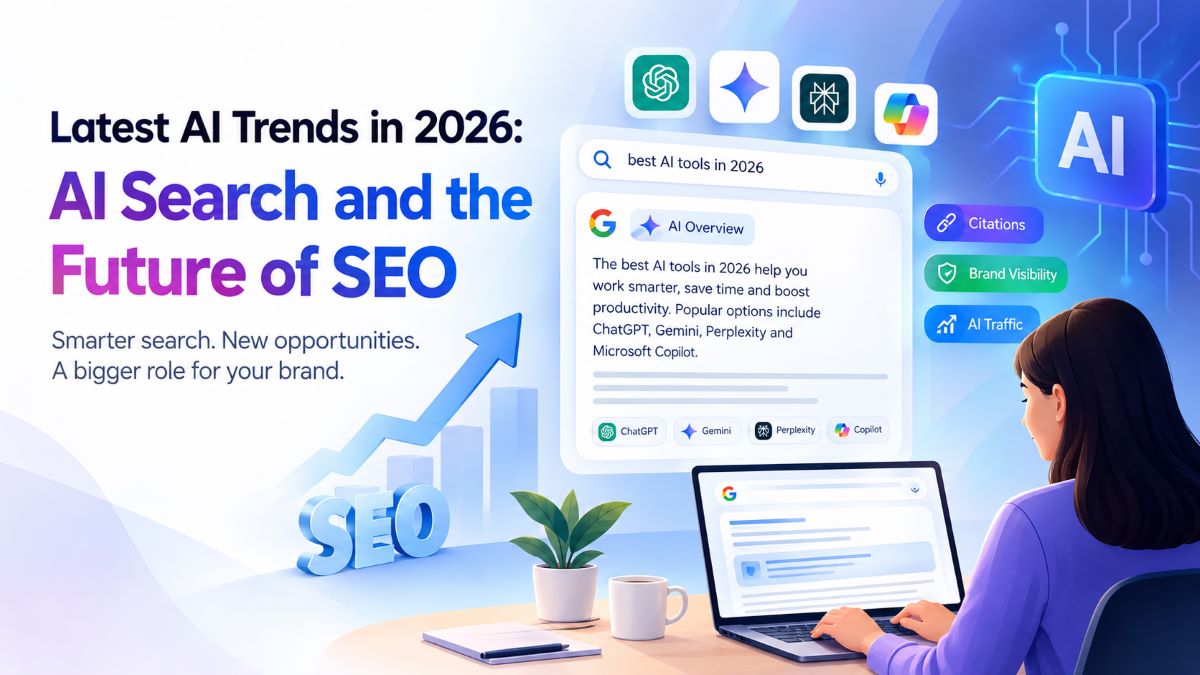
Search is changing faster than it has in years. People are no longer relying only on traditional search results to find information. AI-powered experiences such as Google AI Overviews, ChatGPT, Gemini, Microsoft Copilot, and Perplexity can now understand questions, summarize information, compare sources, and provide conversational answers. These changes are creating new opportunities for businesses while also changing how SEO works. The fundamentals of useful content, technical accessibility, authority, and relevance still matter, but AI search is adding another layer to online discovery. Understanding the latest AI trends in 2026 can help businesses prepare their websites for the way people search today and may search tomorrow.
How AI Is Changing Search in 2026
Traditional search generally directs users toward a list of webpages, while AI-powered search can combine information from different sources into a single response. Instead of matching a query primarily with pages containing related words, modern search systems can consider context, intent, entities, relationships, and the usefulness of information. This means visibility is no longer only about achieving a high position for a keyword. Being clearly represented, referenced, or cited in an AI-generated response can also become valuable. At the same time, traditional organic search remains important because users still need reliable sources when they want to investigate an answer further.
Traditional Search vs AI-Powered Search
| Factor | Traditional SEO | AI Search |
| Main experience | Ranked webpages | AI-generated answers and sources |
| Optimization | Relevance and keywords | Context, clarity, and usefulness |
| Visibility | Search rankings | Rankings, mentions, and citations |
| User behavior | Click and browse | Ask, read, verify, and explore |
| Measurement | Traffic and rankings | Traffic plus AI visibility signals |
What Is AI Search and How Does It Work?
AI search refers to search experiences that use artificial intelligence to understand queries and generate or organize information for users. The exact technology differs between platforms, but a simplified process is retrieve information → understand the query → evaluate relevant information → generate an answer → provide supporting sources where available. AI search engines may combine information from webpages, databases, knowledge sources, and other systems. Because each platform has its own technology and policies, marketers should not assume that optimizing for one AI system guarantees the same visibility everywhere.
What Are AI Search Engines?: AI-powered search is now appearing across several major platforms. Google uses AI Overviews within its search experience, while ChatGPT and Gemini provide conversational research and information experiences. Microsoft Copilot also combines AI assistance with information retrieval, and Perplexity is designed around answer-focused search with sources. These platforms are not identical, but they share an important characteristic: users can interact with information in a more conversational way instead of depending entirely on traditional keyword-based queries.
AI Search Engine Optimization: What Has Changed?
AI search optimization builds on traditional SEO rather than completely replacing it. Websites still need to be crawlable, technically sound, relevant, useful, and authoritative. However, content also needs to communicate information clearly enough for AI systems to interpret individual facts and concepts correctly. Strong organization, concise explanations, meaningful headings, entity relationships, trustworthy sources, and clear context can make content easier for both humans and machines to understand. This is where AI SEO, AEO, and GEO overlap.
AI SEO vs Traditional SEO: Traditional SEO has often focused on rankings, organic traffic, keyword relevance, backlinks, and technical performance. AI SEO adds greater emphasis on whether information can be understood, extracted, verified, and represented accurately in AI-generated answers. This does not make keywords irrelevant. Instead, keyword research becomes part of a wider process that includes search intent, semantic relationships, entities, questions, content depth, and user experience.
SEO vs AEO vs GEO: SEO focuses broadly on improving visibility in search engines. Answer Engine Optimization (AEO) focuses on providing information that can directly answer user questions, while Generative Engine Optimization (GEO) focuses on visibility within generative AI experiences. These approaches overlap significantly. A well-structured page that answers questions clearly, demonstrates expertise, and provides useful supporting information can potentially serve traditional search users as well as users interacting with AI-powered systems.
Google AI Overviews and the Future of Google Search
Google AI Overviews have changed how some search queries are presented by placing AI-generated information above or alongside traditional search results. For publishers and businesses, this means the search journey can begin with a summary rather than a list of links. However, organic results have not become irrelevant. Users may still visit websites to verify claims, explore products, read detailed explanations, or complete transactions. The practical goal for SEO professionals is therefore to create content that is useful enough to perform well in traditional search while also being clear and trustworthy enough to support AI-generated answers.
How to Optimize Content for Google AI Overviews: There is no guaranteed formula for appearing in an AI Overview, but strong SEO fundamentals remain useful. Start sections with direct answers, use descriptive headings, explain concepts clearly, support important claims with reliable evidence, maintain accurate information, and demonstrate relevant expertise. Internal links can help users and search systems discover related content, while appropriate structured data can help communicate what a page contains. Most importantly, content should provide genuine value rather than being written solely to manipulate a search feature.
Latest AI Trends in 2026 That Are Changing SEO
One of the most important Latest AI Trends in 2026 is the movement toward answer-first discovery. AI systems can respond to conversational questions, combine different types of information, and increasingly support text, voice, images, and other formats. This creates a more natural search experience but also introduces greater competition for attention. Zero-click searches may satisfy some users without a website visit, while AI agents can potentially help users research, compare, and complete tasks. As a result, SEO increasingly involves visibility throughout the discovery journey rather than focusing only on a single ranking position.
Conversational and Multimodal Search: People can now search using natural questions instead of short keyword phrases, and AI systems can work with more than text. Voice, images, video, and conversational prompts are becoming increasingly relevant to search behavior. Businesses should therefore consider the questions customers actually ask, not simply the keywords they type. Clear language, descriptive image information, useful video content, and comprehensive answers can help a website serve a wider range of search experiences.
Brand Mentions and Citations as Visibility Signals: A brand can gain visibility when its information is referenced or cited within an AI-generated response, even when the user does not immediately click through to the website. This makes brand authority and factual consistency increasingly important. Businesses should ensure that important information about their products, services, people, locations, and expertise is consistent across trustworthy sources. AI visibility should complement—not replace—traditional SEO measurement.
How to Optimize Your Website for AI Search
A practical AI search strategy begins with content that is easy to understand. Use clear headings, short paragraphs, direct explanations, lists, tables, definitions, and relevant examples. Build topic clusters instead of publishing disconnected articles, and connect related pages with useful internal links. Clearly explain important entities such as products, services, organizations, people, and locations. Use appropriate structured data where relevant, but remember that schema markup does not guarantee rankings or AI citations. Strong E-E-A-T signals—including genuine experience, expert authorship, reliable sources, and accurate information—also help establish trust.
How AI Changes Keyword Research and Search Intent
AI search makes it more useful to think beyond individual keywords. Search research should include conversational questions, long-tail queries, related concepts, entities, supporting topics, and follow-up questions. A customer may begin with an informational question, compare different solutions, evaluate providers, and then make a purchase. Content should support this complete journey rather than targeting only one phrase. Understanding the underlying intent behind a search is therefore becoming more valuable than repeatedly inserting an exact keyword into a page.
How to Create Content That AI Search Engines Can Understand
Good AI-friendly content should first be good human content. Write naturally, answer the main question early, provide supporting details, and avoid unnecessary filler. Original research, real examples, expert commentary, first-hand experience, and useful data can make content more distinctive than generic summaries. Accuracy also matters because outdated or unsupported claims can reduce trust and potentially lead to incorrect representations. AI can assist with research, outlining, editing, or analysis, but valuable content still requires human judgment, verification, and expertise.
Measuring AI SEO Performance in 2026
Traditional SEO metrics such as organic traffic, rankings, click-through rate, engagement, leads, and conversions remain important. However, businesses interested in AI search may also monitor AI citations, brand mentions, AI referral traffic, visibility across selected AI platforms, answer inclusion, and citation accuracy. These measurements should be interpreted carefully because AI platforms can change their interfaces, retrieval systems, and data availability. The goal is to understand whether AI discovery is contributing to awareness, qualified visits, engagement, or conversions—not simply to collect another set of numbers.
How AI Search Visibility Can Affect Conversions: AI visibility can influence the early stages of a customer’s decision process. A user may discover a brand through an AI-generated answer, research its products on the website, compare alternatives, and eventually convert. The relationship is not automatic, but it creates another potential path between discovery and conversion. Businesses should therefore connect AI visibility data with broader analytics where possible instead of treating citations as an isolated SEO metric.
AI SEO Strategy for Businesses in 2026
Businesses can approach AI SEO through a simple process: audit existing content, identify important customer questions, improve structure and clarity, strengthen authority signals, implement relevant technical improvements, monitor search and AI visibility, and update content based on evidence. This process works best when AI optimization is integrated into the wider SEO strategy rather than treated as a separate campaign. The strongest opportunities will often come from improving content that already has valuable expertise but is difficult to understand, outdated, poorly structured, or disconnected from related topics.
Will AI Search Replace Traditional SEO?
AI search is changing how information is discovered, but traditional SEO remains an important foundation. Websites still need to be accessible to search engines, technically healthy, relevant to user needs, authoritative, and useful. Organic search results also remain important for users who want detailed information or need to visit a website. Rather than viewing AI search and traditional SEO as competing systems, businesses can treat AI-powered discovery as an additional layer of search behavior that expands the role of SEO.
The Future of SEO Beyond 2026
The future of SEO is likely to involve a combination of traditional search, conversational discovery, multimodal experiences, AI-generated answers, and increasingly capable AI agents. Brand entities, original information, trustworthy sources, and strong first-party content may become even more important as search systems become better at synthesizing information. SEO professionals will need to think beyond rankings and consider how information is discovered, understood, summarized, cited, and acted upon. The fundamental principle remains simple: create information that people genuinely need, make it easy to understand, and build enough trust for both users and search systems to recognize its value.
Frequently Asked Questions About AI Search and SEO?
What is AI search?
AI search uses artificial intelligence to understand user queries and provide synthesized, conversational, or context-aware answers. Depending on the platform, it may also provide links or citations to supporting sources.
What is AI SEO?
AI SEO is the practice of improving website content and technical signals so information can be effectively discovered, understood, and represented across AI-powered search experiences while maintaining traditional SEO best practices.
How does AI search affect SEO in 2026?
AI search adds new ways for users to discover information. Rankings and organic traffic still matter, but businesses may also need to consider citations, brand mentions, answer visibility, and changing click behavior.
How can I optimize my website for AI search?
Create clear and useful content, answer important questions directly, demonstrate expertise, strengthen internal linking, use appropriate structured data, maintain accurate information, and build authority around your subject.
Is traditional SEO still important in 2026?
Yes. Technical SEO, crawling, indexing, relevance, content quality, authority, user experience, and organic visibility remain important foundations for search discovery.
What is the difference between AEO and GEO?
AEO focuses on providing direct answers to user questions, while GEO focuses more specifically on visibility within generative AI experiences. Both overlap with broader SEO practices.
How do Google AI Overviews affect organic traffic?
The effect can vary depending on the query, industry, search intent, SERP features, and user behavior. Some searches may receive more information directly in the results, while others can still generate substantial website visits.
Can AI-generated content rank in search engines?
Using AI to assist with content does not automatically determine whether a page will perform well. The important factors include usefulness, originality, accuracy, expertise, relevance, and whether the content provides genuine value to users.
