
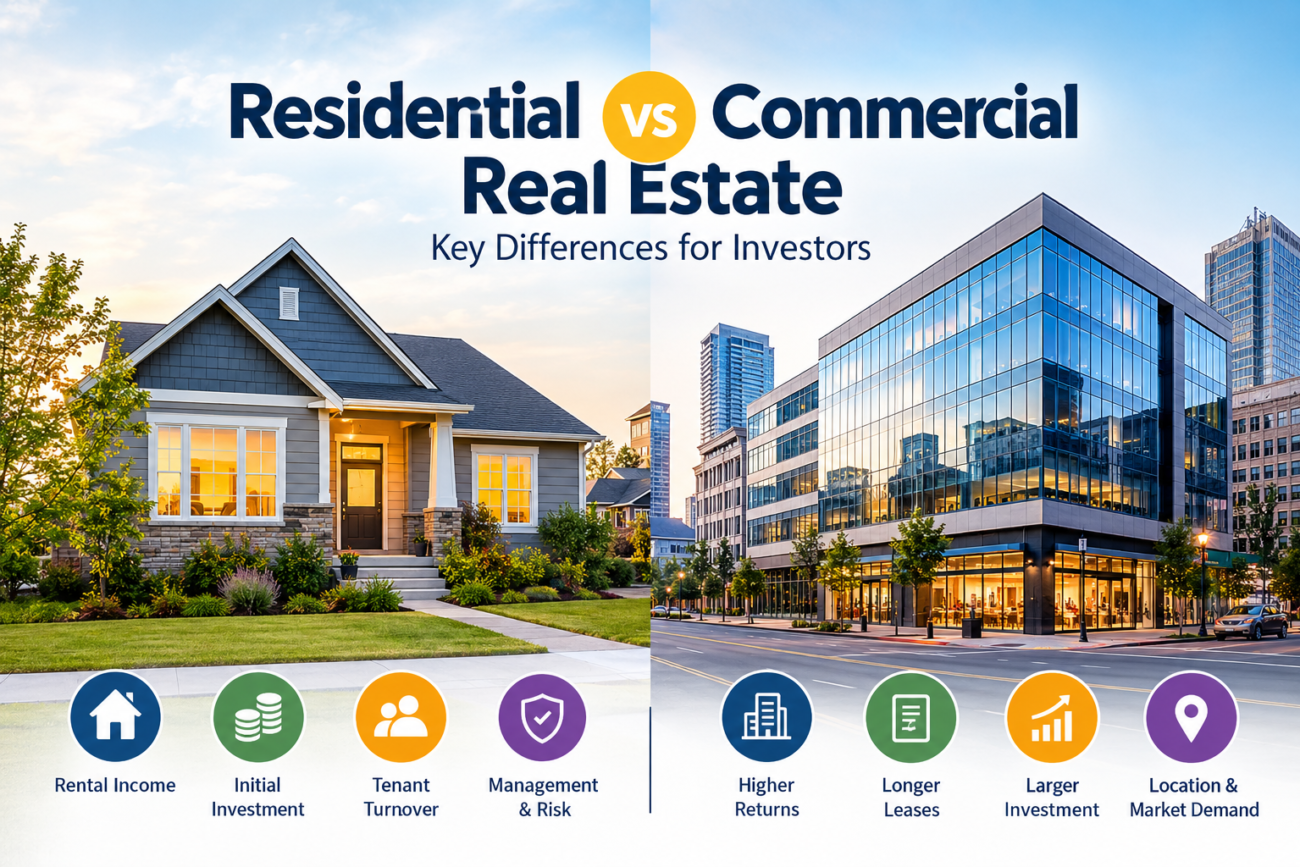
Residential vs Commercial Real Estate: Key Differences for Investors
Choosing between residential and commercial property is an important decision for anyone considering real estate as an investment. Both property types can generate rental income and may increase in value over time, but they differ in cost, management, tenant relationships, lease structures, risks, and potential returns.
Understanding Residential vs Commercial Real Estate can help investors compare opportunities more carefully instead of focusing only on the purchase price or expected rent. The right property depends on factors such as available capital, investment goals, experience, time commitment, location, financing, and tolerance for vacancies or changing market conditions.
This guide explains the major differences between residential and commercial real estate and the factors investors should consider before choosing a property.
Understanding Residential vs Commercial Real Estate can help investors compare opportunities more carefully instead of focusing only on the purchase price or expected rent. Investors can also explore more real estate insights to better understand property markets, investment risks, and market trends.
What Is Residential Real Estate?
Residential real estate refers to properties primarily designed for people to live in. Common examples include single-family homes, condominiums, townhouses, duplexes, and smaller multifamily properties.
Investors typically purchase residential properties to generate rental income, benefit from potential long-term appreciation, or combine both objectives.
Residential properties are often considered more accessible because smaller properties can require less capital than many commercial assets. They may also be easier for individual investors to understand and manage.
However, residential investment still involves costs such as mortgage payments, insurance, maintenance, property taxes, repairs, management fees, and periods when a property may be vacant.
What Is Commercial Real Estate?
Commercial real estate generally refers to property used for business or income-producing purposes. Examples include office buildings, retail spaces, warehouses, industrial properties, hotels, medical offices, and other business-oriented properties.
Some larger multifamily apartment buildings can also be treated as commercial real estate for financing and investment purposes, even though people live in them.
Commercial properties often involve more complicated lease agreements and management requirements. Depending on the property and lease structure, tenants may be responsible for some expenses such as taxes, insurance, maintenance, or utilities.
Because commercial properties can be larger and more specialized, investors may need more capital, market knowledge, and professional support.
Residential vs Commercial Real Estate: Key Differences
The biggest differences between residential and commercial real estate usually involve investment size, tenants, leases, operating costs, vacancies, management, and market sensitivity.
| Factor | Residential Real Estate | Commercial Real Estate |
|---|---|---|
| Main use | Housing | Business or commercial activity |
| Typical tenants | Individuals or families | Businesses and organizations |
| Initial investment | Often lower for smaller properties | Often higher |
| Lease terms | Commonly shorter | Often longer |
| Tenant turnover | Can be higher | Often lower, depending on property |
| Management | Usually simpler for small properties | Often more complex |
| Market drivers | Housing demand and local conditions | Business demand and economic activity |
| Vacancy impact | Usually spread across individual units | A single vacancy can have a larger effect |
| Financing | Often more accessible for small properties | Can require specialized financing |
| Operating complexity | Generally lower | Generally higher |
The comparison is not absolute. A large residential development can be highly complex, while a small commercial property can be relatively straightforward. Investors should therefore evaluate the specific asset rather than relying only on the property category.
Initial Investment and Capital Requirements
One of the first differences investors notice is the amount of capital required.
A small residential property may have a lower purchase price and can therefore be accessible to individual investors with limited capital. Investors may also have more financing options depending on their location and financial circumstances.
Commercial properties often require a larger upfront investment. In addition to the purchase price, investors may need to budget for renovations, professional fees, tenant improvements, insurance, maintenance, and periods of vacancy.
The important point is that investors should calculate the total investment cost, not just the advertised property price.
A basic property budget may include:
- Purchase price
- Down payment
- Financing costs
- Legal and professional fees
- Taxes and transaction costs
- Insurance
- Repairs and renovation
- Property management
- Maintenance
- Vacancy allowance
- Emergency reserves
Rental Income and Potential Returns
Rental income is one of the main reasons investors consider both residential and commercial property.
Residential properties can generate recurring rent from individual tenants or households. Income can vary according to location, property size, condition, local demand, and rental market conditions.
Commercial properties can generate income through business leases. Some commercial leases may shift certain operating expenses to tenants, depending on the agreement.
However, higher rent does not automatically mean a higher investment return.
Investors should consider net income after expenses rather than looking only at gross rental income.
A simple calculation is:
Rental Income − Operating Expenses − Financing Costs = Estimated Cash Flow
For a more complete analysis, investors should also consider vacancy periods, taxes, capital expenditures, repairs, and potential changes in financing costs.
Lease Terms and Tenant Relationships
Lease structure is another major difference between residential and commercial real estate.
Residential leases are often shorter, which can give landlords flexibility when market rents change. However, shorter leases can also mean more frequent tenant turnover, marketing expenses, inspections, and periods without rental income.
Commercial leases are often longer and can provide greater income visibility for the lease period. However, commercial tenants may have more specific requirements, and negotiating a commercial lease can involve more complex terms.
Commercial agreements may address:
- Rent increases
- Maintenance responsibilities
- Insurance
- Property taxes
- Utilities
- Repairs
- Tenant improvements
- Renewal options
- Early termination conditions
The exact responsibilities depend on the lease agreement and local regulations.
Vacancy Risk
Vacancy is an important consideration in any rental investment.
With residential property, a landlord with several units may continue receiving income from occupied units even if one unit becomes vacant. However, an investor who owns only one residential property can experience a complete loss of rental income during a vacancy.
Commercial vacancy can work differently.
If a commercial building has one major tenant and that tenant leaves, the financial impact can be significant. Finding another tenant may take time, particularly when the property is highly specialized or located in a market with weak business demand.
Investors should therefore test their investment under different vacancy scenarios before purchasing.
For example:
What happens if the property remains vacant for three, six, or twelve months?
Answering this question can reveal whether the investment has enough financial flexibility to handle an unexpected period without rental income.
Property Management Requirements
Management requirements can vary significantly between properties.
A small residential property may involve tenant communication, rent collection, repairs, inspections, maintenance, and advertising when a tenant leaves.
Commercial properties can involve additional responsibilities related to business tenants, larger building systems, complex leases, maintenance contracts, compliance requirements, and tenant improvements.
Professional property management can reduce the owner’s workload, but the cost needs to be included in the investment calculation.
Before buying, investors should decide whether they will manage the property themselves or use a professional management company.
Location Factors Are Different
Location matters for both residential and commercial real estate, but investors may evaluate different factors.
For residential property, important considerations can include:
- Population growth
- Employment opportunities
- Schools
- Public transportation
- Local amenities
- Housing supply
- Rental demand
- Neighborhood development
- Property prices
- Comparable rental properties
Commercial investors may place greater emphasis on:
- Business activity
- Customer traffic
- Accessibility
- Transportation infrastructure
- Parking
- Nearby businesses
- Employment growth
- Industrial or logistics demand
- Local development
- Commercial vacancy rates
A property can look attractive at the national level but perform differently at the neighborhood or city level. Local market research is therefore essential before making an investment decision.
Risk Differences Between Residential and Commercial Property
Every real estate investment carries risk.
Residential properties can face tenant turnover, maintenance costs, property damage, vacancy, financing costs, and changing housing demand.
Commercial properties can face business closures, longer vacancy periods, economic downturns, tenant concentration, specialized property requirements, and larger operating expenses.
Commercial properties can also be more dependent on the financial health of business tenants. If a tenant’s business struggles, the landlord may eventually face delayed payments, vacancy, or lease renegotiation.
Residential demand can also change during economic downturns, so it should not be treated as risk-free.
The best approach is to identify the specific risks attached to the property rather than assuming one category is always safer.
Liquidity and Selling Considerations
Real estate is generally less liquid than many financial assets because selling a property requires a transaction process, buyer, financing, legal work, and closing.
Commercial properties can sometimes have a smaller pool of potential buyers because the property may be expensive or designed for a specific business use.
Residential properties can have a broader potential buyer market, particularly for common property types in areas with strong housing demand.
However, liquidity depends heavily on location, property condition, pricing, financing conditions, and market demand.
Investors should avoid assuming that they can quickly sell a property whenever they need cash.
Financing Residential vs Commercial Real Estate
Financing can also differ between the two categories.
Residential properties may have more standardized mortgage products, particularly for smaller properties. Commercial financing can involve more detailed analysis of the property, tenant agreements, income, expenses, and the borrower’s financial position.
For commercial properties, lenders may pay close attention to the property’s income-producing ability and existing leases.
Before purchasing either type of property, investors should calculate how financing costs affect monthly and annual cash flow.
A property that looks profitable before financing may produce much less cash flow after interest and other borrowing costs are included.
How to Compare the Two Investments
Rather than asking which category is automatically better, investors can compare individual opportunities using the same framework.
Consider these questions:
- How much capital is available?
- What level of rental income is realistic?
- What are the total operating costs?
- How long could the property remain vacant?
- How complicated is property management?
- What type of tenant is likely to rent the property?
- How strong is local demand?
- How much financing is required?
- What happens if interest rates or operating costs increase?
- How easy could the property be to sell?
- What are the local taxes and regulations?
- Does the property fit the investor’s long-term strategy?
This approach creates a more realistic comparison than simply comparing advertised rental yields.
A Simple Example of Residential vs Commercial Real Estate
Imagine an investor is comparing a small residential rental property with a small commercial property.
The residential property requires less upfront capital and has several potential tenants in the local market. Its lease terms are shorter, so the investor may have more frequent tenant changes.
The commercial property requires more capital but has a longer lease with an established business. The lease may provide more predictable income during the contract period, but if the business leaves, finding a replacement tenant could take considerably longer.
Neither scenario automatically produces a better outcome.
The investor needs to compare purchase price, financing, operating costs, expected income, vacancy assumptions, lease terms, management requirements, and potential resale value.
Can Investors Own Both Residential and Commercial Property?
Yes. Investors can build portfolios containing both residential and commercial real estate.
Diversification across property types and locations can reduce dependence on a single market segment. Residential and commercial properties may respond differently to changes in employment, consumer spending, housing demand, interest rates, and economic activity.
However, diversification does not remove investment risk.
Owning several properties can also increase financing obligations, management responsibilities, maintenance costs, and exposure to different markets.
The portfolio should therefore be built according to the investor’s available capital and ability to manage risk.
Common Mistakes to Avoid
Investors comparing residential and commercial real estate should avoid several common mistakes.
Focusing Only on Purchase Price
A low purchase price does not necessarily mean a better investment. Operating costs, repairs, taxes, financing, and vacancy can significantly change the final numbers.
Assuming Higher Rent Means Higher Profit
Gross rental income does not show the full financial picture. Investors should calculate net cash flow after relevant expenses.
Ignoring Vacancy Risk
Always test the investment under realistic vacancy assumptions.
Underestimating Management
Commercial properties can require specialized management, while residential properties can still demand considerable time and attention.
Relying Only on National Data
Real estate markets can vary significantly between cities and neighborhoods. Local research should be part of the investment process.
Assuming Property Values Always Increase
Property appreciation is not guaranteed. Economic conditions, interest rates, supply, demand, and local development can affect prices.
Frequently Asked Questions
Is residential or commercial real estate easier to manage?
Small residential properties are often simpler to manage, but the actual difficulty depends on property size, tenant requirements, location, and management arrangements. Commercial properties can involve more complex leases and building requirements.
Does commercial real estate always provide higher returns?
No. Commercial properties can offer strong income potential, but returns vary by property type, location, tenant quality, lease terms, operating expenses, financing, and market conditions.
Is residential real estate less risky than commercial real estate?
Risk depends on the individual property and investment structure. Residential property can have more frequent tenant turnover, while commercial property can face larger vacancy or business-demand risks.
Which requires more capital: residential or commercial real estate?
Commercial properties generally require more upfront capital, particularly when purchasing larger office, retail, industrial, or other specialized properties. Smaller residential properties can be more accessible to individual investors.
Can a beginner invest in commercial real estate?
Yes, but beginners should understand the property’s financials, lease structure, financing, operating costs, and local market before investing. Professional advice may also be useful for complex transactions.
Can I invest in both residential and commercial real estate?
Yes. Combining different property types can provide diversification, although it also increases the need for capital, planning, and management.
Final Thoughts on Residential vs Commercial Real Estate
Understanding Residential vs Commercial Real Estate requires looking beyond the simple difference between homes and business properties.
Residential real estate can offer a more accessible entry point for some investors, while commercial real estate can involve larger properties, more complex leases, and different income and vacancy dynamics. Neither category should be evaluated only by its potential rent or expected appreciation.
A stronger investment analysis considers total acquisition costs, financing, operating expenses, tenant demand, vacancy risk, lease terms, location, management requirements, liquidity, and long-term objectives.
Before making a purchase, investors should research the specific property and local market, build realistic cash-flow projections, maintain an appropriate financial reserve, and understand the legal and tax rules that apply to the investment.
The most useful comparison is therefore not simply Residential vs Commercial Real Estate. It is whether a specific property, in a specific location, with specific numbers and risks, fits the investor’s financial strategy.
