
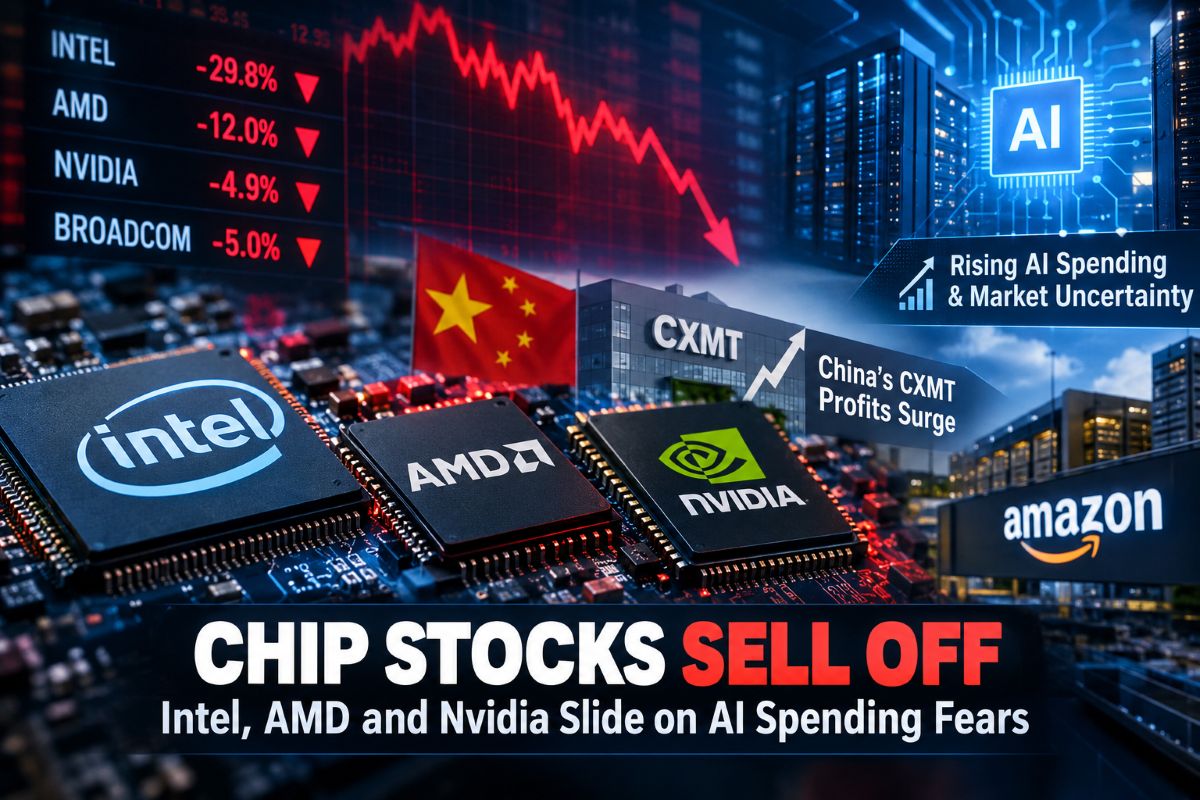
Chip Stocks Sell Off as Intel, AMD and Nvidia Slide on AI Spending Fears
The global semiconductor industry faced renewed pressure on Friday, October 30, 2026, as major chipmakers experienced sharp stock declines amid growing concerns about artificial intelligence (AI) spending, rising production costs and uncertain market demand.
Intel led the decline, with its shares falling nearly 30% during trading. Advanced Micro Devices (AMD) dropped approximately 12%, while Nvidia declined around 5%. Other semiconductor companies, including Qualcomm, Broadcom and Micron Technology, also experienced significant selling pressure.
The latest downturn reflects a growing concern across Wall Street: although demand for AI chips continues to expand, investors are becoming increasingly selective about which companies can convert that demand into sustainable profits.
Several developments contributed to the selloff, including China’s ChangXin Memory Technologies (CXMT) reporting a substantial increase in profits, Intel issuing a weaker financial outlook and Amazon maintaining an enormous investment budget for AI infrastructure.
Why Chip Stocks Are Falling in October 2026
The semiconductor market has benefited significantly from the rapid expansion of artificial intelligence. Companies developing advanced processors, memory chips and data-center infrastructure have attracted substantial investor attention.
However, the latest market reaction suggests that strong industry demand alone may no longer be enough to support rising stock valuations.
Investors are increasingly evaluating manufacturing capacity, operating expenses, cash flow and future earnings expectations.
Intel’s disappointing outlook created additional pressure, while Amazon’s infrastructure spending raised questions about how quickly investments in AI technology can generate financial returns.
Together, these developments weakened investor confidence across the semiconductor sector.
China’s CXMT Reports a Massive Increase in Profits
One of the important developments influencing the semiconductor industry was the latest financial performance of China’s ChangXin Memory Technologies (CXMT).
The Chinese memory-chip manufacturer reported third-quarter revenue of 118.71 billion yuan, approximately $16.7 billion, representing growth of more than seven times compared with the same period last year.
Net profit attributable to shareholders reached 54.4 billion yuan for the quarter ended September 30, 2026, reversing the company’s loss from the previous year.
The improvement was supported by several factors:
- Strong global demand for memory chips.
- Higher semiconductor selling prices.
- Tight supply conditions across the memory market.
- Increased manufacturing capacity.
- Improvements in product mix and production efficiency.
The results highlight the importance of memory technology in the expanding AI infrastructure market.
Modern AI systems require substantial amounts of high-performance memory to process information, train models and support increasingly complex applications.
However, stronger competition and additional manufacturing capacity could eventually change pricing conditions across the industry.
For investors, CXMT’s results provide another indication that the semiconductor supply chain is undergoing significant changes.
Intel Stock Plunges Nearly 30% After Weak Financial Outlook
Intel became one of the biggest losers during Friday’s trading session.
The company’s shares fell nearly 30% after investors reacted negatively to its fourth-quarter financial guidance and concerns about its ability to meet demand.
Intel reported third-quarter revenue of approximately $16.5 billion, representing 21% year-over-year growth. However, its forecast for the final quarter disappointed market expectations.
The company projected fourth-quarter revenue between $15 billion and $16 billion, while its non-GAAP earnings guidance was $0.25 per share.
Intel also indicated that weakness in the personal computer market could continue through at least the first half of 2027.
Several challenges are affecting the company’s business:
- Weakness in traditional PC demand.
- Higher memory prices affecting computer manufacturers.
- Manufacturing capacity limitations.
- Significant investment requirements.
- Competition in data-center processors and advanced semiconductor technology.
Although Intel continues to invest in manufacturing and AI-related opportunities, investors want stronger evidence that these investments will translate into consistent financial growth.
The company’s latest performance demonstrates how quickly market expectations can change when future guidance falls short.
For a deeper look at the company’s financial challenges, read our coverage of Intel’s nearly 30% stock decline and its weak financial outlook.
AMD and Nvidia Shares Also Face Selling Pressure
The decline was not limited to Intel.
Advanced Micro Devices and Nvidia also experienced significant losses as investors reduced exposure to semiconductor stocks.
AMD Faces Pressure Across the Chip Market
AMD shares dropped approximately 12% during Friday’s trading session.
The company operates in several important semiconductor markets, including data-center processors, graphics processing units and AI computing hardware.
Demand for AI infrastructure has created opportunities for AMD, particularly as businesses seek alternatives and additional suppliers for advanced computing products.
However, broader market uncertainty can affect semiconductor valuations even when individual companies have attractive long-term growth opportunities.
Investors are now paying closer attention to revenue expectations, competition and the financial returns associated with AI-related investments.
Nvidia Faces Growing Investor Scrutiny
Nvidia also experienced selling pressure, with its shares declining approximately 5% during the trading session.
The company remains one of the most important suppliers of advanced processors used in artificial intelligence systems and data centers.
Its products play a central role in AI model training, accelerated computing and large-scale infrastructure development.
Nevertheless, Nvidia is not immune to wider market volatility.
When investors become concerned about technology spending, financing costs and future profitability, even leading semiconductor companies can experience substantial share-price movements.
The latest decline demonstrates that strong exposure to AI growth does not eliminate short-term market risks.
Amazon’s $220 Billion AI Investment Raises Questions
Another major factor behind the technology selloff was Amazon’s spending strategy.
The company continues to invest heavily in data centers, cloud computing infrastructure and artificial intelligence services.
Amazon reported more than $77 billion in property and equipment spending during the third quarter, according to the financial figures reported around its latest results.
It also maintained its expectation of approximately $220 billion in capital expenditure for 2026.
These investments are designed to expand computing capacity and support increasing demand for AI services.
Amazon Web Services remains an important part of this strategy, with third-quarter net sales increasing 39.3% year over year.
However, investors are considering whether the financial benefits of these investments will arrive quickly enough to justify the enormous spending requirements.
This is particularly important because data centers require expensive processors, memory, networking equipment, electricity and ongoing maintenance.
If revenue growth fails to keep pace with infrastructure costs, companies could face additional pressure on cash flow and profitability.
How AI Spending Is Changing the Semiconductor Industry
Artificial intelligence is creating one of the largest infrastructure investment cycles in modern technology.
Companies are expanding their computing capacity to support generative AI, enterprise automation, cloud services and advanced machine-learning applications.
This expansion is creating opportunities across several semiconductor segments.
AI processors: Advanced GPUs and specialized processors are essential for training and operating complex AI models.
Memory chips: High-performance memory supports the processing requirements of modern AI systems.
Networking technology: High-speed networking components connect thousands of processors inside large data centers.
Semiconductor manufacturing: Chipmakers must invest in advanced production facilities to meet growing demand.
However, the industry also faces important challenges.
Manufacturing advanced semiconductors requires substantial investment, specialized equipment and highly developed production processes.
Supply shortages can increase costs, while additional manufacturing capacity may eventually create pricing pressure.
The companies that successfully balance demand, production efficiency and profitability may be better positioned to benefit from the next stage of AI development.
What the Semiconductor Selloff Means for Investors
The latest decline highlights the importance of looking beyond market enthusiasm when evaluating technology companies.
Investors may want to monitor several financial indicators when assessing semiconductor businesses.
1. Revenue Growth
Strong revenue growth can indicate increasing demand for semiconductor products. However, investors should also examine whether that growth is sustainable.
2. Profit Margins
Higher production costs and competition can affect profitability. Companies with stronger operating efficiency may be better positioned during periods of market uncertainty.
3. Capital Expenditure
Manufacturing facilities and AI infrastructure require significant investment. Investors should evaluate whether spending plans are supported by realistic revenue expectations.
4. Cash Flow
Cash flow provides insight into a company’s ability to finance operations, expansion and future investments without becoming excessively dependent on borrowing.
5. Competitive Position
The semiconductor industry is highly competitive. Product performance, manufacturing technology, customer relationships and supply-chain reliability can influence long-term business performance.
These factors may become increasingly important as investors distinguish between companies benefiting from AI demand and companies struggling with the costs of expansion.
What Could Happen Next in the Chip Stock Market?
The direction of semiconductor stocks will depend on several developments over the coming months.
First, investors will monitor upcoming earnings reports from major technology and chip companies for evidence that AI infrastructure investments are generating stronger commercial returns.
Second, memory-chip supply and pricing conditions will remain important. Changes in manufacturing capacity and demand could influence the profitability of memory producers and computer manufacturers.
Third, Intel’s ability to improve production capacity and strengthen its financial performance will remain an important issue for investors.
Nvidia and AMD will also face continued scrutiny as businesses evaluate their AI-related growth opportunities and future earnings expectations.
A recovery in technology stocks could become more sustainable if companies demonstrate stronger cash generation and improving profitability.
However, additional earnings disappointments, rising investment costs or weaker demand could create further volatility.
Conclusion
The October 30 semiconductor selloff highlights a changing environment for the global technology industry.
Intel’s weak financial outlook, declining shares across major chipmakers, China’s CXMT earnings growth and Amazon’s enormous AI infrastructure budget have combined to create fresh uncertainty among investors.
Although artificial intelligence continues to generate substantial demand for advanced computing products, the semiconductor industry is entering a period in which financial performance and investment discipline may matter as much as technological leadership.
For companies such as Nvidia, AMD and Intel, the challenge is not simply participating in the AI boom. It is converting industry growth into sustainable revenue, stronger margins and reliable cash flow.
The coming earnings reports and developments in the global memory-chip market will provide important signals about the next direction of semiconductor stocks.
Disclaimer: This article is for informational and educational purposes only. It does not constitute investment advice or a recommendation to buy or sell any security. Investors should conduct independent research and consult qualified financial professionals before making investment decisions.
Sources and Further Reading
- Reuters — Nasdaq and semiconductor stocks fall amid AI spending concerns
- Intel Investor Relations — Third-quarter 2026 financial results
- Amazon Investor Relations — Third-quarter 2026 results
