
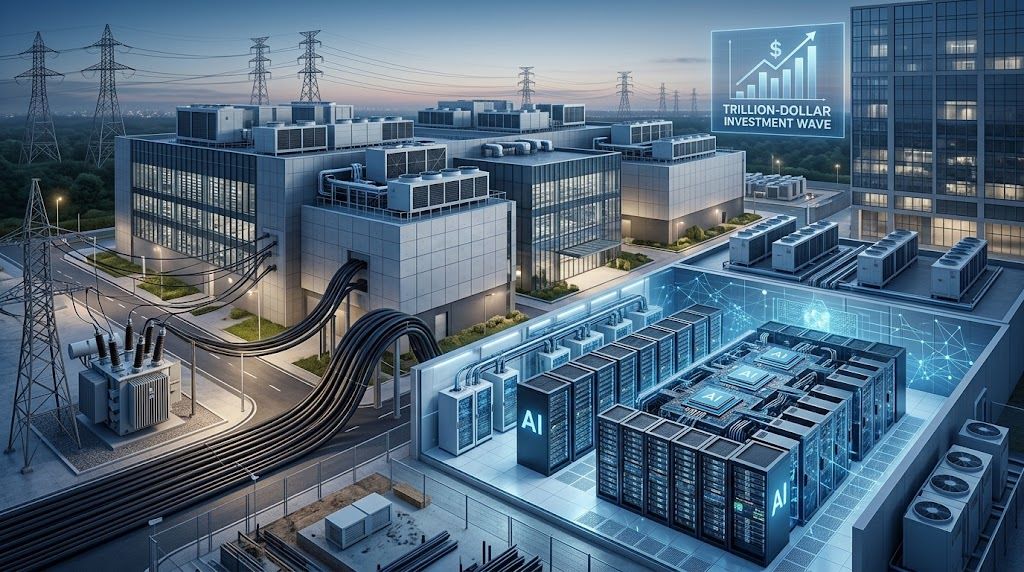
AI Data Center Boom Could Drive a Trillion-Dollar Infrastructure Investment Wave
Artificial intelligence is rapidly changing more than software and semiconductor markets. The global expansion of AI is creating a massive infrastructure race involving data centers, electricity, cooling systems, networking equipment, chips, and digital infrastructure.
As companies deploy increasingly powerful AI models and applications, demand for computing capacity is putting data centers at the center of the next major technology investment cycle. Research from JLL estimates that global data-center capacity could reach roughly 200 gigawatts by 2030, requiring up to $3 trillion in spending when new capacity and technology fit-outs are considered.
McKinsey has published an even larger estimate, projecting that global data-center infrastructure could require nearly $7 trillion in capital through 2030 under its demand scenarios.
AI Is Turning Data Centers Into a Major Investment Theme
The rapid adoption of generative AI and other compute-intensive applications is increasing the amount of processing power companies need.
Unlike traditional workloads, many AI applications require specialized accelerators, high-speed networking, advanced storage and substantially greater power and cooling capacity. This is changing the economics of data-center development.
JLL expects AI and cloud computing to help drive data-center growth at approximately a 14% compound annual growth rate through 2030. Its research also estimates that nearly 100 GW of new data-center capacity could be added between 2026 and 2030.
That expansion creates opportunities across a much broader supply chain than traditional technology companies.
The Data Center Supply Chain Is Expanding
The AI infrastructure boom is creating demand across several interconnected industries.
These include:
- Data-center developers and operators
- Semiconductor and AI accelerator manufacturers
- Networking equipment suppliers
- Power-generation and electrical infrastructure companies
- Cooling and thermal-management providers
- Energy-storage businesses
- Construction and engineering firms
- Fiber and connectivity providers
- Cloud and colocation companies
This means the economic impact of AI infrastructure investment is extending beyond companies that directly develop AI models.
McKinsey notes that power and thermal equipment are becoming important constraints as data-center demand accelerates, highlighting the importance of infrastructure suppliers in the broader AI ecosystem.
Power Availability Is Becoming a Critical Challenge
Building a data center is no longer simply a question of finding land and constructing a facility.
Large AI campuses can require enormous amounts of electricity, making access to reliable power one of the most important factors in determining where new facilities can be built.
JLL identifies “speed to power” as the primary site-selection criterion for data-center development in its 2026 outlook. The firm also expects construction costs to continue increasing as demand for new facilities grows.
The result is a growing connection between the AI industry and the energy sector.
Utilities, power developers, battery-storage providers and other energy infrastructure companies could therefore become increasingly important to the expansion of AI computing capacity.
Cooling Technology Is Becoming More Important
Power is only one part of the infrastructure challenge.
AI processors generate significant amounts of heat, increasing the need for advanced thermal-management systems. Traditional air-cooling approaches may not be sufficient for every high-density AI deployment.
That is driving greater attention toward liquid cooling, thermal-management equipment and other technologies designed to handle high-performance computing environments.
McKinsey identifies power and cooling infrastructure as key components of the data-center buildout, particularly as AI workloads increase computing density.
Hyperscalers Are Driving Large-Scale Expansion
Major cloud and technology companies remain among the most important sources of data-center demand.
Hyperscalers are expanding through a combination of leasing existing capacity and developing their own facilities. JLL expects this dual strategy to remain an important driver of data-center growth through 2030.
The scale of these projects is also changing the financial structure of the industry. Large facilities require substantial upfront capital, long-term power arrangements and sophisticated financing.
As a result, data-center development increasingly involves partnerships between technology companies, infrastructure operators, energy providers, private capital and real-estate investors.
AI Infrastructure Could Require Trillions in Capital
The size of the potential investment cycle is one of the most important aspects of the story.
JLL estimates that the sector could require up to $3 trillion through 2030, including investment in new capacity and tenant technology fit-outs.
McKinsey’s estimate is significantly larger, putting cumulative global data-center capital requirements at approximately $6.7 trillion in its analysis. More than $4 trillion of that could be directed toward computing hardware, with the remainder covering areas such as power and real estate infrastructure.
The different estimates reflect different assumptions and methodologies, but both point to the same broad trend: AI is creating an unusually large infrastructure spending cycle.
What This Means for Technology and Energy Businesses
The expansion of AI infrastructure could reshape several parts of the business economy.
Semiconductor manufacturers may benefit from increasing demand for AI processors. Networking companies face growing requirements for high-speed data movement. Energy companies are being asked to provide more reliable electricity, while cooling specialists are developing systems capable of handling increasingly dense computing environments.
Data-center operators also face opportunities as companies seek additional capacity without building every facility themselves.
However, expansion will not happen without constraints. Access to electricity, construction timelines, equipment availability, financing costs, permitting and local infrastructure can all affect how quickly new capacity comes online.
The Biggest Risk May Be Building Too Quickly
The AI infrastructure story also carries significant uncertainty.
AI demand is growing rapidly, but forecasts extending to 2030 depend on assumptions about AI adoption, computing efficiency, semiconductor availability and the pace at which companies deploy new applications.
McKinsey has emphasized that the data-center buildout faces constraints involving capital, energy resources and the supply of critical equipment.
That means companies investing heavily in new facilities must balance expected future demand against the risk of excess capacity.
AI Is Expanding From a Software Story Into an Infrastructure Story
The next stage of the AI boom is increasingly about the physical infrastructure required to support computing at scale.
Data centers, power systems, cooling technologies, networking equipment and advanced processors are becoming interconnected parts of the same investment ecosystem.
With global data-center capacity potentially approaching 200 GW by 2030 and multi-trillion-dollar capital requirements projected by major research firms, AI infrastructure is emerging as one of the largest technology-linked construction and investment themes of the decade.
For businesses, the key question is no longer simply how quickly AI adoption will grow. It is also whether the physical infrastructure needed to power that growth can be built quickly, efficiently and economically enough to keep pace.
Frequently Asked Questions
How much could be invested in global data centers by 2030?
Estimates vary by methodology. JLL estimates up to $3 trillion could be required for new data-center supply and associated technology fit-outs through 2030, while McKinsey estimates cumulative capital requirements of roughly $6.7 trillion under its data-center demand model.
Why are AI data centers different from traditional data centers?
AI workloads can require substantially greater computing density, specialized processors, high-speed networking, large power supplies and advanced cooling systems.
Why is electricity important for AI infrastructure?
Large AI facilities require significant and reliable electricity. JLL identifies access to power and speed to power as critical factors in data-center site selection.
Which industries are connected to the AI data-center boom?
The ecosystem includes semiconductors, networking, cloud computing, data-center real estate, construction, electrical equipment, power generation, energy storage and cooling technologies.
Source: JLL Research; McKinsey & Company; PRNewswire/Market News Updates.
