

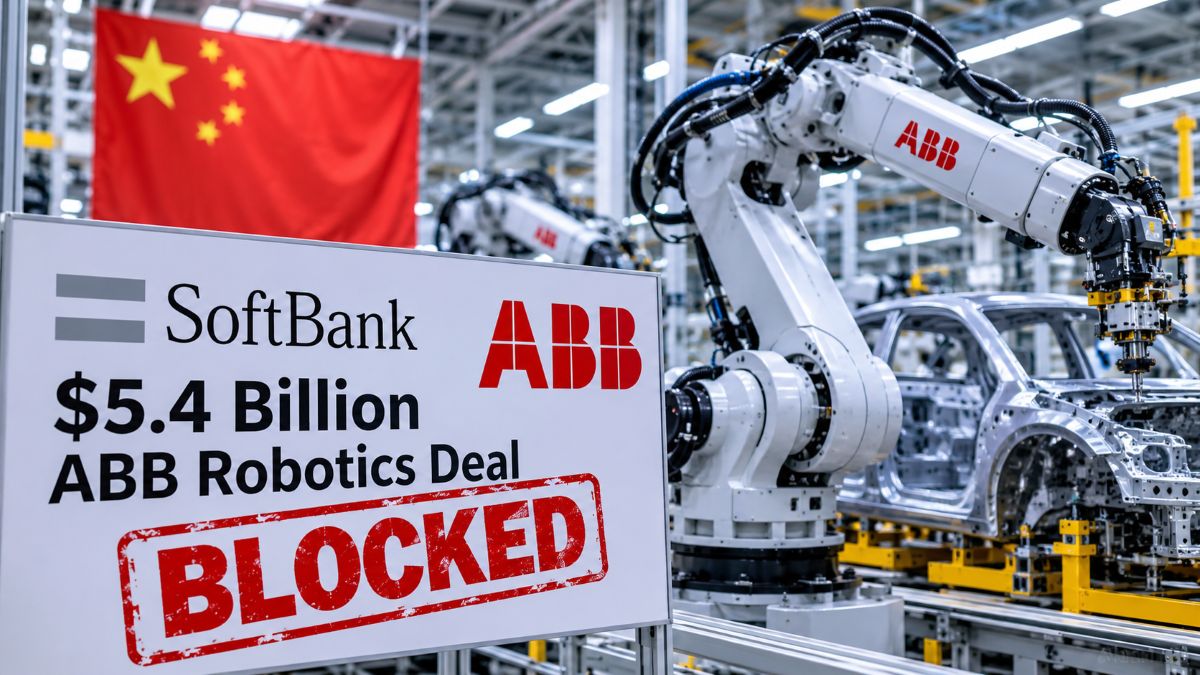
China Blocks $5.4 Billion SoftBank Acquisition of ABB Robotics Business Amid AI Security Concerns
China has blocked a major technology acquisition involving Japanese investment giant SoftBank and Swiss-Swedish engineering company ABB, creating a significant setback for the global robotics industry. The proposed $5.4 billion transaction was expected to strengthen SoftBank’s position in industrial automation and artificial intelligence (AI), but Chinese regulatory intervention has placed the agreement under serious pressure.
ABB confirmed on November 5, 2026, that SoftBank had informed the company that Chinese authorities had prohibited the acquisition of its robotics business in China. The decision highlights Beijing’s increasing focus on protecting strategically important technologies, industrial data and domestic manufacturing capabilities from transferring overseas.
The development also raises important questions about international mergers and acquisitions, particularly when advanced robotics and artificial intelligence technologies are involved.
China Blocks SoftBank’s $5.4 Billion Robotics Acquisition
The proposed transaction was originally announced in October 2025, when SoftBank agreed to acquire ABB’s robotics business for an enterprise value of approximately $5.375 billion.
The acquisition was intended to combine ABB’s industrial robotics expertise with SoftBank’s investments in artificial intelligence, robotics and next-generation computing.
However, the transaction required regulatory approval in China because the country represents a major market for ABB’s robotics operations.
ABB stated that it had received information from SoftBank regarding the Chinese government’s decision to prohibit the acquisition of its robotics business in the country.
The companies remain in close dialogue and say they are working constructively on the transaction. This means the announcement should not automatically be interpreted as confirmation that every part of the global agreement has been terminated.
The regulatory decision nevertheless creates substantial uncertainty about whether the original transaction can proceed as planned.
Why Chinese Regulators Rejected the Deal
China’s decision is closely connected to concerns about technology security, industrial data and the ownership of strategically important manufacturing capabilities.
According to reports citing people familiar with the regulatory review, Chinese authorities were concerned that technology and information developed through ABB’s Chinese operations could eventually be transferred overseas.
Robotics systems generate valuable information through manufacturing processes, equipment performance, automation systems and industrial applications. This information can become particularly important when companies develop artificial intelligence models designed to control physical machines.
Regulators reportedly examined whether data from the robotics business could be transferred outside China and potentially used to train AI systems.
SoftBank is also a major investor in OpenAI, adding another dimension to concerns about the international movement of technology and data.
However, ABB’s official announcement confirmed the regulatory prohibition without publicly detailing all the reasons behind the decision. The reported data-security concerns should therefore be understood as reported explanations rather than a complete official statement from Chinese authorities.
ABB Robotics Was Strategically Important to SoftBank
The acquisition was an important part of SoftBank founder Masayoshi Son’s broader ambition to expand beyond traditional technology investments.
Son has increasingly focused on artificial intelligence, robotics and physical AI, an emerging area where intelligent software interacts with machines and the physical environment.
ABB’s robotics business offered SoftBank an established industrial platform with decades of engineering experience, manufacturing relationships and automation expertise.
Its products are used in several industries, including:
- Automotive manufacturing
- Electronics production
- Industrial assembly
- Logistics and material handling
- Factory automation
- Advanced manufacturing systems
These capabilities could have helped SoftBank connect AI software with real-world industrial applications.
Rather than developing every robotics technology independently, the acquisition would have provided access to an established business with existing customers, engineering teams and production capabilities.
The blocked transaction therefore represents more than a financial setback. It creates a challenge for SoftBank’s strategy of building a stronger position in the physical AI market.
China’s Robotics Market Makes the Decision More Significant
China is one of the world’s most important markets for industrial robotics and automated manufacturing.
ABB has built a substantial presence in the country through manufacturing facilities, research operations, engineering teams and commercial relationships.
The company’s Shanghai robotics mega-factory, which began operating in 2022, represents an important part of its manufacturing presence.
Reports indicate that China accounts for approximately 30% of ABB’s robotics business, making the market particularly important to the proposed acquisition.
This commercial exposure helps explain why regulatory approval in China was essential to the transaction.
For international investors, the situation demonstrates that acquiring a global technology business does not necessarily mean gaining unrestricted control over every part of its operations.
A company may operate internationally while still facing different regulatory requirements in individual markets.
AI and Industrial Data Are Becoming Strategic Assets
Artificial intelligence is changing the economic importance of industrial robotics.
Traditional industrial robots were primarily designed to perform programmed tasks, such as welding, lifting, assembling and packaging products.
Modern AI-powered robotics systems are increasingly being developed to interpret information, respond to changing environments and perform more complex activities.
This creates demand for several valuable resources:
Industrial data: Information collected from machines, factories and production systems can help improve automation and train intelligent systems.
Engineering expertise: Experienced robotics engineers develop the software, hardware and control technologies needed to operate advanced machines.
Manufacturing capabilities: Production facilities and specialized supply chains are essential for producing industrial robotics at scale.
Intellectual property: Patents, technical designs and proprietary software can provide companies with long-term competitive advantages.
As businesses invest more heavily in AI, governments are paying greater attention to who controls these resources and where they can be transferred.
The broader technology investment landscape is also changing rapidly. For example, Marvell and Lumentum’s proposed AI infrastructure combination demonstrates how companies are investing in the semiconductor, optical networking and connectivity technologies needed to support advanced AI systems.
The robotics sector represents another important part of this expanding technology ecosystem.
What the Decision Means for ABB
The regulatory intervention creates uncertainty for ABB’s plans to sell its robotics division.
The company had previously selected SoftBank as the buyer after considering a separate corporate restructuring approach for the business.
The expected proceeds from the transaction were an important element of ABB’s capital allocation strategy.
A delay or restructuring of the agreement could affect the timing of those financial plans.
ABB may need to evaluate several possible outcomes, including:
- Continuing discussions with SoftBank to determine whether the transaction can be modified.
- Exploring whether a revised ownership structure could address regulatory concerns.
- Considering alternative strategic options for its robotics business.
- Assessing the financial implications of a delayed or unsuccessful transaction.
At this stage, neither company has confirmed a final alternative arrangement.
The next steps will depend on regulatory discussions and whether both businesses can find a commercially acceptable solution.
Financial and Market Implications for SoftBank
The blocked transaction also creates concerns for SoftBank investors.
The company has committed substantial resources to artificial intelligence and next-generation technology businesses. Acquiring ABB’s robotics operations was expected to strengthen its exposure to industrial automation and create additional opportunities in physical AI.
The regulatory setback could force SoftBank to reconsider how quickly it can expand its robotics strategy.
Investors may pay particular attention to three areas.
1. AI Investment Strategy
SoftBank has positioned artificial intelligence as a major part of its long-term investment strategy.
The loss of access to the planned ABB acquisition could require the company to identify alternative robotics businesses, technology partnerships or investment opportunities.
2. Capital Allocation
A major acquisition requires significant financial resources.
If the transaction cannot proceed in its original form, SoftBank may need to reassess how it allocates capital across AI infrastructure, software, robotics and other strategic investments.
3. Regulatory Risk
The decision demonstrates that international technology investments can face unexpected regulatory obstacles.
Investors may increasingly evaluate political and regulatory risks when assessing companies involved in cross-border acquisitions.
These factors could influence how financial markets assess SoftBank’s future growth opportunities.
What This Means for Global Technology Mergers and Acquisitions
The decision could have implications beyond the two companies involved.
Governments are increasingly treating artificial intelligence, robotics, semiconductor technology and industrial data as strategically important resources.
As a result, companies pursuing international acquisitions may need to consider national security reviews alongside traditional competition and financial assessments.
This creates additional challenges for multinational businesses.
A transaction may offer strong financial benefits and receive approval from some regulators but still encounter restrictions in another important market.
For investors and corporate executives, the situation highlights several important considerations:
- Regulatory approval must be considered early in the acquisition process.
- Industrial data ownership can influence technology investment decisions.
- Local manufacturing operations may carry strategic importance beyond their financial value.
- Cross-border acquisitions involving advanced technology may require more complex ownership arrangements.
- Political relationships can influence the commercial environment for international businesses.
These considerations are becoming increasingly relevant as competition in artificial intelligence and advanced manufacturing intensifies.
Could SoftBank Find Another Way Into the Robotics Industry?
Despite the setback, SoftBank’s broader interest in robotics is unlikely to disappear.
Industrial automation is becoming increasingly important as manufacturers seek to improve productivity, reduce operational costs and address labor shortages.
The combination of AI software, advanced sensors, robotic hardware and computing infrastructure could create new opportunities across manufacturing, healthcare, logistics and other industries.
SoftBank could explore alternative acquisitions, strategic partnerships or internal technology development to strengthen its position.
However, replacing an established robotics business with thousands of employees, manufacturing capabilities and customer relationships may not be straightforward.
Any future strategy will need to address the same commercial and regulatory challenges that affected the ABB transaction.
Conclusion: A Major Setback for SoftBank’s Global Robotics Ambitions
China’s decision to block the planned $5.4 billion acquisition of ABB’s robotics business represents an important development in the global technology and investment landscape.
The transaction was designed to give SoftBank access to established industrial robotics expertise and strengthen its ambitions in physical AI.
However, the regulatory intervention demonstrates how national security, industrial data and technology ownership can influence major international business agreements.
For ABB, the immediate challenge is determining the future of its planned sale. For SoftBank, the setback raises questions about its robotics expansion strategy and the availability of alternative investment opportunities.
More broadly, the development sends an important message to multinational companies: technological expertise and access to industrial data are becoming increasingly important considerations in international business transactions.
As artificial intelligence continues to transform manufacturing and automation, regulatory approval and strategic technology control may play an even greater role in determining which global acquisitions can move forward.
Disclaimer: This article is intended for informational and educational purposes only. It does not constitute financial or investment advice. Readers should conduct independent research before making investment decisions.
