
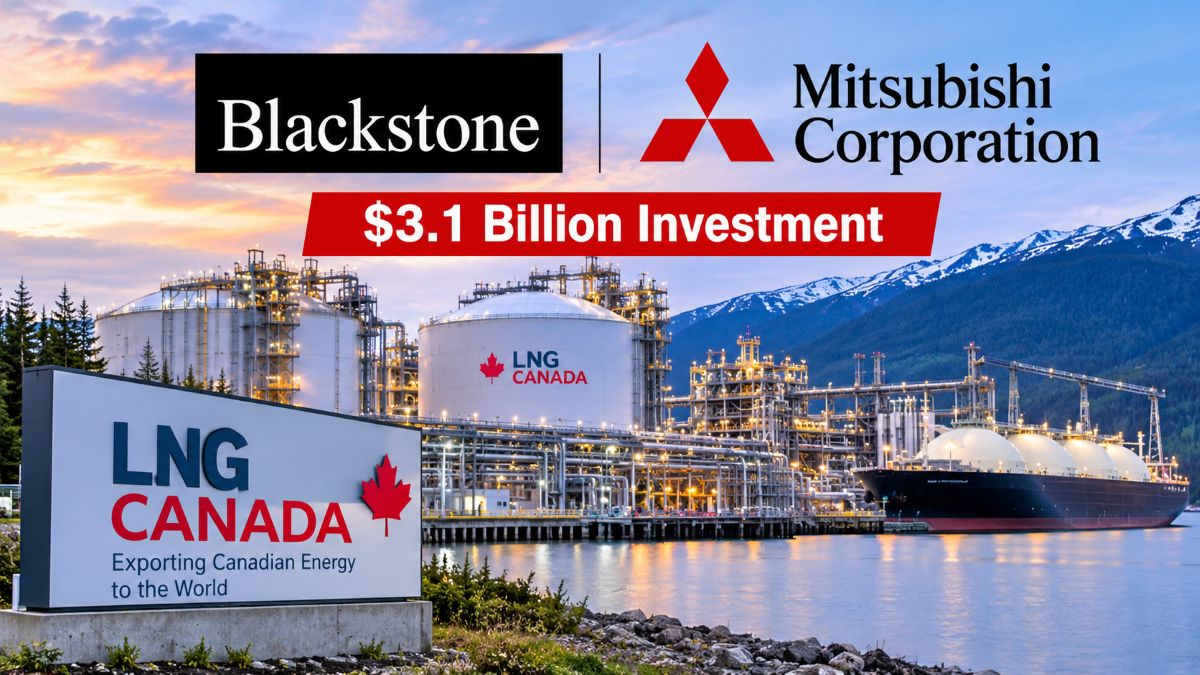
Blackstone Leads $3.1 Billion Investment in Mitsubishi’s LNG Canada Business
Introduction
A major investment agreement is bringing renewed attention to Canada’s energy infrastructure sector as Blackstone leads a $3.1 billion investment involving Mitsubishi Corporation’s interest in the LNG Canada project. The deal highlights the growing role of international financial institutions in supporting large-scale energy developments and strengthening global natural gas supply networks.
The agreement involves Blackstone investment funds and several Canadian institutional investors acquiring a minority interest in a Mitsubishi subsidiary connected to the liquefied natural gas business in British Columbia.
The development is particularly important for international energy markets because the Canadian facility is expected to increase its production capacity through a major expansion. The additional supply could strengthen Canada’s position as an exporter while creating new commercial opportunities for companies operating across the global energy industry.
Blackstone Announces Major Investment in Mitsubishi’s Canadian Energy Business
Blackstone announced on November 2, 2026, that its funds, alongside Canadian institutional investors, had agreed to acquire a 49.9% non-controlling stake in a Mitsubishi Corporation subsidiary.
The subsidiary holds Mitsubishi’s interest in the LNG Canada liquefaction business in British Columbia.
The investment agreement is valued at approximately $3.1 billion and represents a significant financial partnership between international investment firms and Canada’s institutional investment community.
The transaction does not involve the direct acquisition of 49.9% of the entire LNG Canada project. Instead, the investors are purchasing a minority interest in the holding company through which Mitsubishi owns its project interest.
Mitsubishi will retain control of the holding company, allowing the Japanese trading company to maintain its strategic involvement in the business.
Why Mitsubishi Is Bringing in Institutional Investors
Mitsubishi Corporation has established a significant position in international energy trading, natural gas supply and infrastructure development.
By bringing additional investors into its subsidiary, the company can unlock financial value from its existing investment while maintaining control of its business operations.
The partnership also allows Mitsubishi to share part of the financial exposure associated with major infrastructure developments.
For Blackstone, the agreement provides access to an established energy business with long-term commercial potential.
The participation of Canadian institutional investors further demonstrates how pension funds and large investment organizations are increasingly interested in infrastructure assets that support international trade and industrial activity.
LNG Canada Expansion Could Transform the Project’s Production Capacity
One of the most important aspects of the investment is the planned expansion of the LNG Canada facility.
Located in Kitimat, British Columbia, the project currently has an annual production capacity of approximately 14 million metric tons of liquefied natural gas.
The planned second phase is expected to increase the facility’s total production capacity to approximately 28 million metric tons annually.
This expansion could significantly improve Canada’s ability to supply international energy markets.
For Mitsubishi, the additional production capacity is especially important because its annual LNG offtake from the project is expected to increase from approximately 2.1 million metric tons to 4.2 million metric tons.
The additional volume could strengthen the company’s international supply operations and support its relationships with energy customers across Asia.
Why Canada Is Becoming an Important LNG Exporter
Canada has significant natural gas resources, and its Pacific coastline provides a strategic geographical advantage for exporting energy to Asian markets.
The LNG Canada facility represents an important development in the country’s efforts to expand its international energy trade.
The project is backed by several major international companies, including Shell, Mitsubishi Corporation, Petronas, PetroChina and Korea Gas.
Their participation brings together international experience in energy production, natural gas trading, infrastructure development and global distribution.
Canada’s ability to deliver LNG directly to international customers through Pacific shipping routes could also provide an alternative to traditional supply routes.
This geographical advantage is particularly relevant for countries seeking to diversify their energy imports and improve long-term supply security.
How the Investment Could Influence Global Energy Markets
The agreement reflects a wider trend in which major financial institutions are increasing their participation in strategic energy infrastructure.
Natural gas remains an important energy source for electricity generation, manufacturing, heating and industrial operations in many countries.
As global businesses continue to expand their operations, reliable energy supplies remain essential for economic activity.
The relationship between major infrastructure investments and broader economic development is also reflected in our coverage of AI investment and global economic growth in 2026, which explores how strategic investment is influencing international business activity.
For the energy sector, additional LNG production capacity could create opportunities for exporters, shipping companies, pipeline operators and international trading businesses.
However, the ultimate impact will depend on global demand, contract structures, transportation costs and future natural gas prices.
Why Asian Markets Matter to Mitsubishi’s Strategy
Asia is one of the most important destinations for international LNG supplies.
Japan and South Korea depend heavily on imported energy, while China remains a major participant in the international natural gas market.
Mitsubishi’s increased supply capacity could help the company strengthen its position among international buyers.
The expected rise in annual LNG offtake may also support its ability to manage long-term supply arrangements and serve customers across multiple markets.
For Asian energy importers, Canadian LNG provides another potential source of supply.
Diversification can help countries reduce dependence on individual suppliers and manage potential disruptions in international energy transportation.
Nevertheless, demand will continue to depend on economic conditions, energy policies and the competitiveness of natural gas compared with alternative energy sources.
Investment Opportunities and Risks in the LNG Industry
Large-scale energy infrastructure can offer long-term commercial opportunities, but investors must also consider several important risks.
Construction expenses: Expanding LNG facilities requires substantial investment in industrial equipment, processing systems and supporting infrastructure.
Market volatility: International natural gas prices can change significantly depending on supply, demand, weather and geopolitical conditions.
Regulatory challenges: Energy infrastructure projects must meet environmental standards and government requirements.
Global competition: LNG exporters compete with suppliers from different regions, making production costs and transportation efficiency important factors.
Energy transition: Growing investment in renewable energy and lower-emission technologies could influence long-term natural gas demand.
These challenges mean that financial returns will depend on more than production capacity alone. Efficient operations, reliable customers and competitive export costs will also be essential.
What Investors Should Watch in the Coming Months
The investment agreement could become an important development for Canada’s energy industry, but several factors will determine its long-term significance.
Investors should monitor the completion of the transaction, progress toward the second phase of the facility and Mitsubishi’s future supply arrangements.
Changes in international LNG prices and demand from major Asian importing countries will also be important.
Additionally, the financial performance of the project and future capital requirements could influence how institutional investors evaluate similar infrastructure opportunities.
The coming years will show whether the expansion can deliver the expected production growth and strengthen Canada’s role in international energy trade.
Final Thoughts
Blackstone’s $3.1 billion investment agreement involving Mitsubishi’s Canadian energy business represents a major development in the global infrastructure investment market.
The partnership combines international investment capital, Canadian institutional funding and Mitsubishi’s experience in the natural gas industry.
With the planned expansion expected to double the facility’s annual production capacity, the project could become increasingly important for Canada’s energy exports and international LNG supply networks.
Although construction costs, market volatility and the global energy transition present challenges, the agreement demonstrates continued institutional interest in strategically located energy infrastructure.
As international demand and energy policies continue to evolve, Canada’s LNG industry could play an increasingly important role in connecting North American natural gas resources with customers around the world.
Disclaimer: This article is for informational purposes only and does not constitute financial or investment advice.
