
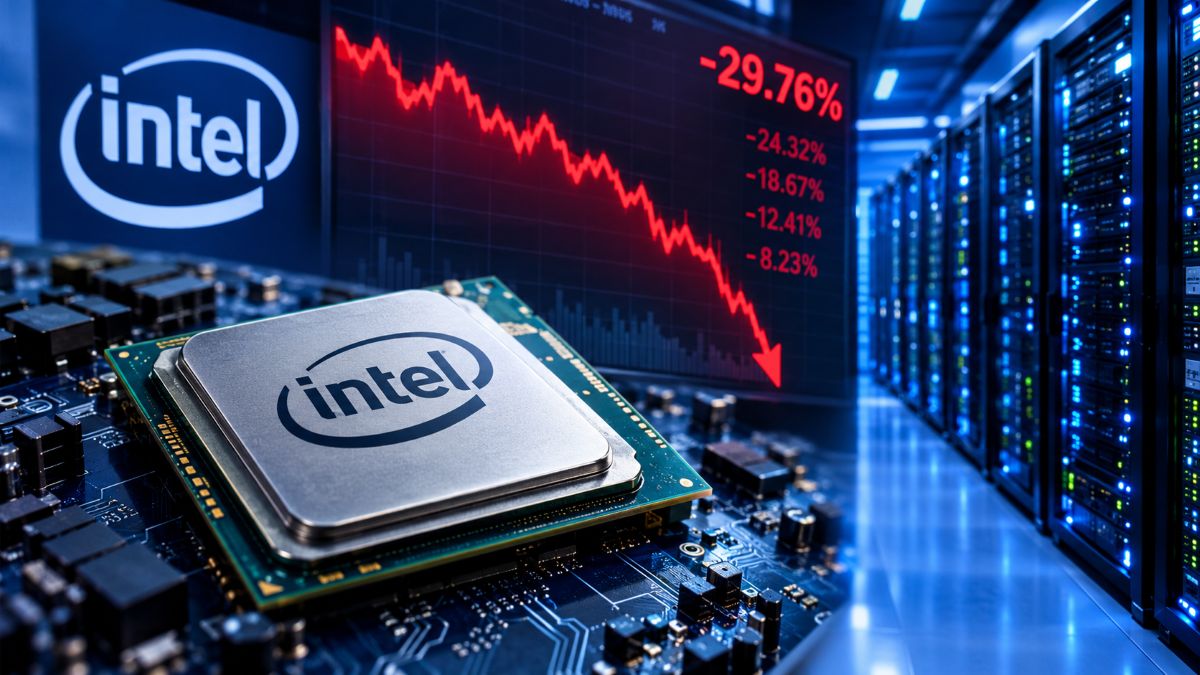
Intel Stock Plunges Nearly 30% as Weak Outlook and AI Chip Shortages Rattle Investors
Intel shares suffered a dramatic decline on Friday, October 30, 2026, after the semiconductor company delivered a disappointing fourth-quarter financial outlook and warned that production challenges could continue affecting its business. Despite reporting stronger-than-expected third-quarter earnings, investors reacted negatively to concerns about manufacturing capacity, rising memory costs and weakening personal computer demand.
The sharp decline erased more than $100 billion in market value during Friday’s trading, putting fresh pressure on the company’s ongoing turnaround strategy. The latest developments have also raised questions about whether Intel can fully benefit from the global artificial intelligence boom while struggling to meet demand for its processors.
The situation highlights a growing challenge across the semiconductor industry: strong demand for AI infrastructure does not automatically translate into stronger financial performance for every chipmaker.
Intel Stock Drops Nearly 30% Following Weak Financial Guidance
Intel shares plunged nearly 30% during Friday’s trading session after investors evaluated the company’s latest earnings report and weaker-than-expected business forecast.
The decline followed Intel’s third-quarter financial results, released on October 29. Although the company delivered revenue and adjusted earnings above analyst expectations, its outlook for the final quarter of 2026 disappointed Wall Street.
Intel projected fourth-quarter revenue between $15 billion and $16 billion, below the approximately $17 billion expected by analysts. The company also forecast non-GAAP earnings of $0.25 per share, compared with market expectations of approximately $0.43.
This gap between market expectations and management’s forecast quickly changed investor sentiment.
Investors had anticipated that increasing demand for AI servers and data-center processors would support stronger growth. However, Intel’s latest guidance showed that production limitations and weakness in its traditional PC business could prevent the company from capturing more of that opportunity.
Intel Reports Strong Third-Quarter Revenue Despite Market Concerns
One of the most important details behind Intel’s latest stock decline is that its third-quarter results were not entirely negative.
The company reported revenue of approximately $16.5 billion, representing 21% year-over-year growth. Its adjusted earnings reached $0.52 per share, exceeding analyst expectations of approximately $0.40.
These results demonstrated that demand for Intel’s products remained relatively strong across important parts of its business.
However, investors focused more heavily on what could happen next than on the company’s previous-quarter performance.
The weaker fourth-quarter forecast suggested that Intel might struggle to maintain its recent financial momentum. In the stock market, expectations often influence share prices as much as reported earnings, particularly when investors are evaluating companies undergoing major business transformations.
AI Chip Demand Creates New Opportunities but Exposes Supply Problems
Artificial intelligence has become one of the most important growth drivers for the semiconductor industry.
Technology companies are investing heavily in data centers, cloud computing infrastructure and advanced processors to support increasingly complex AI applications. This has created substantial demand for server CPUs and other semiconductor components.
Intel has been working to strengthen its position in this expanding market. Its Xeon processor family plays an important role in data-center computing, where businesses require reliable processing capacity for cloud services, enterprise applications and AI workloads.
However, the company faces a significant operational challenge: it cannot currently produce enough chips to satisfy all customer demand.
Manufacturing capacity limitations have restricted Intel’s ability to convert strong market demand into additional sales. This creates a difficult situation because the company has invested heavily in expanding its manufacturing operations while still facing shortages in important production areas.
For investors, the central question is no longer simply whether AI demand will increase. It is whether Intel can manufacture enough competitive products to benefit from that growth.
PC Market Weakness Adds More Pressure to Intel’s Business
Intel’s difficulties extend beyond AI-related manufacturing constraints.
The global personal computer market is facing additional pressure as higher memory prices increase the cost of producing laptops and desktop computers.
Memory components are essential parts of modern computing devices. When their prices increase, manufacturers may face higher production costs, while consumers may become more cautious about purchasing expensive computers.
This creates pressure throughout the PC supply chain.
Intel depends heavily on demand for processors used in personal computers. When manufacturers reduce production or delay purchasing decisions, demand for Intel’s client computing products can weaken.
The company has warned that weakness in the PC market could continue through at least the first half of 2027.
This longer recovery timeline has created additional uncertainty for investors who expected Intel’s traditional computing business to stabilize sooner.
Manufacturing Disruptions Create Additional Challenges
Intel’s production difficulties have also been affected by a factory disruption in Israel.
An explosion at the company’s Kiryat Gat facility resulted in a temporary shutdown that affected manufacturing operations. Intel has indicated that the disruption could reduce revenue by approximately $600 million across two quarters.
The company estimated that the incident would affect fourth-quarter revenue by roughly $300 million, with a similar impact potentially extending into the following quarter.
The disruption is particularly significant because Intel is already dealing with supply constraints.
When production facilities experience unexpected interruptions, manufacturers may struggle to maintain delivery schedules, meet customer commitments and manage operating costs.
For Intel, restoring production capacity and minimizing the financial impact of the incident will be important priorities over the coming months.
Intel’s Foundry Business Faces Increasing Competitive Pressure
Another major concern surrounding Intel is its ambition to become a stronger player in the contract chip manufacturing market.
Intel’s foundry strategy aims to manufacture semiconductors for external customers, creating a business that could compete with established manufacturing leaders such as Taiwan Semiconductor Manufacturing Company.
The opportunity is substantial because demand for advanced semiconductor manufacturing continues to expand.
However, attracting external customers requires competitive manufacturing technology, reliable production capacity and confidence in long-term execution.
Some Wall Street analysts have questioned whether Intel has demonstrated enough progress in securing major external foundry customers.
Bank of America also downgraded its rating on Intel following the latest results, citing concerns about foundry customer traction, PC demand and competitive pressure in data-center processors.
These concerns suggest that rebuilding investor confidence will require more than ambitious manufacturing announcements. Intel must demonstrate measurable progress in technology development, customer relationships and production efficiency.
Intel’s Turnaround Strategy Faces a Longer Road
CEO Lip-Bu Tan has been leading Intel’s efforts to improve manufacturing performance, strengthen its product portfolio and restore the company’s competitive position.
The turnaround strategy is particularly important as Intel competes against companies benefiting from growing demand for advanced computing and AI infrastructure.
However, the latest earnings outlook indicates that the recovery could take longer than many investors previously expected.
Intel must address several challenges simultaneously:
- Increase manufacturing capacity to meet customer demand.
- Improve the competitiveness of its server and PC processors.
- Stabilize its traditional personal computing business.
- Attract more external customers to its foundry operations.
- Manage manufacturing investments and operating costs.
- Restore confidence among investors and technology customers.
Successfully addressing these issues could strengthen Intel’s position over the long term. However, execution risks remain significant, particularly while competitors continue expanding their semiconductor capabilities.
How Intel’s Problems Reflect the Wider AI Semiconductor Market
Intel’s latest stock decline offers an important lesson about the broader AI investment cycle.
The rapid expansion of artificial intelligence has created opportunities for semiconductor manufacturers, data-center operators and technology infrastructure companies. However, the benefits are not distributed equally across the industry.
Some companies are experiencing stronger demand for their specialized products, while others are struggling with production limitations, competition and rising component costs.
For example, companies such as Marvell Technology are targeting opportunities in custom silicon, networking and advanced data-center connectivity as AI infrastructure expands.
This broader semiconductor market development is also reflected in our coverage of Marvell Technology’s long-term revenue ambitions as AI demand accelerates.
Meanwhile, Nvidia’s growing market influence demonstrates how investor expectations have increasingly focused on companies supplying critical AI computing infrastructure.
However, Intel’s latest performance shows that having exposure to the AI market does not guarantee immediate financial success.
Manufacturing execution, product competitiveness, supply availability and customer demand remain essential factors in determining which semiconductor companies can turn industry growth into sustainable earnings.
What Investors Will Watch Next
Intel’s next several quarters could be important in determining whether its turnaround strategy is gaining momentum or facing further delays.
Investors will likely monitor several important developments.
1. Manufacturing Capacity Improvements
Intel needs to demonstrate that it can increase production and reduce supply constraints. Stronger manufacturing output could help the company capture more demand from data-center customers.
2. Recovery in the PC Market
A stabilization in memory prices and improved consumer demand could support Intel’s client computing business. However, the company has indicated that meaningful improvement may take time.
3. Foundry Customer Growth
Securing additional external foundry customers would provide evidence that Intel’s manufacturing strategy is becoming more competitive.
4. Data-Center Revenue Growth
Demand for server processors remains an important opportunity. Investors will watch whether Intel can convert customer interest into actual shipments and sustained revenue growth.
5. Financial Performance and Cash Flow
Intel’s substantial manufacturing investments make profitability and cash generation especially important. Investors will evaluate whether the company can expand production while managing its financial commitments.
Is Intel Stock Facing a Temporary Setback or a Bigger Challenge?
Intel’s latest share-price collapse reflects concerns that extend beyond one disappointing earnings forecast.
The company continues to operate in a semiconductor market experiencing rapid technological change, intense competition and growing demand for AI infrastructure.
Its third-quarter results demonstrated that revenue growth remains possible. Nevertheless, weaker fourth-quarter guidance, production limitations, PC market weakness and manufacturing disruptions have created a more uncertain outlook.
A successful turnaround will depend on Intel’s ability to improve its manufacturing operations, strengthen its processor portfolio and attract more customers to its foundry business.
For now, investors will need to evaluate the company’s progress through future financial results rather than relying only on its long-term ambitions.
Final Thoughts
Intel’s nearly 30% stock decline on October 30 highlights the risks facing semiconductor companies during a period of rapid AI-driven industry expansion.
Although the company reported stronger-than-expected third-quarter earnings, its disappointing fourth-quarter outlook exposed significant challenges involving production capacity, PC demand and manufacturing execution.
The AI boom continues to create opportunities across the global technology industry, but Intel must demonstrate that it can translate those opportunities into consistent financial growth.
As demand for AI chips and data center infrastructure continues to grow, AI investment and global economic growth in 2026 are becoming increasingly connected to the semiconductor industry’s future.
The coming quarters will be important for determining whether the company’s turnaround strategy can regain momentum and restore investor confidence.
