
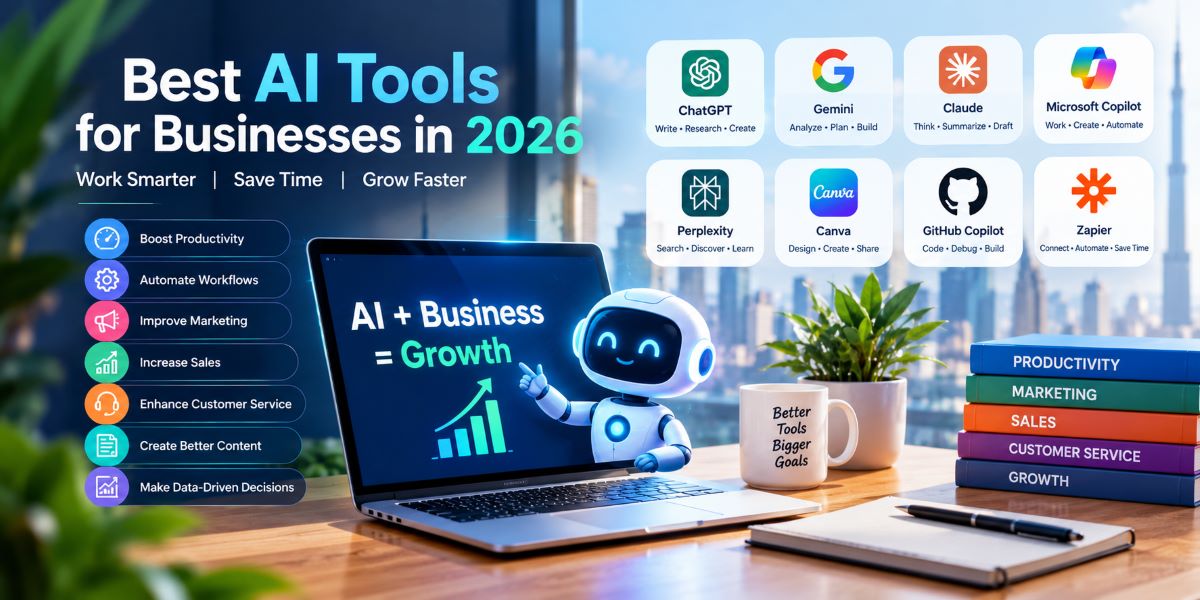
AI has quickly moved from an experimental technology to a practical business tool. Companies now use AI for writing, research, marketing, sales, customer support, data analysis, software development, and workflow automation. Popular platforms such as ChatGPT, Google Gemini, Claude, Microsoft Copilot, and Perplexity can help employees complete everyday tasks faster, while specialized tools can automate marketing, design, customer service, and development workflows. As the Latest AI Trends in 2026 continue to develop, businesses should focus less on using AI simply because it is popular and more on choosing tools that solve real problems, fit their workflow, and provide measurable value.
What Are AI Tools for Businesses?
AI tools for businesses are software applications that use artificial intelligence to help employees perform tasks, analyze information, create content, communicate with customers, or automate workflows. Some are general-purpose assistants, while others are designed for specific departments such as marketing, sales, customer service, finance, or software development.
How AI Business Tools Work: AI business tools can understand and process different types of information, including text, documents, images, data, audio, and code. For example, ChatGPT can help create drafts, summarize information, brainstorm ideas, analyze supplied data, and assist with research. Google Gemini can support writing, research, and productivity tasks across Google’s ecosystem, while Microsoft Copilot is designed to assist users within Microsoft’s work environment.
Why Companies Are Adopting AI Tools: Businesses are adopting AI because employees often spend hours on repetitive tasks such as writing emails, preparing reports, summarizing meetings, researching information, and organizing documents. AI can speed up these activities and give employees more time for strategy, creativity, customer relationships, and other work that requires human judgment.
AI Tools vs Traditional Business Software: Traditional software generally follows predefined workflows, while AI software can interpret information and generate responses dynamically. For example, a traditional reporting tool may display sales figures, while an AI assistant can help summarize the figures, identify patterns, and turn the information into a readable report.
Best AI Tools for Businesses in 2026
There is no single best AI tool for every company. The right choice depends on the task, industry, budget, existing software, and level of human oversight required.
Best AI Productivity Tools: ChatGPT is useful for drafting emails, creating documents, brainstorming, summarizing information, researching topics, and assisting with everyday knowledge work. Claude can also help teams work with long documents, write and edit content, and organize complex information. Microsoft Copilot can be particularly useful for organizations already working extensively with Microsoft applications. These tools can reduce the time employees spend on routine writing and information-processing tasks.
Best AI Automation Tools for Businesses: Tools such as Zapier can connect different business applications and automate repetitive workflows. For example, a business can create workflows that move information between applications, trigger follow-up actions, or organize incoming data. AI-powered automation becomes particularly useful when repetitive tasks involve multiple applications and would otherwise require manual intervention.
Best AI Tools for Marketing: Marketing teams can use ChatGPT, Google Gemini, Claude, Canva AI, and other specialized marketing platforms for content ideas, copywriting, campaign planning, research, and creative production. Canva’s AI features can help teams create and modify visual content more efficiently, while general AI assistants can help marketers brainstorm campaigns, prepare content briefs, and refine messaging. Human review remains important for brand consistency, originality, and factual accuracy.
Best AI Tools for Sales: AI can support sales teams with prospect research, email drafting, lead qualification, CRM assistance, and meeting preparation. ChatGPT, Gemini, and Microsoft Copilot can help sales representatives prepare personalized communication and summarize customer information, while specialized CRM platforms can provide AI features directly inside sales workflows. The main benefit is reducing administrative work so salespeople can spend more time with prospects and customers.
Best AI Tools for Customer Service: Businesses can use AI-powered customer service platforms to answer common questions, search knowledge bases, summarize support tickets, and assist human agents. ChatGPT and other AI assistants can help create support responses and organize information, while dedicated customer-service platforms can integrate AI directly into ticketing and support workflows. This can help companies respond faster while allowing human agents to handle complex or sensitive issues.
Best AI Tools for Content Creation: ChatGPT, Claude, Google Gemini, and Canva AI can support different parts of the content-production process. ChatGPT and Claude can help with outlines, drafts, editing, and idea development, while Canva AI can assist with visual content. AI video and voice platforms can also speed up production for marketing teams. The biggest benefit is usually faster content production, but businesses should add original information, expert input, editing, and fact-checking before publishing.
Best AI Tools for Data Analysis: AI assistants can make business data easier to understand. ChatGPT can help users analyze supported datasets, summarize findings, and explain information in plain language. Other business intelligence platforms increasingly include AI features for reporting and data exploration. These tools can help non-technical employees ask questions about business information without manually creating every analysis, although important decisions should still be checked against the underlying data.
Best AI Tools for Software Development: GitHub Copilot is designed to assist developers with coding, while general AI assistants such as ChatGPT and Claude can help explain code, troubleshoot problems, create documentation, and suggest solutions. These tools can reduce development time and help developers work through technical problems more quickly. However, generated code should always be reviewed for security, correctness, performance, and compatibility.
AI Tools for Small Businesses and Startups
Small businesses do not need dozens of AI applications to benefit from the technology. A small team might start with ChatGPT or Gemini for general productivity, Canva AI for marketing design, and an automation platform such as Zapier for repetitive workflows. The goal should be to solve the team’s biggest time-consuming problems before adding more software.
Affordable AI Tools for Small Businesses: General-purpose AI assistants can be cost-effective because one platform may support several tasks, including writing, research, brainstorming, customer communication, and document work. This can be useful for small companies that cannot afford separate software for every business function.
AI Tools for Startups: Startups can use AI to accelerate market research, content production, customer support, product development, and internal operations. ChatGPT, Claude, Gemini, Perplexity, and GitHub Copilot can support different parts of the startup workflow, allowing small teams to move faster without immediately expanding every department.
How Small Teams Can Use AI With Limited Resources: The best approach is to start with a clear use case. For example, a small company could use ChatGPT to reduce writing time, Canva AI for social graphics, and Zapier to automate repetitive administrative processes. Measuring the time saved can help determine whether an AI tool is actually worth keeping.
How AI Tools Can Help Businesses Grow
AI can contribute to business growth by helping teams work faster and make better use of existing resources.
Improve Employee Productivity
Tools such as ChatGPT, Claude, Gemini, and Microsoft Copilot can assist with drafting, summarization, research, meeting preparation, and everyday knowledge work. This can reduce time spent on routine tasks.
Reduce Repetitive Work
Automation platforms can connect applications and handle recurring processes. This can reduce manual data entry, repetitive reporting, and routine administrative work.
Improve Customer Experience
AI assistants and chatbots can provide faster answers to common questions and help support teams find relevant information. Human agents can then focus on complicated customer issues.
Support Faster Decision-Making
AI can summarize large amounts of information and present it in an easier-to-understand format. Business leaders can use those summaries as an input while still reviewing the underlying information before making important decisions.
Reduce Operational Costs
When AI reduces the amount of manual work required for certain processes, businesses may be able to handle more work without increasing administrative workload at the same pace. Actual cost savings depend on how the technology is implemented.
How to Choose the Best AI Tools for Your Business
Choosing the right AI tool should start with the business problem rather than the name of the technology.
Identify Your Business Goal: Decide what you want to improve. It could be content production, customer support, sales productivity, research, reporting, or workflow automation.
Check Features and Integrations: Look for tools that work with your existing software. For example, Microsoft-focused organizations may benefit from Copilot integrations, while businesses using many different applications may find automation platforms useful.
Compare Pricing and Scalability: Consider your current budget as well as future usage. A tool should remain practical as the number of employees, customers, and tasks increases.
Evaluate Security and Data Privacy: Before entering company information into an AI service, review its privacy policies, data controls, access permissions, and security practices. Sensitive information requires particular care.
Check Accuracy and Human Oversight: AI-generated information can contain errors. Employees should review important outputs, especially information involving finances, legal matters, security, customers, or business-critical decisions.
What to Consider Before Using AI Business Software
Introducing AI successfully requires more than purchasing a subscription. Businesses should establish clear rules for data handling, train employees, test outputs, and decide which tasks require human approval. Companies should also avoid adding too many overlapping AI applications, because unnecessary tools can increase costs and make workflows harder to manage.
AI Tools for Businesses and the Latest AI Trends in 2026
The Latest AI Trends in 2026 are influencing how business software works. AI agents are moving toward multi-step task completion, multimodal systems can process different types of information, and AI assistants are becoming more deeply connected with workplace applications. Tools such as ChatGPT, Gemini, Claude, Microsoft Copilot, and Perplexity demonstrate how general-purpose AI is becoming useful across research, writing, analysis, and business workflows.
AI Agents and Workflow Automation: AI agents are designed to handle sequences of tasks rather than simply answer individual questions. Combined with automation platforms, they can potentially manage more complex business processes with less manual involvement.
Multimodal AI: Modern AI systems increasingly work with text, images, audio, documents, and other formats. This can help businesses process information that previously required separate tools.
AI-Powered Business Assistants: AI assistants can help employees research information, draft communications, summarize documents, organize work, and answer questions. Their value increases when they can work with the tools and information employees already use.
AI Search and Business Discovery: Perplexity and other AI-powered search experiences demonstrate a shift toward conversational information discovery. Businesses should continue producing useful, accurate, well-structured content that clearly explains their products, services, expertise, and answers to customer questions.
More Specialized AI Business Tools: Alongside general-purpose platforms, specialized AI tools are appearing for marketing, design, sales, development, customer support, analytics, and other professional tasks. This gives businesses more opportunities to choose software specifically suited to their workflows.
AI Business Tools by Business Need
| Business Need | Example AI Tools | Main Benefit |
| Productivity | ChatGPT, Claude, Gemini | Writing, research, summaries, brainstorming |
| Workplace assistance | Microsoft Copilot | AI support within workplace applications |
| Research | Perplexity, ChatGPT | Faster information discovery and analysis |
| Automation | Zapier and AI automation platforms | Reduce repetitive workflows |
| Marketing | ChatGPT, Gemini, Canva AI | Content, campaigns, ideas, visual creation |
| Sales | ChatGPT, Copilot, CRM AI tools | Research, emails, customer information |
| Customer support | AI chatbots and support platforms | Faster responses and ticket assistance |
| Content | ChatGPT, Claude, Canva AI | Writing and creative production |
| Development | GitHub Copilot, ChatGPT, Claude | Coding, debugging, documentation |
| Data | ChatGPT and AI-enabled analytics tools | Analysis, summaries, reporting |
Frequently Asked Questions About AI Tools for Businesses
What are the best AI tools for businesses in 2026?
The right tool depends on the business need. ChatGPT, Claude, Gemini, Microsoft Copilot, Perplexity, Canva AI, Zapier, and GitHub Copilot can support different areas such as productivity, research, marketing, automation, design, and software development.
What are the best AI tools for small businesses?
Small businesses can start with multipurpose tools such as ChatGPT or Gemini and add specialized tools such as Canva AI or Zapier when a specific workflow requires them.
Which AI tools can help a business grow?
AI tools can support growth by improving productivity, automating repetitive tasks, assisting marketing and sales, improving customer service, and helping teams understand business information.
What are the best AI tools for marketing and sales?
ChatGPT, Gemini, Claude, Canva AI, Microsoft Copilot, and specialized marketing or CRM AI tools can assist with content, research, campaign planning, sales communication, and customer information.
How can businesses use AI for automation?
Businesses can use AI and automation platforms to process documents, organize information, update records, trigger workflows, prepare reports, and handle repetitive administrative tasks.
Are AI tools safe for business data?
Security depends on the specific provider, plan, configuration, and information being processed. Businesses should review privacy and security policies before entering confidential or sensitive data.
How do I choose the right AI tool for my company?
Start with a specific business problem, then compare features, integrations, pricing, scalability, security, accuracy, and ease of use. Testing a tool with a limited workflow can help determine whether it provides genuine value.
Can startups use AI tools to reduce costs?
Yes. Startups can use AI for research, content, customer support, coding, administration, and automation. Tools such as ChatGPT, Claude, Gemini, Canva AI, and GitHub Copilot can support multiple areas of a small operation, reducing the need for separate tools or manual work in some workflows.
