


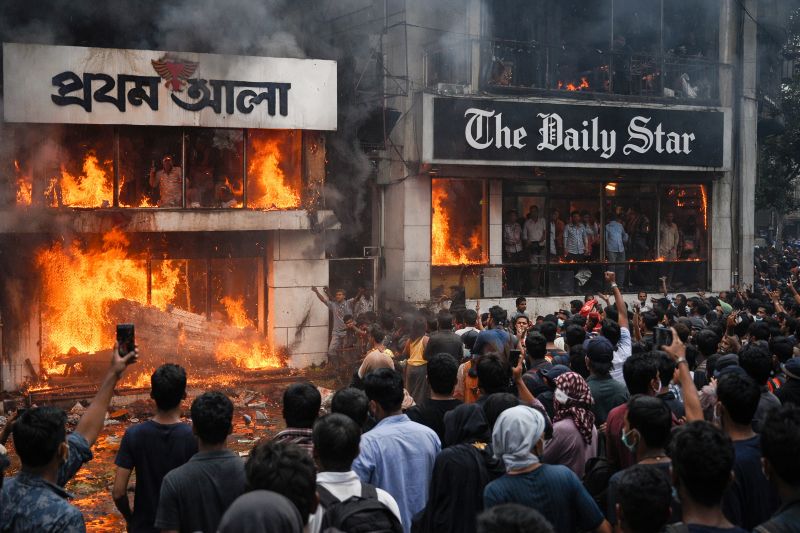
Protesters Storm and Set Fire to Offices of Major Newspapers in Dhaka After Death of Student Leader
Dhaka, Bangladesh — Offices of two of Bangladesh’s most prominent newspapers, Prothom Alo and The Daily Star, were attacked and set on fire in the capital Dhaka as nationwide protests intensified following the death of student leader Sharif Osman Hadi, according to witnesses, journalists, and local authorities.
The attacks occurred amid escalating unrest that erupted after confirmation that Hadi, a 32-year-old student activist who had been shot earlier this month, died while undergoing treatment in Singapore. His death has sparked widespread demonstrations across the country, with anger increasingly directed not only at the authorities but also at media organizations accused by protesters of bias or silence.
Newspaper Offices Targeted Amid Escalating Protests
On Tuesday evening, large crowds gathered outside the offices of Prothom Alo and The Daily Star, located in central Dhaka. Witnesses said protesters broke through security gates, vandalized property, and set fire to parts of the buildings. Thick smoke was seen rising from the premises as chaos unfolded in the surrounding areas.
Journalists and staff working inside the buildings were temporarily trapped as fires spread and exits were blocked by demonstrators. Several media workers later said they feared for their lives as windows were smashed and smoke filled the offices.
Emergency services and law enforcement units eventually arrived at the scene, evacuating journalists and extinguishing the fires. No fatalities were reported, but several people were treated for smoke inhalation and minor injuries, according to hospital officials.
Journalists Evacuated as Fire Spreads
Reporters inside the buildings described moments of panic as protesters breached the premises. Some journalists barricaded themselves in rooms, while others attempted to flee through alternative exits once security forces intervened.
“We could hear shouting, glass breaking, and then smoke started coming in,” one journalist said on condition of anonymity due to safety concerns. “We did not know if we would be able to get out.”
Media unions and press freedom organizations later confirmed that all journalists were safely evacuated, though equipment, archives, and office infrastructure sustained significant damage.
Motives Behind the Attacks
Protest organizers accused certain media outlets of failing to adequately cover Hadi’s shooting and death or of presenting narratives they believed favored the authorities. Social media posts circulating ahead of the attacks called for demonstrations outside media houses perceived as “complicit” or “silent.”
However, senior editors from both Prothom Alo and The Daily Star strongly rejected the allegations, stating that their coverage had adhered to journalistic standards and that they had reported on the incident responsibly.
“These attacks are an assault on press freedom,” said a senior editor at one of the newspapers. “Journalists cannot be held hostage for reporting facts.”
Government and Police Response
Authorities condemned the attacks, calling them unacceptable and unlawful. Police officials said investigations had been launched to identify those responsible for the arson and vandalism.
“The safety of journalists and media institutions is a priority,” a police spokesperson said. “Anyone involved in violence or destruction of property will be brought to justice.”
Security was increased around major media outlets in Dhaka and other cities following the incidents, with additional police patrols deployed overnight.
Press Freedom Groups Condemn Violence
Local and international press freedom organizations swiftly condemned the attacks, warning that violence against media institutions undermines democratic principles and the public’s right to information.
The Bangladesh Journalists’ Union said the assaults represented one of the most serious threats to media safety in recent years. International watchdogs echoed these concerns, urging the government to ensure accountability and protect journalists during the ongoing unrest.
“Targeting news organizations is a dangerous escalation,” one statement said. “Journalists must be allowed to do their work without fear of violence.”
Wider Context of National Unrest
The attacks on media offices come amid widespread unrest triggered by the death of Sharif Osman Hadi. Protests have erupted across Dhaka and other major cities, with demonstrators blocking roads, clashing with police, and demanding justice for the slain activist.
Hadi was known as a prominent student leader who participated in organizing protests and speaking out on political and social issues. Supporters have described his death as emblematic of broader concerns about political accountability and security in the country.
Authorities have said an investigation into his shooting is ongoing, while urging the public to remain calm and allow legal processes to proceed.
Media Caught in the Crossfire
Analysts say the attacks highlight the increasingly precarious position of media organizations during periods of political turmoil. While journalists are often tasked with documenting unrest, they can also become targets of public anger when trust in institutions erodes.
“Media houses are being unfairly blamed for political grievances,” said a Dhaka-based political analyst. “This is a troubling development that could have long-term consequences for press freedom.”
Several media outlets temporarily suspended operations following the attacks, citing security concerns. Journalists were advised to work remotely, and some newspapers delayed print editions.
Public Reaction and Calls for Restraint
Public reaction to the attacks has been mixed. While many expressed outrage at the violence against journalists, others on social media defended the protests while stopping short of endorsing attacks on media offices.
Civil society groups and academics have called for restraint, urging protesters to channel grievances peacefully and warning that attacks on the press could undermine legitimate demands for justice.
“The right to protest does not include the right to silence the media,” one civil rights advocate said.
Uncertain Path Ahead
As protests continue and tensions remain high, questions linger about how the government will balance maintaining order with respecting freedom of expression and assembly. The attacks on Prothom Alo and The Daily Star have added a new dimension to the crisis, raising fears of further escalation if grievances are not addressed.
For now, Bangladesh remains on edge, with journalists, protesters, and authorities navigating an increasingly volatile environment. The coming days are expected to be critical in determining whether calm can be restored or whether unrest will deepen further.
