


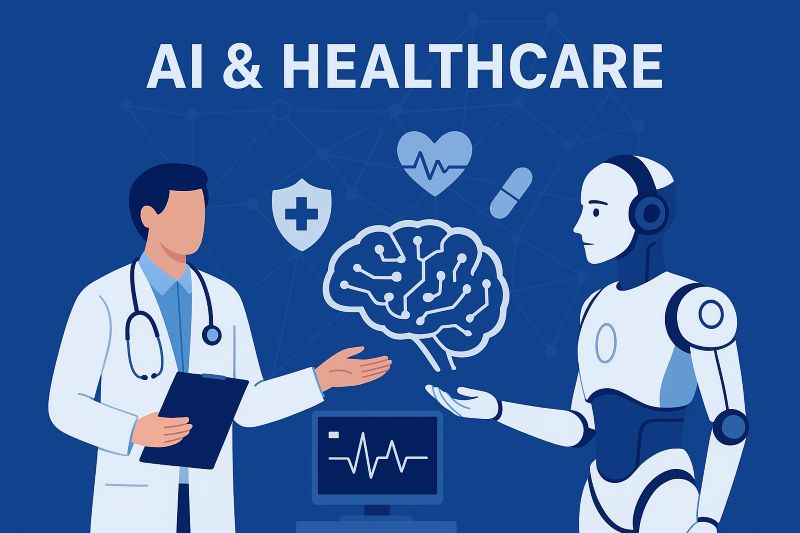
AI and Healthcare: How Artificial Intelligence Is Transforming Modern Medicine
The healthcare world is changing fast — and artificial intelligence (AI) is leading the way. From reading medical scans to predicting illnesses before they happen, AI and machine learning are helping doctors make better, faster decisions.
This new digital shift isn’t about replacing doctors — it’s about giving them powerful tools that make care safer, smarter, and more personal.
What Is AI in Healthcare?
AI in healthcare means using intelligent computer systems that can think, learn, and improve from medical data.
These systems study patterns in test results, medical images, and patient histories to find insights that humans might miss.
Machine learning (ML) — a branch of AI — trains models to recognize patterns and make predictions.
Together, AI and ML are improving how diseases are detected, diagnosed, and treated.
The Major Ways AI Is Changing Healthcare
1. Early and Accurate Diagnosis
AI is helping doctors find diseases earlier and more accurately.
It can analyze X-rays, CT scans, or even eye images within seconds.
Instead of waiting days for results, doctors get instant alerts when something looks unusual.
This early detection helps start treatment faster, often improving survival rates and recovery times.
2. Personalized Treatments
Every person’s body reacts differently to medicine. AI looks at thousands of factors — age, genetics, habits, and past medical records — to recommend the best treatment for each individual.
This is called personalized medicine. It ensures patients get care that fits them, not just a general plan.
3. Reducing Doctors’ Workload
AI tools are also helping behind the scenes.
They can write medical notes, fill forms, and even summarize patient histories.
Doctors spend less time on paperwork and more time caring for people.
Hospitals that use AI-driven record systems are finding that it saves hours every day.
4. Smarter Monitoring with Wearables
Smartwatches, fitness bands, and health apps collect huge amounts of real-time data.
AI studies this data to detect unusual heartbeats, sleep problems, or oxygen drops — sometimes even before the user notices.
This helps prevent emergencies and encourages healthier habits.
Why AI Adoption Is Growing
AI in healthcare is booming because technology and data are finally ready.
Hospitals now collect millions of data points daily, and modern computers can process them quickly.
Cloud storage and secure servers make it easier to train and deploy AI systems safely.
At the same time, patients and doctors are becoming more open to digital health tools, especially after seeing their power during the pandemic.
Real-World Examples of AI in Action
-
Cancer Detection: AI tools help radiologists identify tumors in scans faster than traditional methods.
-
Eye Screening: Small clinics use AI cameras to detect diabetic eye problems, even without an eye specialist present.
-
Virtual Assistants: AI chatbots guide patients to the right care or answer simple health questions.
-
Drug Development: AI shortens the time needed to find effective new medicines by analyzing millions of combinations quickly.
The Benefits for Everyone
For Patients
-
Faster diagnosis and treatment
-
More personalized care
-
Better access to healthcare in remote areas
For Doctors
-
Less paperwork
-
More accurate data insights
-
Time to focus on patient care instead of admin work
For Hospitals
-
Lower costs through automation
-
Fewer errors due to consistent AI checks
-
Improved patient satisfaction and efficiency
The Challenges and Risks
AI brings big advantages, but it’s not perfect.
1. Data Privacy
AI systems need access to health data, which raises privacy concerns.
Hospitals must make sure all information is stored and shared securely.
2. Bias in Algorithms
If AI learns mostly from one type of data, it might perform poorly on other groups.
That’s why it’s important to train models on diverse and accurate datasets.
3. Overdependence on Technology
AI should support, not replace doctors.
Human judgment and compassion remain irreplaceable in healthcare.
4. Regulation and Trust
Governments are still figuring out how to approve and monitor AI systems.
Until clear rules exist, hospitals must test every tool carefully before full use.
The Future of AI in Healthcare
The next few years will bring even more exciting progress:
-
AI Health Assistants: Digital assistants that answer medical questions or prepare reports instantly.
-
Predictive Medicine: Tools that warn doctors weeks before a health issue happens.
-
Remote Hospitals: Virtual monitoring for patients anywhere in the world.
-
AI-Driven Clinical Trials: Faster, cheaper ways to test new drugs and vaccines.
The ultimate goal is a world where technology and doctors work hand in hand to keep people healthier, longer.
How Healthcare Providers Can Start with AI
-
Identify a small problem first. Don’t try to digitize everything at once.
-
Train your staff. Everyone must understand how the AI tool works.
-
Keep human review. AI gives advice, but final decisions stay with experts.
-
Monitor constantly. Track results, safety, and patient feedback after AI deployment.
-
Choose reliable vendors. Use solutions built by transparent, ethical developers.
Final Thoughts
AI is not the future of healthcare — it’s the present.
It is already helping doctors save time, patients get better care, and hospitals run more smoothly.
The key is balance: using AI to make healthcare smarter, without losing the human touch.
When combined with skilled professionals and ethical oversight, AI has the power to make medicine more accurate, affordable, and compassionate than ever before.
FAQs
Q1: What does AI actually do in healthcare?
AI helps doctors read medical data, predict health risks, and manage records faster and more accurately.
Q2: Can AI replace doctors?
No. AI supports doctors by handling repetitive or data-heavy work, but medical decisions still need human expertise.
Q3: Is AI safe to use in hospitals?
Yes, when tested and monitored properly. Hospitals must follow strict privacy and safety rules.
Q4: How does AI protect patient data?
AI systems use encryption and secure storage, but hospitals are responsible for ensuring full compliance with privacy laws.
Q5: What is the future of AI in medicine?
AI will continue to grow in areas like early disease detection, personalized care, and remote monitoring — making healthcare more proactive and efficient.
