


Table of Contents
ToggleAI Agents in Customer Support: The Future of Call Centers
Customer support has always been a critical part of business success. Whether a customer has a question about a product, needs help with a service, or faces a technical issue, the support team plays a major role in maintaining customer satisfaction and trust. Traditionally, companies relied on large call centers with human agents handling phone calls, emails, and live chats.
However, the modern business environment is changing rapidly. Customers now expect instant responses, 24/7 support, and personalized experiences. Meeting these expectations with only human agents can be expensive and difficult. As a result, many organizations are turning to AI agents to transform the way customer support works.
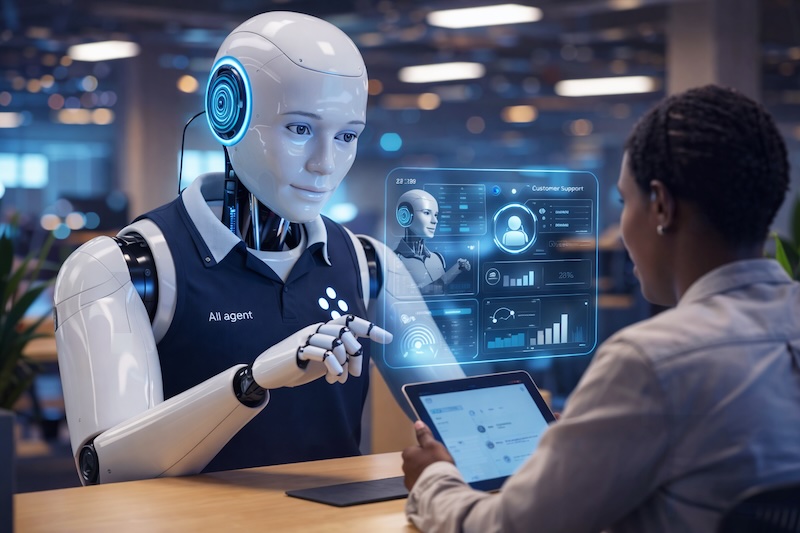
AI agents are intelligent software systems that can understand customer requests, analyze information, and provide solutions automatically. These systems are becoming an essential part of the modern call center, helping companies deliver faster and more efficient support.
This article explores how AI agents are reshaping customer service operations and why they are considered the future of call centers.
Understanding AI Agents in Customer Support
AI agents in customer support are advanced systems powered by artificial intelligence technologies such as natural language processing, machine learning, and automation. These agents can communicate with customers through multiple channels, including chat, voice, email, and messaging platforms.
Unlike traditional chatbots that follow simple scripts, AI agents are capable of understanding the context of a conversation and responding intelligently. They can analyze customer questions, search for relevant information, and provide accurate responses.
For example, if a customer asks about an order status, an AI agent can automatically access the company’s database, retrieve the information, and provide an update within seconds. This process reduces the need for manual intervention and speeds up customer support.
Because AI agents can operate continuously without breaks, they enable companies to offer round-the-clock assistance, which is especially valuable for businesses with global customers.
The Evolution of Call Centers
Call centers have evolved significantly over the years. In the past, support operations relied entirely on human agents answering phone calls. As digital communication grew, companies introduced email support, live chat systems, and online help desks.
The next step in this evolution is the integration of artificial intelligence.
Initially, businesses adopted simple chatbots that could answer frequently asked questions. While helpful, these systems were limited because they relied on predefined scripts.
Today, AI agents represent a new generation of customer support technology. These systems can handle complex interactions, learn from customer data, and improve their performance over time. As a result, modern call centers are becoming AI-assisted support centers, where human agents and AI systems work together.
Key Benefits of AI Agents in Call Centers
The adoption of AI agents in customer support offers several important benefits for businesses and customers alike.
Faster Response Times
One of the biggest advantages of AI agents is their ability to provide instant responses. Customers no longer need to wait in long call center queues or wait hours for email replies.
AI agents can immediately respond to inquiries and provide relevant information. This significantly improves customer satisfaction.
24/7 Customer Support
Human support teams usually work in shifts and may not be available at all times. AI agents, on the other hand, can operate continuously without interruptions.
This allows companies to provide customer service around the clock, which is especially important for international businesses serving customers in different time zones.
Reduced Operational Costs
Running a traditional call center requires significant resources, including salaries, training, infrastructure, and management.
AI agents help reduce these costs by automating many routine tasks. Businesses can handle a larger number of customer inquiries without hiring additional staff.
Improved Accuracy and Consistency
Human agents may occasionally make mistakes or provide inconsistent information. AI agents rely on structured data and predefined knowledge bases, ensuring that responses are accurate and consistent.
This helps maintain service quality and reduces the risk of errors.
How AI Agents Handle Customer Support Tasks
AI agents can perform a wide range of customer service tasks, many of which previously required human intervention.
Answering Frequently Asked Questions
Many customer inquiries involve common questions such as product information, delivery timelines, or account management. AI agents can quickly provide answers to these questions by accessing company databases.
Order Tracking and Account Support
Customers often contact support teams to check order statuses or update account details. AI agents can automatically retrieve this information and provide updates in real time.
Technical Troubleshooting
AI agents can guide customers through troubleshooting steps for technical issues. For example, they may help users reset passwords, fix connectivity problems, or configure software settings.
Routing Complex Issues
While AI agents can handle many tasks, some situations still require human expertise. In such cases, AI systems can intelligently route the issue to the appropriate human agent.
By analyzing the problem and providing relevant information to the support team, AI agents help resolve issues faster.
AI Agents and Human Agents Working Together
Despite their advanced capabilities, AI agents are not designed to completely replace human support teams. Instead, they work alongside human agents to improve efficiency.
AI agents handle routine tasks such as answering basic questions or retrieving information. This allows human agents to focus on more complex or sensitive issues that require empathy and critical thinking.
For example, if a customer is frustrated about a service problem, a human agent can provide personalized assistance and build a positive relationship with the customer.
This collaboration between AI systems and human agents creates a hybrid support model, combining the speed of automation with the understanding of human interaction.
Personalization Through AI
One of the most powerful features of AI agents is their ability to personalize customer interactions.
By analyzing customer data such as purchase history, preferences, and previous interactions, AI agents can provide tailored recommendations and solutions.
For instance, if a customer frequently buys certain products, an AI agent may suggest similar items or notify them about relevant promotions.
This personalized experience improves customer engagement and strengthens brand loyalty.
Challenges and Considerations
While AI agents offer many benefits, businesses must also address certain challenges when implementing them in customer support operations.
Data Privacy and Security
AI systems often process large amounts of customer data. Companies must ensure that this data is protected and handled according to privacy regulations.
Maintaining Human Touch
Customer service is not only about solving problems but also about building relationships. Over-reliance on automation may make interactions feel impersonal.
Businesses must balance automation with human support to maintain a positive customer experience.
Continuous Training and Improvement
AI agents must be trained with accurate data and continuously updated to handle new situations. Without proper training, AI systems may provide incorrect responses.
Regular monitoring and improvement are necessary to maintain high-quality support.
The Future of Call Centers
The future of call centers will likely involve deeper integration between artificial intelligence and human support teams.
In the coming years, AI agents are expected to become even more advanced. They may be able to understand emotions in customer conversations, predict potential issues before they occur, and proactively offer assistance.
Voice-based AI agents may also become more common, enabling natural conversations that closely resemble human interactions.
Additionally, companies may deploy multi-agent AI systems, where different AI agents collaborate to handle complex support workflows.
As these technologies evolve, customer support will become faster, more efficient, and more personalized.
Conclusion
AI agents are transforming the way businesses handle customer support. By automating routine tasks, providing instant responses, and operating around the clock, these intelligent systems are helping companies deliver better service while reducing operational costs.
Rather than replacing human agents, AI technology is enabling a new model where automation and human expertise work together. AI agents handle repetitive tasks, while human agents focus on solving complex issues and building meaningful customer relationships.
As artificial intelligence continues to advance, the role of AI agents in call centers will only grow. Businesses that adopt these technologies today will be better prepared to meet the expectations of modern customers and create more efficient customer support operations in the future.
