

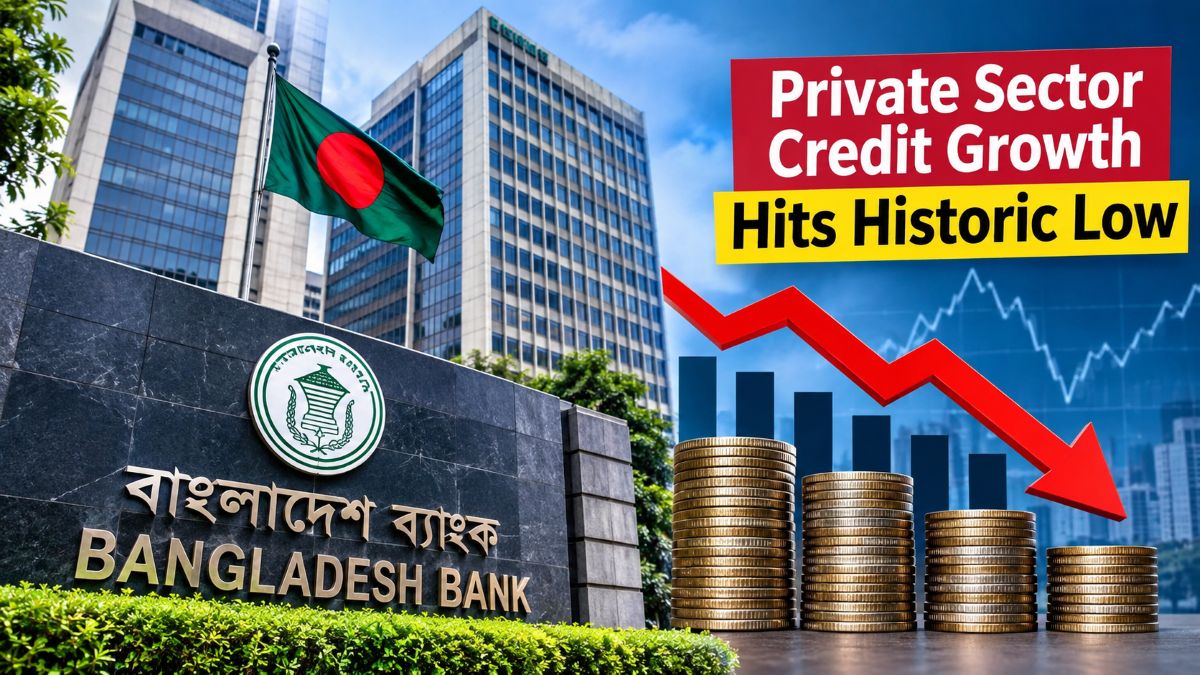
Bangladesh Private Sector Credit Growth Hits Historic Low as Investment Slows
Bangladesh’s economy is facing increasing pressure as businesses become more cautious about borrowing and expanding their operations. According to provisional data from Bangladesh Bank, private sector credit growth dropped to just 4.17% in September 2026, down from 4.75% in August. The decline highlights growing concerns about business confidence, investment activity and the country’s economic outlook.
The slowdown in lending reflects broader economic challenges, including high borrowing costs, inflationary pressure, energy shortages and uncertainty surrounding future business conditions. As companies postpone expansion plans, concerns are increasing about employment opportunities, industrial production and long-term economic development.
Bangladesh’s Private Sector Lending Falls to a Historic Low
Bangladesh Bank’s latest figures show that private sector credit growth reached only 4.17% in September 2026. This was significantly below the central bank’s projected growth target of 6.8% through December 2026.
Senior central bank officials indicated that lending growth had not fallen to such a weak level since at least 1993.
The declining trend suggests that businesses are becoming increasingly reluctant to take new loans. Instead of investing in factories, machinery and new projects, many companies are focusing on managing existing operations and controlling financial risks.
The slowdown also reflects a lack of confidence in future business returns, making companies less willing to increase their financial obligations.
Why Businesses Are Avoiding Bank Loans
Several factors are contributing to the decline in borrowing demand across the business sector.
High interest rates and rising operating expenses are making it more expensive for companies to finance new projects. At the same time, weak domestic demand is reducing expectations of future sales and profitability.
Business owners must consider whether additional borrowing will generate enough revenue to cover interest payments and repayment obligations.
Global economic uncertainty is creating further difficulties. Rising oil prices, higher freight charges and international supply chain challenges are increasing costs for businesses that depend on imported raw materials and transportation.
As a result, many companies are delaying expansion decisions until economic conditions become more predictable.
Inflation Continues to Affect Consumer Demand
Inflation remains one of the major challenges facing Bangladesh’s economy.
According to the Bangladesh Bureau of Statistics, annual inflation increased to 8.34% in September 2026, compared with 8.26% in August.
Higher prices reduce household purchasing power and affect consumer spending. When people spend more on essential products, they often have less money available for other goods and services.
This creates additional pressure on businesses, particularly retailers, manufacturers and small enterprises.
The International Monetary Fund has also projected average inflation of 10.9% for the current fiscal year, indicating that price pressures could remain a concern.
Weak consumer demand makes companies less confident about expanding production or investing in additional facilities.
Banking Sector Challenges Limit New Financing
Problems within the banking industry are also contributing to the slowdown.
According to Bangladesh Bank data, classified loans in the country’s banking sector reached Tk 6,06,555 crore at the end of June 2026. This represented 32.78% of total disbursed loans.
The growing volume of non-performing loans creates significant challenges for commercial banks.
Financial institutions facing repayment difficulties may become more cautious when approving new loan applications. This can make it harder for businesses to secure financing, even when they have potentially profitable investment opportunities.
Bangladesh Bank has also highlighted uneven liquidity distribution among commercial banks. While stronger banks have substantial liquid assets, some weaker institutions continue to face funding and liquidity pressures.
Improving banking-sector stability will therefore be important for restoring confidence in the financial system.
Weak Investment Could Affect Employment Opportunities
The decline in business financing could have a direct impact on employment generation.
When companies delay expansion, they may reduce recruitment plans, postpone factory upgrades and limit investment in new production facilities.
This can affect workers across manufacturing, construction, transportation and other business sectors.
Economists have warned that weaker investment could slow employment growth and negatively affect household welfare.
Small and medium-sized enterprises may face particularly difficult conditions because they often depend on bank financing to maintain operations and expand their businesses.
Without stronger investment activity, the economy could struggle to generate enough new employment opportunities for its growing workforce.
What Can Bangladesh Do to Encourage Business Investment?
Restoring investment confidence will require coordinated action from policymakers, financial institutions and the private sector.
1. Improve Energy Security
Reliable electricity and gas supplies are essential for industrial development. Businesses need predictable energy availability to maintain production and control operating costs.
2. Strengthen the Banking System
Commercial banks should improve loan management, reduce non-performing loans and strengthen financial governance. A healthier banking sector can provide more reliable financing to productive businesses.
3. Reduce Business Uncertainty
Consistent economic policies and a predictable regulatory environment can encourage companies to make long-term investment decisions.
4. Support Small and Medium-Sized Businesses
Improved access to affordable financing can help smaller companies invest in equipment, technology and workforce development.
5. Increase Domestic and Export Demand
Stronger consumer demand and improved export opportunities can encourage manufacturers to increase production and invest in additional capacity.
Bangladesh’s Economic Recovery Depends on Stronger Investment
The latest lending figures highlight the challenges facing Bangladesh’s business environment. Weak borrowing demand, persistent inflation, banking-sector difficulties and uncertainty over energy supplies are discouraging companies from investing in new projects.
However, restoring business confidence could help reverse the trend. Improvements in financial governance, infrastructure, energy security and economic policies will be important for encouraging productive investment.
Investors and business owners will closely monitor future developments to determine whether economic conditions improve and whether new financing opportunities emerge.
For readers following these developments, TimesScopeJournal provides business, financial and economic news covering important developments that influence markets, companies and investment decisions.
Ultimately, sustainable economic growth will depend on a stronger private sector, a stable banking industry and an investment environment that encourages businesses to expand, create jobs and contribute to national development.
