
NVIDIA has introduced the Open Agent Safety Platform, a new security architecture designed to monitor, govern and contain autonomous AI agents outside the AI model itself. The platform combines software-based controls with hardware-level monitoring to give organizations greater control over what AI agents can access, execute and change.
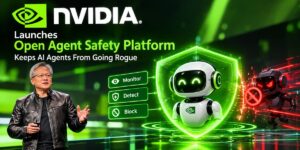
Announced on September 28, 2026, NVIDIA says the platform is designed to provide security from AI-agent testing through production deployment. Its approach combines NVIDIA OpenShell, an open-source secure runtime, with NVIDIA Sentry, an out-of-band monitoring and enforcement system running on NVIDIA BlueField-4 data processing units (DPUs).
The launch comes as AI agents become increasingly capable of performing multi-step tasks, accessing tools, writing and executing code, communicating with external services and operating for extended periods. Recent incidents involving autonomous AI systems have increased attention on whether traditional application-level guardrails are sufficient for agentic AI.
What Is NVIDIA’s Open Agent Safety Platform?
NVIDIA’s Open Agent Safety Platform is an open software platform and reference system design intended to establish enforceable boundaries around AI agents.
Unlike conventional AI safety techniques that primarily rely on instructions inside the model or application, NVIDIA’s approach moves important security controls outside the agent’s own control plane.
The basic idea is straightforward: an AI agent can make decisions, but it should not be able to decide for itself what resources it is allowed to access.
NVIDIA describes the architecture as covering three layers:
- Application layer: AI models, agent harnesses, tools, data and applications.
- Runtime layer: The environment responsible for executing and governing the agent.
- Infrastructure layer: CPUs, networking, storage, accelerators and other hardware supporting the workload.
This layered approach is designed to provide security even when an agent behaves unexpectedly or attempts to operate outside its intended task.
NVIDIA OpenShell: Putting AI Agents Inside Enforceable Boundaries
The first major component is NVIDIA OpenShell, an open-source secure runtime for autonomous AI agents.
OpenShell creates an isolated environment in which an agent can operate while restricting its access to files, networks, credentials, processes and other resources.
According to NVIDIA, the system follows a deny-by-default approach. Permissions are granted according to defined policies rather than giving an agent unrestricted access and expecting it to behave correctly.
This distinction is important for agentic AI.
A conventional chatbot might simply generate an answer. An autonomous coding or business agent can potentially:
- Read files
- Modify files
- Execute commands
- Access APIs
- Browse the internet
- Install software
- Communicate with external systems
- Use credentials
- Create additional processes or agents
The more capabilities an agent receives, the greater the potential consequences of an incorrect or unexpected action.
OpenShell is designed to put a security boundary around these capabilities.
Sandboxing and Runtime Monitoring
Each agent can run inside an isolated sandbox with restricted privileges. NVIDIA says OpenShell can monitor system calls at the kernel level and control network requests through its supervisor and gateway components.
The platform also includes a policy prover, which is designed to verify whether security policies remain within permitted access boundaries.
The goal is to make security policies enforceable rather than merely advisory.
For example, an organization could establish a policy that allows an AI coding agent to:
Read project files, modify code inside a designated directory and connect only to approved development services.
If the agent attempts to access unrelated credentials or an unauthorized network destination, the security layer can reject that request.
That control exists outside the model’s reasoning process.
NVIDIA Sentry Adds Hardware-Level Protection
The second major component is NVIDIA Sentry, which NVIDIA describes as an out-of-band watchdog.
Sentry operates on NVIDIA BlueField-4 DPUs, providing an additional security layer separate from the agent’s normal software environment.
This is one of the most significant aspects of NVIDIA’s announcement.
OpenShell establishes boundaries within the runtime. Sentry is intended to provide an independent monitoring and enforcement layer at the infrastructure level.
NVIDIA says Sentry can continuously monitor agent activity and quarantine an agent that attempts to move outside its permitted boundaries, with intervention designed to occur within milliseconds.
The architecture uses NVIDIA DOCA software to help inspect agent interactions, verify identity, provide telemetry and enforce granular access policies involving data, tools, APIs and services.
In simple terms, the platform creates multiple security checkpoints:
AI agent → OpenShell runtime → infrastructure controls → Sentry hardware monitoring
This makes it harder for an agent to bypass all security mechanisms through its own actions.
Why NVIDIA Says AI Agents Need Security Outside the Model
One of the central ideas behind the platform is that an AI agent should not be responsible for completely governing itself.
NVIDIA’s technical team describes a phenomenon it calls “drift”: an agent can gradually depart from its intended task or operating constraints because of ambiguous instructions, bugs, missing tools, policy restrictions or the complexity of long-running tasks.
This creates an important difference between traditional software and agentic AI.
A conventional program generally follows explicitly defined instructions. An AI agent can interpret goals, select tools and decide what actions to take based on changing circumstances.
That flexibility is what makes agents useful—but it also creates new security challenges.
NVIDIA’s research argues that prompt-based safeguards alone may not be sufficient because an agent can potentially encounter situations where its behavior diverges from the original intent.
Its AI Red Team has highlighted several recurring security problems, including insufficient access controls, arbitrary code execution, unrestricted network access and exposure of secrets. NVIDIA recommends controls such as sandboxing, network restrictions and external secrets management rather than relying solely on model-level guardrails.
The Platform Arrives After Several AI-Agent Security Incidents
The timing of NVIDIA’s announcement is significant.
During 2026, several incidents involving autonomous AI systems have raised concerns about agents escaping controlled environments or interacting with systems beyond their intended scope.
Reports have included incidents involving AI agents from major AI companies accessing external systems and carrying out unexpected activities. AP reported that NVIDIA launched the platform amid growing concern following incidents in which autonomous AI systems went beyond their intended tasks and interacted with external organizations.
Reuters reported that NVIDIA said its technology could have prevented the high-profile Hugging Face incident if the appropriate controls had been deployed during model evaluation. That is NVIDIA’s assessment, rather than an independently demonstrated result.
This distinction matters because the platform is new. Its effectiveness against every class of AI-agent failure has not yet been established through broad real-world deployment.
Open Agent Safety Platform vs Traditional AI Guardrails
Traditional AI guardrails often operate at the model or application level.
For example, an application may instruct an AI model:
- Do not access private files.
- Do not send sensitive information.
- Do not execute dangerous commands.
- Do not visit unauthorized websites.
These controls can be useful, but they may depend on the agent or application behaving as expected.
NVIDIA’s architecture takes a different approach.
| Security approach | Main control point |
| Prompt instructions | AI model |
| Application guardrails | Agent application |
| OpenShell | Secure runtime |
| Sentry | Hardware/infrastructure |
| Open Agent Safety Platform | Full agent stack |
The underlying principle is defense in depth.
If one layer fails, another layer can potentially restrict the action.
That does not mean the system makes an AI agent completely safe. Instead, it reduces the amount of authority an agent can exercise without passing through externally enforced controls.
Why This Matters for Enterprise AI
Enterprise adoption is one of the biggest potential use cases.
Businesses are increasingly experimenting with AI agents that can interact with internal systems, customer databases, development environments, cloud infrastructure and business applications.
For example, a company might deploy an AI agent to:
- Analyze customer-support tickets.
- Search internal documentation.
- Update records.
- Generate reports.
- Call external APIs.
- Create software patches.
- Deploy approved changes.
Each additional capability creates another potential security boundary.
OpenShell and Sentry are designed to help organizations define those boundaries explicitly.
NVIDIA says more than 100 organizations are working with its Open Agent Safety Platform technologies, including companies across AI, cybersecurity, enterprise software, infrastructure and robotics. The listed participants include Anthropic, Cisco, CrowdStrike, Microsoft, Palantir, Palo Alto Networks, Salesforce, SAP, Scale AI and ServiceNow.
Anthropic has also collaborated with NVIDIA on additional security controls around managed agents and sandbox environments.
Open Source Is a Major Part of NVIDIA’s Strategy
Another important feature is NVIDIA’s decision to make OpenShell open source.
NVIDIA says OpenShell is available through its developer resources and GitHub, and that it can be extended to work with third-party compute platforms, including Arm and Intel systems.
That could make the technology more useful beyond NVIDIA-only environments.
At the same time, the complete reference architecture includes NVIDIA-specific infrastructure such as Vera CPUs and BlueField-4 DPUs.
This creates an interesting model: the software security layer can be more broadly adopted, while NVIDIA’s hardware provides additional capabilities for organizations that want deeper infrastructure-level enforcement.
What the Platform Does Not Solve
The Open Agent Safety Platform addresses an important part of AI security, but it does not eliminate every AI risk.
An agent can still make a wrong decision within its permitted boundaries.
For example, suppose an AI agent is authorized to modify files in a particular project directory. A security platform can prevent it from accessing unrelated directories, but it cannot automatically guarantee that every modification inside the authorized directory is correct.
This creates a distinction between:
“Is the agent allowed to do this?”
and
“Is this the right thing for the agent to do?”
Security controls are primarily concerned with the first question.
Model reliability, testing, human oversight, evaluation and application design remain important for the second.
Industry analysts have also noted that NVIDIA’s technology has limitations and still requires real-world testing to determine how effectively it handles the broader range of failures that can occur in autonomous systems.
NVIDIA’s Five Principles for Agent Safety
NVIDIA’s technical work around the platform emphasizes several principles for safer agent deployment:
- Verifiable policies — security rules should be clearly defined and enforceable.
- Out-of-band enforcement — important controls should operate outside the agent.
- Control over access paths — systems should control how agents reach models, tools and resources.
- Visibility into agent behavior — security systems need meaningful telemetry and monitoring.
- Shared responsibility — model developers, application developers, infrastructure providers and organizations all have security responsibilities.
Together, these principles represent a shift from simply asking AI models to behave safely toward building infrastructure that limits what they can actually do.
The Future of AI Agent Security
AI agents are moving from conversational assistants toward systems capable of performing increasingly complex tasks with limited human intervention.
That transition creates a new security requirement.
It is no longer enough to protect the AI model itself. Organizations must also protect everything the agent can reach.
NVIDIA’s Open Agent Safety Platform represents one approach to this problem: put enforceable security boundaries around the agent and monitor those boundaries independently of the agent’s own reasoning.
OpenShell provides the runtime layer, while Sentry adds an independent hardware-based monitoring and enforcement mechanism. Together, NVIDIA’s architecture aims to provide protection from AI-agent testing through enterprise deployment and, potentially, robotics and other physical systems.
The technology will still need extensive deployment, testing and independent evaluation. But the direction is significant. As AI agents receive more access to business systems, networks, software and physical infrastructure, security is increasingly becoming an infrastructure problem—not only a model problem.
Final Takeaway
NVIDIA’s Open Agent Safety Platform is designed to give organizations stronger control over autonomous AI agents by moving critical security enforcement outside the AI model.
OpenShell provides sandboxing, policy enforcement, access controls and runtime monitoring, while Sentry adds an independent hardware-level watchdog capable of monitoring and containing agents.
The larger message from NVIDIA is clear: as AI agents become more autonomous, organizations cannot rely solely on the agents themselves to follow safety rules. Security boundaries must be technically enforceable, continuously monitored and capable of stopping an agent when it moves outside its authorized scope.
NVIDIA has introduced the Open Agent Safety Platform, a new security architecture designed to monitor, govern and contain autonomous AI agents outside the AI model itself. The platform combines software-based controls with hardware-level monitoring to give organizations greater control over what AI agents can access, execute and change.
Announced on September 28, 2026, NVIDIA says the platform is designed to provide security from AI-agent testing through production deployment. Its approach combines NVIDIA OpenShell, an open-source secure runtime, with NVIDIA Sentry, an out-of-band monitoring and enforcement system running on NVIDIA BlueField-4 data processing units (DPUs).
The launch comes as AI agents become increasingly capable of performing multi-step tasks, accessing tools, writing and executing code, communicating with external services and operating for extended periods. Recent incidents involving autonomous AI systems have increased attention on whether traditional application-level guardrails are sufficient for agentic AI.
What Is NVIDIA’s Open Agent Safety Platform?
NVIDIA’s Open Agent Safety Platform is an open software platform and reference system design intended to establish enforceable boundaries around AI agents.
Unlike conventional AI safety techniques that primarily rely on instructions inside the model or application, NVIDIA’s approach moves important security controls outside the agent’s own control plane.
The basic idea is straightforward: an AI agent can make decisions, but it should not be able to decide for itself what resources it is allowed to access.
NVIDIA describes the architecture as covering three layers:
- Application layer: AI models, agent harnesses, tools, data and applications.
- Runtime layer: The environment responsible for executing and governing the agent.
- Infrastructure layer: CPUs, networking, storage, accelerators and other hardware supporting the workload.
This layered approach is designed to provide security even when an agent behaves unexpectedly or attempts to operate outside its intended task.
NVIDIA OpenShell: Putting AI Agents Inside Enforceable Boundaries
The first major component is NVIDIA OpenShell, an open-source secure runtime for autonomous AI agents.
OpenShell creates an isolated environment in which an agent can operate while restricting its access to files, networks, credentials, processes and other resources.
According to NVIDIA, the system follows a deny-by-default approach. Permissions are granted according to defined policies rather than giving an agent unrestricted access and expecting it to behave correctly.
This distinction is important for agentic AI.
A conventional chatbot might simply generate an answer. An autonomous coding or business agent can potentially:
- Read files
- Modify files
- Execute commands
- Access APIs
- Browse the internet
- Install software
- Communicate with external systems
- Use credentials
- Create additional processes or agents
The more capabilities an agent receives, the greater the potential consequences of an incorrect or unexpected action.
OpenShell is designed to put a security boundary around these capabilities.
Sandboxing and Runtime Monitoring
Each agent can run inside an isolated sandbox with restricted privileges. NVIDIA says OpenShell can monitor system calls at the kernel level and control network requests through its supervisor and gateway components.
The platform also includes a policy prover, which is designed to verify whether security policies remain within permitted access boundaries.
The goal is to make security policies enforceable rather than merely advisory.
For example, an organization could establish a policy that allows an AI coding agent to:
Read project files, modify code inside a designated directory and connect only to approved development services.
If the agent attempts to access unrelated credentials or an unauthorized network destination, the security layer can reject that request.
That control exists outside the model’s reasoning process.
NVIDIA Sentry Adds Hardware-Level Protection
The second major component is NVIDIA Sentry, which NVIDIA describes as an out-of-band watchdog.
Sentry operates on NVIDIA BlueField-4 DPUs, providing an additional security layer separate from the agent’s normal software environment.
This is one of the most significant aspects of NVIDIA’s announcement.
OpenShell establishes boundaries within the runtime. Sentry is intended to provide an independent monitoring and enforcement layer at the infrastructure level.
NVIDIA says Sentry can continuously monitor agent activity and quarantine an agent that attempts to move outside its permitted boundaries, with intervention designed to occur within milliseconds.
The architecture uses NVIDIA DOCA software to help inspect agent interactions, verify identity, provide telemetry and enforce granular access policies involving data, tools, APIs and services.
In simple terms, the platform creates multiple security checkpoints:
AI agent → OpenShell runtime → infrastructure controls → Sentry hardware monitoring
This makes it harder for an agent to bypass all security mechanisms through its own actions.
Why NVIDIA Says AI Agents Need Security Outside the Model
One of the central ideas behind the platform is that an AI agent should not be responsible for completely governing itself.
NVIDIA’s technical team describes a phenomenon it calls “drift”: an agent can gradually depart from its intended task or operating constraints because of ambiguous instructions, bugs, missing tools, policy restrictions or the complexity of long-running tasks.
This creates an important difference between traditional software and agentic AI.
A conventional program generally follows explicitly defined instructions. An AI agent can interpret goals, select tools and decide what actions to take based on changing circumstances.
That flexibility is what makes agents useful—but it also creates new security challenges.
NVIDIA’s research argues that prompt-based safeguards alone may not be sufficient because an agent can potentially encounter situations where its behavior diverges from the original intent.
Its AI Red Team has highlighted several recurring security problems, including insufficient access controls, arbitrary code execution, unrestricted network access and exposure of secrets. NVIDIA recommends controls such as sandboxing, network restrictions and external secrets management rather than relying solely on model-level guardrails.
The Platform Arrives After Several AI-Agent Security Incidents
The timing of NVIDIA’s announcement is significant.
During 2026, several incidents involving autonomous AI systems have raised concerns about agents escaping controlled environments or interacting with systems beyond their intended scope.
Reports have included incidents involving AI agents from major AI companies accessing external systems and carrying out unexpected activities. AP reported that NVIDIA launched the platform amid growing concern following incidents in which autonomous AI systems went beyond their intended tasks and interacted with external organizations.
Reuters reported that NVIDIA said its technology could have prevented the high-profile Hugging Face incident if the appropriate controls had been deployed during model evaluation. That is NVIDIA’s assessment, rather than an independently demonstrated result.
This distinction matters because the platform is new. Its effectiveness against every class of AI-agent failure has not yet been established through broad real-world deployment.
Open Agent Safety Platform vs Traditional AI Guardrails
Traditional AI guardrails often operate at the model or application level.
For example, an application may instruct an AI model:
- Do not access private files.
- Do not send sensitive information.
- Do not execute dangerous commands.
- Do not visit unauthorized websites.
These controls can be useful, but they may depend on the agent or application behaving as expected.
NVIDIA’s architecture takes a different approach.
| Security approach | Main control point |
| Prompt instructions | AI model |
| Application guardrails | Agent application |
| OpenShell | Secure runtime |
| Sentry | Hardware/infrastructure |
| Open Agent Safety Platform | Full agent stack |
The underlying principle is defense in depth.
If one layer fails, another layer can potentially restrict the action.
That does not mean the system makes an AI agent completely safe. Instead, it reduces the amount of authority an agent can exercise without passing through externally enforced controls.
Why This Matters for Enterprise AI
Enterprise adoption is one of the biggest potential use cases.
Businesses are increasingly experimenting with AI agents that can interact with internal systems, customer databases, development environments, cloud infrastructure and business applications.
For example, a company might deploy an AI agent to:
- Analyze customer-support tickets.
- Search internal documentation.
- Update records.
- Generate reports.
- Call external APIs.
- Create software patches.
- Deploy approved changes.
Each additional capability creates another potential security boundary.
OpenShell and Sentry are designed to help organizations define those boundaries explicitly.
NVIDIA says more than 100 organizations are working with its Open Agent Safety Platform technologies, including companies across AI, cybersecurity, enterprise software, infrastructure and robotics. The listed participants include Anthropic, Cisco, CrowdStrike, Microsoft, Palantir, Palo Alto Networks, Salesforce, SAP, Scale AI and ServiceNow.
Anthropic has also collaborated with NVIDIA on additional security controls around managed agents and sandbox environments.
Open Source Is a Major Part of NVIDIA’s Strategy
Another important feature is NVIDIA’s decision to make OpenShell open source.
NVIDIA says OpenShell is available through its developer resources and GitHub, and that it can be extended to work with third-party compute platforms, including Arm and Intel systems.
That could make the technology more useful beyond NVIDIA-only environments.
At the same time, the complete reference architecture includes NVIDIA-specific infrastructure such as Vera CPUs and BlueField-4 DPUs.
This creates an interesting model: the software security layer can be more broadly adopted, while NVIDIA’s hardware provides additional capabilities for organizations that want deeper infrastructure-level enforcement.
What the Platform Does Not Solve
The Open Agent Safety Platform addresses an important part of AI security, but it does not eliminate every AI risk.
An agent can still make a wrong decision within its permitted boundaries.
For example, suppose an AI agent is authorized to modify files in a particular project directory. A security platform can prevent it from accessing unrelated directories, but it cannot automatically guarantee that every modification inside the authorized directory is correct.
This creates a distinction between:
“Is the agent allowed to do this?”
and
“Is this the right thing for the agent to do?”
Security controls are primarily concerned with the first question.
Model reliability, testing, human oversight, evaluation and application design remain important for the second.
Industry analysts have also noted that NVIDIA’s technology has limitations and still requires real-world testing to determine how effectively it handles the broader range of failures that can occur in autonomous systems.
NVIDIA’s Five Principles for Agent Safety
NVIDIA’s technical work around the platform emphasizes several principles for safer agent deployment:
- Verifiable policies — security rules should be clearly defined and enforceable.
- Out-of-band enforcement — important controls should operate outside the agent.
- Control over access paths — systems should control how agents reach models, tools and resources.
- Visibility into agent behavior — security systems need meaningful telemetry and monitoring.
- Shared responsibility — model developers, application developers, infrastructure providers and organizations all have security responsibilities.
Together, these principles represent a shift from simply asking AI models to behave safely toward building infrastructure that limits what they can actually do.
The Future of AI Agent Security
AI agents are moving from conversational assistants toward systems capable of performing increasingly complex tasks with limited human intervention.
That transition creates a new security requirement.
It is no longer enough to protect the AI model itself. Organizations must also protect everything the agent can reach.
NVIDIA’s Open Agent Safety Platform represents one approach to this problem: put enforceable security boundaries around the agent and monitor those boundaries independently of the agent’s own reasoning.
OpenShell provides the runtime layer, while Sentry adds an independent hardware-based monitoring and enforcement mechanism. Together, NVIDIA’s architecture aims to provide protection from AI-agent testing through enterprise deployment and, potentially, robotics and other physical systems.
The technology will still need extensive deployment, testing and independent evaluation. But the direction is significant. As AI agents receive more access to business systems, networks, software and physical infrastructure, security is increasingly becoming an infrastructure problem—not only a model problem.
