
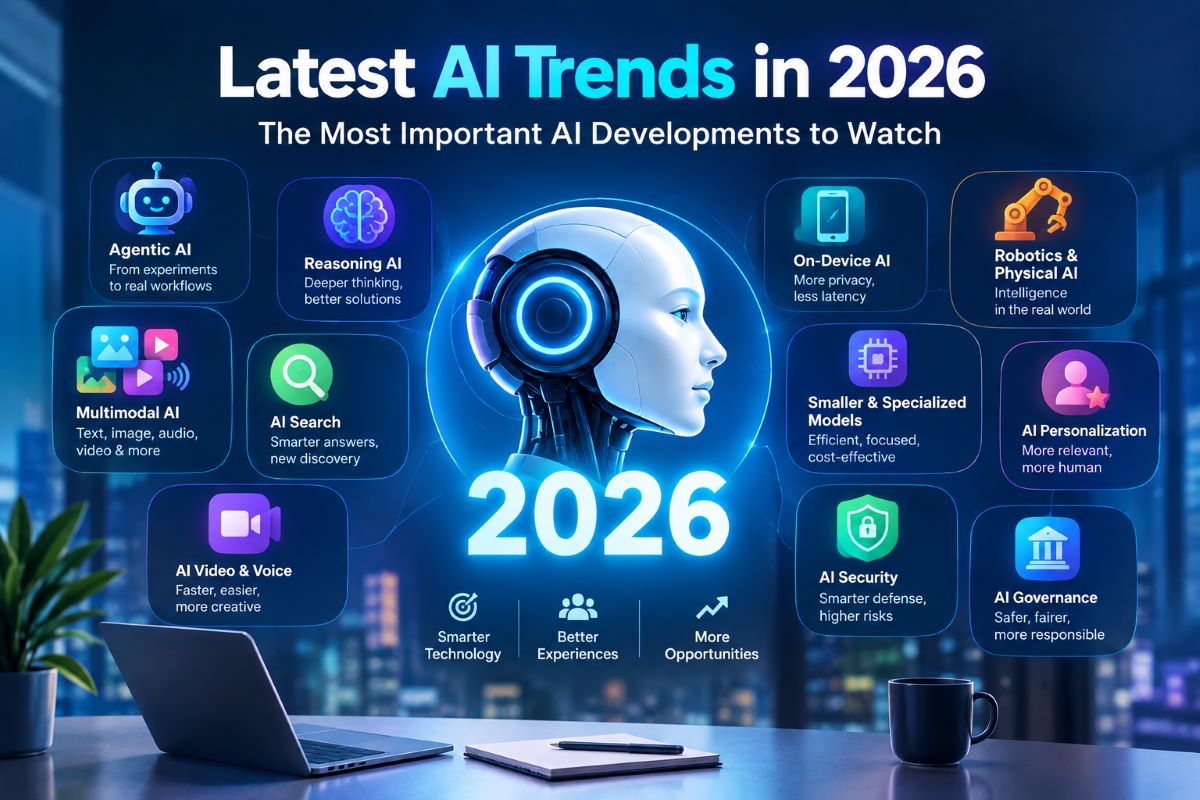
Artificial intelligence is changing rapidly in 2026. AI is moving beyond basic chatbots and content generation toward systems that can reason, use tools, understand different formats, automate tasks, and work inside everyday software. The Latest AI Trends in 2026 show how AI is becoming more practical for businesses, developers, creators, and everyday users.
What Are the Latest AI Trends in 2026?
The biggest shift is from simple AI-generated content to AI-supported workflows. Better models, lower computing costs, improved hardware, and wider software integration are making AI easier to use. Instead of using AI for one prompt at a time, people can now include it in research, coding, customer service, analysis, content creation, and other regular tasks.
From Generative AI to Action-Oriented AI: Generative AI can create text, images, code, audio, and other content. The next step is AI that can plan tasks, use connected tools, analyze information, and complete multiple actions. This makes AI more useful for practical workflows rather than simple question-and-answer interactions.
Why AI Trends Are Changing So Quickly: Better models, efficient computing, lower AI costs, and wider adoption are accelerating AI trends 2026. AI is also being integrated into business software, search platforms, development tools, and consumer devices, creating new applications across many industries.
1. Agentic AI Is Moving From Experiments to Real Workflows
Agentic AI focuses on completing tasks rather than simply responding to prompts. An AI agent can potentially plan a task, gather information, use software tools, check results, and continue working toward a goal.
What Is Agentic AI?: An AI agent is a system designed to perform multiple steps toward a specific objective. It can combine an AI model with instructions, data, tools, and processes for evaluating its work.
How AI Agents Work: Agents can break larger tasks into smaller actions and interact with connected systems. For example, an agent could research information, organize findings, create a draft, and send the result for human review.
Where Businesses Are Using AI Agents: Businesses are exploring agents for research, customer support, coding, data analysis, and routine operations. Their value comes from reducing repetitive work and connecting several steps into one workflow.
Challenges of AI Agents: Reliability, security, privacy, cost, and human oversight remain important challenges. Organizations need clear permissions and monitoring when agents can access business information or take actions.
2. Reasoning AI Models Are Becoming More Capable
Reasoning models are designed to handle tasks that require deeper analysis and multiple steps. They can be useful when a problem requires planning, comparison, calculation, or careful evaluation.
What Are AI Reasoning Models?: These models are designed to work through complex problems rather than immediately producing a short response. They can break problems into smaller parts and consider possible solutions.
Reasoning vs Traditional Generative AI: Traditional generative AI is effective for creating text, images, summaries, and code. Reasoning-focused AI places more emphasis on solving complicated problems before producing an answer, making it an important part of AI technology trends 2026.
Why Reasoning Matters in 2026: Reasoning capabilities can support coding, mathematics, research, planning, and business analysis. These AI developments in 2026 are helping AI handle more demanding tasks.
3. Multimodal AI Is Becoming the New Standard
Multimodal AI can work with different types of information, including text, images, audio, and video. This allows users to interact with AI in more flexible ways.
What Is Multimodal AI?: Instead of relying only on written prompts, multimodal systems can process multiple information formats. This helps AI understand situations where important context comes from different sources.
AI That Understands Text, Images, Audio and Video: A multimodal system can analyze an image with a written question, understand spoken information, or process video. This creates more natural interactions between people and AI.
Practical Uses of Multimodal AI: Education, healthcare, marketing, customer service, and content creation can all benefit from multimodal systems. This makes multimodal technology one of the latest artificial intelligence trends to watch.
4. AI Search and Answer Engines Are Changing How People Find Information
AI is changing online search by providing more direct, conversational answers. Users can ask questions, follow up, and explore information without always opening multiple webpages.
From Traditional Search to AI-Powered Answers: AI-powered search can organize information around a user’s question and provide a summary. However, users should still check reliable sources because AI responses can contain errors or outdated information.
AI Overviews and Answer Engines: AI answer systems can combine information from different sources and present it in a conversational format. This is changing how users discover information online.
How AI Search Changes Websites and SEO: Websites need useful, accurate, well-structured information that search systems can understand. Strong topical coverage, technical SEO, structured data, and clear answers are becoming increasingly important for SEO, AEO, and AI-driven discovery.
What Businesses Need to Do: Businesses should focus on answering real customer questions, demonstrating expertise, keeping information accurate, and creating content that provides genuine value rather than relying on keyword repetition.
5. AI Video and Real-Time Content Generation Are Expanding
AI is making video, voice, and digital media production faster and more accessible.
AI Video Generation in 2026: AI video tools can turn written instructions and creative ideas into visual content for marketing, education, social media, and product demonstrations.
AI Voice and Real-Time Speech: Real-time AI voice systems are becoming more useful for assistants, customer service, accessibility, and interactive applications.
AI Avatars and Digital Characters: AI avatars can support training, presentations, marketing, and entertainment. Businesses can use digital presenters for specific content while maintaining appropriate human review.
How Creators and Businesses Are Using AI Media: Creators can use AI to speed up brainstorming, production, localization, and content adaptation. These new AI technologies 2026 can reduce repetitive production work while people maintain creative control.
6. AI Is Moving Onto Devices With Edge and On-Device AI
On-device AI allows certain AI tasks to run directly on smartphones, computers, vehicles, and other devices.
What Is On-Device AI?: Instead of sending every request to the cloud, some AI processing happens locally on the device. This can improve responsiveness and reduce unnecessary data transfers.
AI PCs, Smartphones and Edge Devices: AI processors are increasingly being included in computers, smartphones, cameras, and other devices. They can support functions such as voice recognition, image processing, translation, and local assistants.
Benefits of Local AI: Local processing can provide better privacy, faster responses, lower latency, and some offline capabilities.
Why On-Device AI Matters in 2026: As AI becomes part of everyday hardware, efficient local processing can make intelligent features faster and more practical.
7. Physical AI and Robotics Are Getting More Attention
Physical AI connects intelligence with machines that interact with the real world.
What Is Physical AI?: Physical AI uses sensors, cameras, AI models, and control systems to help machines understand and respond to physical environments.
AI-Powered Robots: AI can help robots recognize objects, understand surroundings, and adapt to changing situations rather than following only fixed instructions.
Robotics in Manufacturing and Logistics: Manufacturing, warehouses, and logistics can use robots for inspection, movement, repetitive processes, and other controlled tasks.
The Future of AI and Physical Machines: Physical AI could expand automation, but safety, reliability, testing, and hardware costs remain important considerations.
8. Smaller and More Specialized AI Models Are Growing
Smaller AI models are becoming useful where speed, privacy, cost, or limited computing resources matter.
Small Language Models vs Large AI Models: Large models support many tasks, while smaller models can be optimized for specific applications and devices.
Why Efficient AI Models Matter: Efficient models can reduce computing requirements, improve response times, and make AI deployment more affordable.
Specialized Models for Specific Tasks: Organizations can use specialized models for coding, customer service, document analysis, translation, or industry-specific tasks.
Lower Cost and Better Performance: Choosing an AI model is increasingly about balancing accuracy, speed, privacy, hardware requirements, and cost.
9. AI Personalization Is Becoming More Advanced
AI assistants and digital services are becoming more personalized by using relevant preferences and context.
Personalized AI Assistants: Personalized assistants can adapt to recurring tasks, preferences, and workflows, making AI interactions more relevant.
AI That Understands User Context: Context allows AI to understand an ongoing project rather than treating every request separately. This can improve support for research, documents, schedules, and long-term tasks.
Personalized Recommendations and Experiences: AI can personalize recommendations in shopping, entertainment, education, and digital services based on available information.
Privacy Challenges With Personal AI: Greater personalization can require more user data. Privacy, permissions, security, and user control therefore remain important.
10. AI Security and AI-Powered Cybersecurity Are Evolving
AI can help security teams detect threats while also creating new risks.
How AI Is Improving Cybersecurity: Security teams can use AI to analyze activity, identify unusual patterns, prioritize alerts, and support threat detection.
AI-Generated Cyber Threats: Attackers can also use AI to create convincing phishing content, automate tasks, and improve certain attacks.
Protecting AI Systems and Data: Organizations need strong access controls, secure data handling, monitoring, testing, and clear permissions for AI systems.
Why AI Security Matters in 2026: As AI becomes connected to important systems, security needs to be considered from the beginning of deployment.
11. AI Governance, Regulation and Responsible AI Are Becoming Essential
AI governance helps organizations establish rules for responsible AI use.
Why AI Governance Matters: Governance can define how AI systems are selected, deployed, monitored, and reviewed.
AI Safety and Transparency: Organizations need testing, monitoring, and review processes to identify errors and understand AI performance.
Data Privacy and Copyright: Businesses must consider personal information, intellectual property, and content usage when adopting AI.
Human Oversight and AI Accountability: Human review remains important when AI operates in sensitive areas or can produce significant consequences.
12. AI Is Becoming More Connected to Business Tools and Workflows
AI is becoming part of CRM platforms, communication tools, project-management systems, and other business software. It can summarize meetings, organize information, prepare reports, analyze data, and automate repetitive processes.
AI coding tools can also help developers write code, create tests, find errors, and understand existing projects. Human review remains important for security and production software.
13. AI and Human Collaboration Will Shape the Future of Work
AI is increasingly becoming a copilot that helps people research, draft, analyze, and organize information. This may automate some routine tasks while increasing the value of skills such as critical thinking, creativity, communication, domain knowledge, and AI literacy.
Workers need to understand how to use AI effectively, verify its outputs, protect sensitive information, and recognize when human judgment is necessary. AI can process information quickly, but it can still produce incomplete or incorrect results.
How These AI Trends Will Affect Businesses in 2026
| AI Trend | Business Impact |
| Agentic AI | Workflow automation |
| Reasoning AI | Complex problem solving |
| Multimodal AI | Better customer experiences |
| AI Search | Changes online discovery |
| AI Video | Faster content production |
| On-device AI | Privacy and speed |
| Physical AI | Physical task automation |
| AI Security | Better threat detection |
| AI Governance | Safer AI adoption |
How to Prepare for the AI Trends of 2026
Identify Practical AI Use Cases: Start with real business problems where AI can save time, improve accuracy, or increase productivity.
Improve Data Quality: Accurate, organized, and secure data gives AI systems a stronger foundation.
Train Employees to Work With AI: Employees should learn how to use AI tools, verify outputs, protect data, and recognize limitations.
Build AI Security and Governance: Set clear rules for permissions, privacy, security, human oversight, and responsible AI use.
Measure AI Results: Track practical outcomes such as time saved, productivity, accuracy, costs, customer satisfaction, or revenue.
What Is the Future of AI in 2026 and Beyond?
The future of AI in 2026 is likely to involve more capable agents, stronger reasoning, richer multimodal interaction, on-device intelligence, and deeper integration with everyday software. Robotics may extend AI into physical environments, while privacy, security, governance, and human oversight will become increasingly important.
Frequently Asked Questions About AI Trends in 2026?
What are the latest AI trends in 2026?
Major trends include agentic AI, reasoning models, multimodal AI, AI search, AI video, on-device AI, robotics, specialized models, personalization, cybersecurity, and AI governance.
What is the biggest AI trend in 2026?
A major direction is the shift toward AI systems that can handle multi-step tasks, use tools, understand different information formats, and work inside everyday workflows.
How is AI changing in 2026?
AI is moving beyond simple prompt-and-response interactions toward reasoning, automation, multimodal understanding, tool use, and deeper software integration.
What are the emerging AI trends in 2026?
Emerging areas include agentic AI, physical AI, robotics, on-device intelligence, smaller models, real-time voice, AI search, and specialized AI applications.
How will AI affect businesses in 2026?
AI can automate repetitive work, support customers, analyze information, improve development, create content, and assist employees.
What new AI technologies are emerging in 2026?
Important developments include reasoning models, AI agents, multimodal systems, efficient models, on-device AI, AI video and voice, physical AI, and AI-powered business software.
What is the future of AI in 2026?
AI is becoming more deeply integrated into software, devices, search, business processes, and physical machines, with greater attention to safety and responsible use.
Will AI agents become more common in 2026?
AI agents are an important area of development. Their wider adoption will depend on reliability, security, cost, permissions, and appropriate human supervision.
